
Local non-profits host Massachusetts town hall on anti-Asian racism, urge action
“I am very worried and afraid for my safety, for the safety of my daughter, and for the safety of Asian people in the United States."
Related Links
-
ATLANTA
‘Unconscionable’: Local Asian American leaders respond to Georgia killings, call for hate crime investigation
-
National News
After Georgia spa attacks, officers handcuffed victim’s anguished husband for 4 hours
-
Atlanta
Rallies in Atlanta, nation against hate after spa shootings
-
National
Asian women say shootings point to relentless, racist tropes
-
Georgia shootings
Georgia sheriff’s deputy criticized for comment on shooting suspect, Facebook post
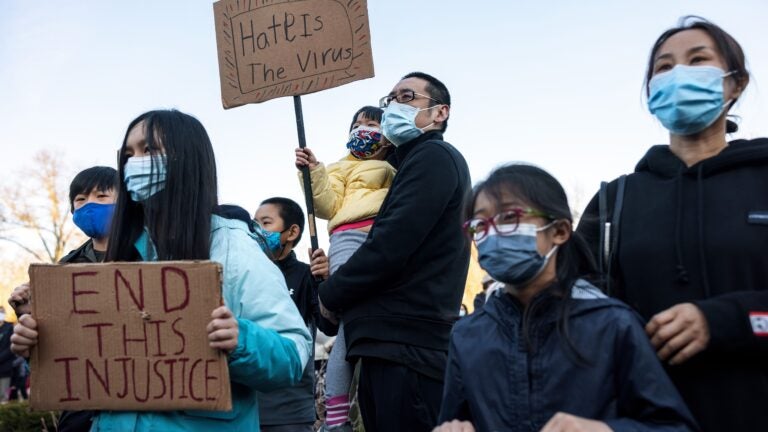
Local non-profit leaders from Asian American Pacific Islander communities in Massachusetts hosted a statewide town hall Thursday, setting the foundation for what organizers said they hoped would become a larger ongoing conversation reckoning with the grief many are feeling after last week’s shootings in Georgia, and the reminder that everyone has a role to play in changing this long-standing and re-emerging anti-Asian sentiment.
Over a dozen organizations sponsored the virtual Massachusetts town hall event Thursday from 6 to 7:30 p.m, highlighting how the COVID-19 pandemic has fueled xenophobia and anti-Asian racism, as well as how long that violence has been present in the U.S. to start.
With over 400 watching via Facebook live, and nearly 2,000 joining over Zoom, the event opened with members from the Bay State’s Asian American community detailing the ways they’re rallying against racism, and calling on neighbors from all communities for more widespread support.
Several of our nonprofit partners are holding a town hall at 6pm tonight on Anti-Asian Racism. Register at https://t.co/wOqo4skwqz #StopAsianHate #StopAAPIHate pic.twitter.com/5K5grUgHAv
— Immigrant Advancement – Boston (@BOSImmigrants) March 25, 2021
The gathering comes after the March 16 mass shooting in Georgia, where a 21-year-old man has been accused of shooting four people inside two Atlanta-area spas and four others at a nearby massage business. Six of those killed were Asian women.
Organizers held a moment of silence during the event to honor the lives lost before calling the incident an act of racialized, and gendered violence.
And in Boston, panelists pointed out, there’s a history of violence toward Asian American Pacific Islander communities.
A 1987 Oct. report from the Asian American Resource Workshop even detailed how at the time, “racial violence in Boston’s Asian American community has reached crisis proportions. Children have been spit on while walking to school, houses have been burned down, people have been killed.”
The review explained how Asian American residents settling in the city’s neighborhoods were constantly forced to confront myths and misconceptions about themselves.
“They have been misunderstood and mistreated — as enemies and strangers; subhumans and superhuman,” the account read. “In East Boston, some say that Vietnamese and Cambodians eat and cook on the floor and that what they eat are the neighbors’ dogs.”
Authors wrote that one summer in 1983, Boston police officers allegedly broke into a Cambodian home and searched their refrigerator for dog meat.
“According to residents in Revere, their new Cambodian neighbors are welfare cheats and are responsible for their economic misfortune. On the most material holiday of the year, Christmas, 21 Cambodians were burned out of their homes from an arson,” the report read. “Racial violence is a social and historical problem; it is neither new to Boston nor to Asians.”
Fast-forward to 2020, and the Center for the Study of Hate and Extremism released a new survey of police data from 16 major U.S. cities that showed how anti-Asian hate crimes have increased this year by 149%.
Stop AAPI Hate recently reported nearly 3,800 hate incidents between March 19, 2020 and Feb. 28 this year, with almost 100 occurring in Massachusetts.
Two panelists shared how trying their own experience was over the course of the pandemic.
https://www.facebook.com/MassAPIsCAN/videos/1092178454638706/
One woman, who has worked in Boston’s Chinatown for nine years now, said sales at her family’s restaurant have dropped by 75% from what they used to be, and what was once a staff of 20 has been whittled down to just four people.
She noted how the divisive language former President Donald Trump used in the early days of the pandemic, repeatedly referring to the coronavirus as the “Chinese” or “China” virus, has driven most customers away from the area.
Another woman who works in a nail salon on the weekend said the pandemic left her with no income. And as an undocumented immigrant, she said the rising acts of anti-Asian racism is another stressor.
“I am very worried and afraid for my safety, for the safety of my daughter, and for the safety of Asian people in the United States,” she said.
As AARW’s Legal and Organizing Fellow, and a member of Greater Boston Legal Services’ Asian Outreach Unit, Thao Ho said many nail salon workers she engages with in the community share similar lived experiences as low-wage Asian immigrant workers.
“Fear is not a new feeling for our community members,” Ho said. “Fear is a constant presence in their lives, way before the pandemic even started.”
Due to the structural violence they encounter in their daily lives, Ho said many workers often feel the need to lock their salon’s doors during open hours until they see a customer walking up.
Tufts University senior lecturer Jean Wu also mentioned how the “model minority” myth often used in the Asian American community acts as a ploy to pit marginalized groups against each other, and pit Asian American people against those in the white working-class.
“The Asian American body is used like a punching bag,” she said, noting how they become a scapegoat — a pattern that rang true throughout the pandemic.
“The model minority is not something that Asian Americans chose for ourselves, but it was a stereotype that was created and imposed on us,” Wu said. “The issue is that model minority is not about Asian Americans as much as it is about a way to discipline other groups and say that the system doesn’t need change.”
Ho said moving forward, it’s critical to build solidarity and have more conversations across racial lines.
Panelists noted the importance of individually looking deeper into the stereotypes we believe, and questioning how we came to believe them, or where we heard them first.
It’s only when looking at the experiences of all different marginalized communities, Wu said, that people begin to see a bigger picture.
“Usually, what really creates change is slow,” she said. “We have to begin to pressure our education systems to teach all the stuff that is left out, all of our histories, all of our experiences, all of our realities.”
Get Boston.com's browser alerts:
Enable breaking news notifications straight to your internet browser.




To comment, please create a screen name in your profile
To comment, please verify your email address
Conversation
This discussion has ended. Please join elsewhere on Boston.com