
Images of slaves belong to Harvard, not a descendant, judge rules
The woman who says the enslaved people are her ancestors plans to appeal the decision “about the patriarch of a family, a subject of bedtime stories.”
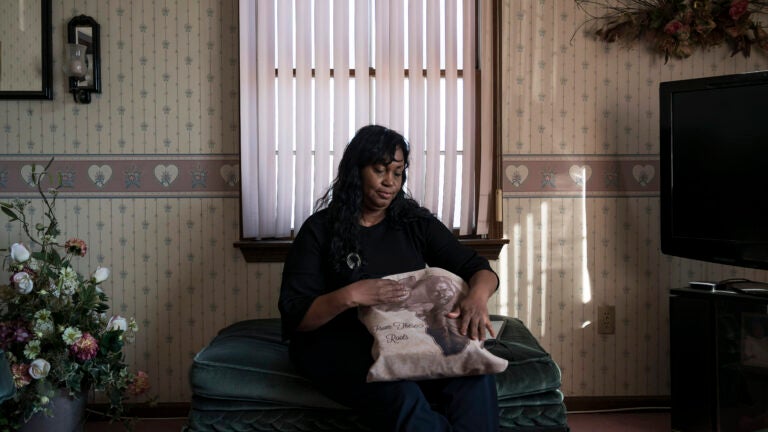
A Massachusetts judge has dismissed a lawsuit by a woman claiming that she, not Harvard University, is the rightful owner of haunting images of an enslaved father and daughter who she says were her ancestors.
The judge acknowledged that the daguerreotypes had been taken under “horrific circumstances” but said that if the enslaved subjects, Renty and Delia, did not own the images when they were taken in 1850, then the woman who brought the lawsuit, Tamara Lanier, did not own them either.
“Fully acknowledging the continuing impact slavery has had in the United States, the law, as it currently stands, does not confer a property interest to the subject of a photograph regardless of how objectionable the photograph’s origins may be,” Justice Camille F. Sarrouf of Middlesex County Superior Court wrote in a judgment filed Tuesday.
Lanier said Thursday that she planned to appeal and that the judge had “completely missed the humanistic aspect of this, where we’re talking about the patriarch of a family, a subject of bedtime stories, whose legacy is still denied to these people.”
Renty and Delia were stripped to the waist in the daguerreotypes, taken in 1850, and treated as scientific evidence of a discredited theory that Black people were inferior. The images, part of a project commissioned by Louis Agassiz, a prominent Harvard professor and zoologist, were hidden away in a Harvard museum until 1976. Their discovery caused a sensation because they were thought to be the earliest known photographs of American slaves.

A program for a 2017 conference at Harvard bears the image of Renty, a slave from whom Lanier says she descended.
For the purposes of the lawsuit, neither Harvard nor the judge disputed Lanier’s evidence that she was a direct descendant of Renty. But, Sarrouf wrote, “It is a basic tenet of common law that the subject of a photograph has no interest in the negative or any photographs printed from the negative.”
The judge also rejected Lanier’s claim that Harvard had exploited the photographs for financial gain — for example, by putting Renty’s image on the cover of a book — saying that the right to control commercial use of the photographs had expired with the deaths of the subjects.
In a statement, Harvard said that the photographs were “powerful visual indictments of the horrific institution of slavery” and that it hoped the court’s ruling would allow it to make them “more accessible to a broader segment of the public and to tell the stories of the enslaved people that they depict.”
Lanier, a retired chief probation officer for the state of Connecticut, said she had grown up with tales of an African ancestor known as Papa Renty but did not know the photographs existed until about 2010, when she began tracing her genealogy.
She said that she hoped her lawsuit would draw interest to the bigger issue of who owned the “cultural property” of enslaved people and that she had been working with Harvard students on legislation that would protect the rights of families like hers.
Get Boston.com's browser alerts:
Enable breaking news notifications straight to your internet browser.





To comment, please create a screen name in your profile
To comment, please verify your email address
Conversation
This discussion has ended. Please join elsewhere on Boston.com