Locked in or locked out: Thaddeus Miles shares his experience being in D.C. during Biden’s inauguration
“The reality is this is America—this is who we are.”
The moment Thaddeus Miles heard the results of the presidential election, he knew that he’d have to be in Washington, D.C., to celebrate the inauguration of President Joe Biden and Vice President Kamala Harris.
The decision was instant. Just as he attended the inauguration of former President Barack Obama in 2009, he knew he couldn’t watch the 2021 ceremony from home in Massachusetts.
“I needed to be there to see and support the first black woman being put into the White House as vice president,” Miles told Boston.com.
The director of community services at MassHousing, who has focused on community work across Massachusetts for 25 years, booked his hotel room and flight right away.
He was prepared to arrive in the nation’s capital during the COVID-19 pandemic — ready for the social-distancing measures and wearing gloves and two masks with a face shield on his flight. He prayed with his family and friends, knowing they were worried about his safety and hoping to make them more comfortable.
His plans didn’t change, even after the deadly attack on the Capitol on Jan. 6. He was determined to be in D.C. to celebrate — to have some joy on the day, even if he couldn’t be on the Capitol grounds.
“There was something about the energy that was going to move through that city at that time that I just wanted to be a part of,” Miles said of the inauguration. “I wanted to be able to see it, I wanted to be able to photograph it, I wanted to be able to talk to people that I didn’t know. I just wanted to be in a different scenery than being in my home or being in Boston and to experience it also as a photographer — to be able to walk through it and engage it.”
When he arrived in Washington, he knew immediately being in the city would be different than past visits. What should have been a 10-minute drive to his hotel spun into an hour-and-15-minute-long Uber rider, his driver navigating closed bridges and checkpoints.
At his hotel, he was greeted by signs of the insurrection that had taken place weeks before. Along with COVID-19 rules plastered through the lobby of his hotel, there were about 50 military personnel milling around. A section of the lobby was cordoned off, filled with boxed lunches and food for the soldiers billeted at the hotel.
A veteran of the U.S. Air Force, it didn’t bother Miles to see the members of the military there. It reminded him of being back in basic training or being on a military base.
Yet, the circumstances for them being there were inescapable and disquieting.
“That told me it was going to be an interesting time,” Miles said.
‘Pray and move your feet’
 The difference on the streets of the city was stark, according to the photographer. Walking from his hotel to Black Lives Matter Plaza, he hardly saw any civilians. Most of the people he saw on the street were homeless, he said. Fences were everywhere, with soldiers posted inside and outside the barriers. At a checkpoint to get to Black Lives Matter Plaza, Miles — along with everyone going into the fenced area — was searched by Transportation Security Administration officials. Troops were also nearby with M16s, with police from multiple departments and Secret Service also nearby.“Walking through the gate put me in a different space, to be like — I am now sort of trapped in here,” Miles said. “I knew I wasn’t trapped, but there are only certain points at which you could exit and which you could enter.”Yet the plaza wasn’t empty. Protesters were there, continuing the call to protect the lives of Black people and address systemic racism in the United States. “Being able to have some conversations with many of those people was amazing, walking around the White House and talking to some of the soldiers that were engaged in protecting the White House and letting people in and out,” Miles said. “It was an experience. I met Black people from Texas, Alabama, and many other places that were celebrating.”
 On the day of the inauguration, Miles got as close as he could to the Capitol. It was a “tough walk” getting to a good spot, through several security checkpoints, where there were about 50 other people gathered in the area. Everyone was watching or listening to the ceremony on their phones. Among them were a few Trump supporters, decked out in campaign sweatshirts. They weren’t defiant or militant, Miles said. Rather they talked about waiting to see what happened under the new administration in the first 100 days, he said. When inaugural poet Amanda Gorman recited her poem, “The Hill We Climb,” they, too, appeared moved by her words.Many of those gathered in the area spoke of feeling relieved as the ceremony went on. For Miles, the moment of the oaths being sworn and the following performances and speeches felt like he had just made his last college loan payment for his son — or the last mortgage payment. “That’s the relief, but I still have maintenance and work to do,” he said. “I felt like in the moment, it was a day to rejoice and to allow Black joy to lift itself. But at the same time, it was more the proverb of ‘Pray and move your feet.’ Prayer alone doesn’t work. What I felt like in that moment was to be joyful — but move my feet.”So he did, dancing to the exhilaration of the moment.
  People around him, Black and white, bumped elbows. Miles tapped feet with another man, doing the “Kid and Play Dance.” Around the city, he saw Black women wearing their “Chucks and pearls,” honoring and celebrating Vice President Harris and her style.“It was just a joyous, joyous time with people being lifted — feeling like they have a voice again and that they had somebody who has compassion for people,” Miles said.
‘This is America’
 Miles estimated he averaged eight to 10 miles of walking a day while in the city, trekking through checkpoints and fencing to take photos, talk to people, witness the inauguration, and see monuments, viewing them, often, through fencing. In his walks, it was disconcerting for the photographer and veteran to see the constant presence of the enlisted troops. His experience and own service made him comfortable enough to strike-up conversations with the troops he met, to let them know he was thankful they were there — for their service, for their sacrifice.His familiarity with being around soldiers helped him move through the different fenced areas more at ease than others, he said. But every time he saw them — whether at the checkpoints or eating out of MREs behind the Washington Monument — he felt sad.
  “The last time I ate an MRE I was out in the desert and I couldn’t get food,” he said. “It just made me be thankful for their service — but it was an uncomfortable sighting.”On his last day, he recalled, he went back to the fence line near the Capitol.Inside the fences were scores of troops. Miles reflected on what that must feel like — to be fenced in by barbed wire because the Capitol had been attacked. “I’m standing on the fence looking through a hole [at] those that I admire and those that I feel like are lifting up and protecting this country,” Miles said. “And the fence created a separation between them and us. … I’m seeing the different troops marching from one location to the next location, marching in groups of 40 or 50. And seeing their faces and their struggle of why they have to be there, and how long they were going to be there, and them praying that nothing happens that causes them to have to act — it was sad. It was a sad moment, every moment. To be able to see it, to be able to have conversations with them and to honor them, was nice for me able to do.”
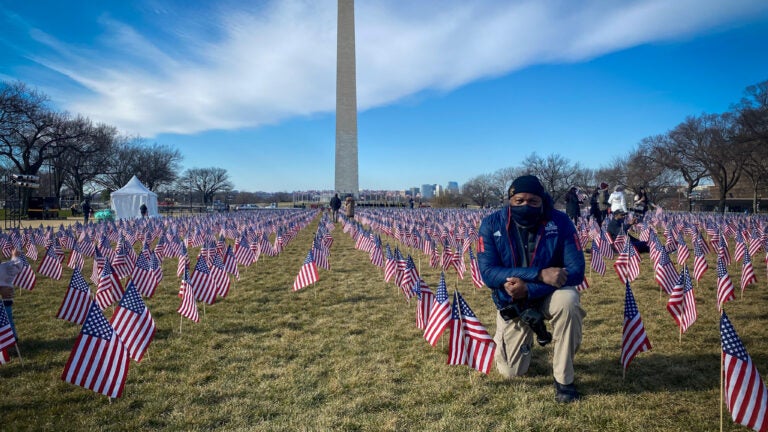
  When Miles went to the National Mall to see the “Field of Flags,” he watched soldiers walk through them as they were being removed, picking up the small banners to take with them. It is a moment Miles said he is cherishing. “Our troops also are humans,” the photographer said. “That is not a place that they wanted to be. They wanted to be there to celebrate the inauguration, just like many of us. … They were again sacrificing for our country. Because of an act.”The “Field of Flags” is a memory he wants to pass on to his grandson. “I was able to take several [flags] home and give some to some folks who I feel like deserved it and were there with me in spirit,” he said. The entire visit for Miles encapsulated who he is — an experience he wants viewers to see in the photos he captured. “It was my military experience, it was my Black man experience, it was my wanting to be a better photographer, it was my activism within my community and nationally, it was my love for my country,” he said. “Those things allowed me to be there. It was my advocacy for being able to express Black joy. It was my concept that fear allows two things — you either run away from it, or you face it and rise above it.”Miles said it’s too easy for the events of Jan. 6 and the following weeks to just be removed and forgotten. It is important to him that the day doesn’t just disappear — that the public remembers in order to make sure it doesn’t happen again. He wanted his photos, much of them taken from outside the fences around the city, to show what the city was like for people who were there on the ground. Much of what viewers watched from home of the inauguration ceremony showed what happened inside the fenced-in areas, where the public could not enter. For Miles, the fencing represented much more than its security function at the Capitol. “That is how Black people see a lot of things every day, the barriers that we have to face every day,” Miles said. “So that fence that’s there, is for me, commonplace. It is the barrier that I struggle with — access. And I’m someone who’s somewhat privileged in Boston or in Massachusetts. But there’s still that fence that’s there.”He’s hopeful that as the literal fences are taken down, that the Biden-Harris administration also “tears down fences around the country” that exist related to equity, systemic racism, opportunity, and the criminal justice system.
  A key part of moving the discussion forward is to stop saying that the events of Jan. 6 “aren’t America,” as some politicians have repeatedly stated, Miles said. “The reality is this is America — this is who we are,” he said. “When I saw Jan. 6 happen … I saw Emmett Till. When I saw it, I saw Tulsa. When I saw it, I saw Wilmington, North Carolina. It was the same thing. This was just that it is televised and people can see it. … The noose wasn’t for us, but the symbolism of it was they wanted to hang Pence, they wanted to hang the speaker. So when you start to look at that, you start to understand that this is America. … There’s a lot of work to do.”He hopes people see in his photos his joy from the inauguration celebrations, but also that work that remains to be done. He wants the public to see that fences are still in place for so many, but that there is power and opportunity to change. It is time, Miles said, for Americans to protect one another and take the moment to grow. “It is not that this isn’t America — it is America. And America needs to change,” he said. “It needs to recognize that we need to reckon with all of these particular issues.”

Get Boston.com's browser alerts:
Enable breaking news notifications straight to your internet browser.