
The 2020 voter’s guide: Here’s what to know for Election Day in Massachusetts
Polls are open from 7 a.m. to 8 p.m.
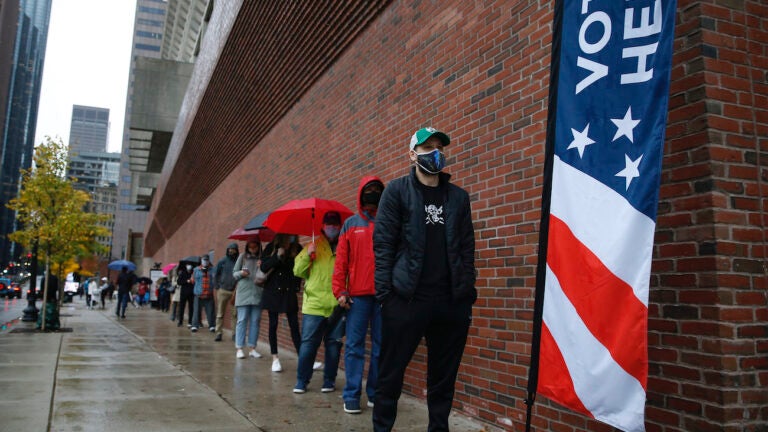
Election Day 2020 has arrived, Massachusetts.
Voters are slated to weigh in on races and issues across the board, from the contentious presidential election to ballot questions impacting residents here in the Bay State.
Here’s everything voters should know:
Polling hours, locations, and mail-in voting
Polls in Massachusetts are open from 7 a.m. to 8 p.m. Tuesday.
Mail-in ballots must be postmarked by Tuesday, Nov. 3, and received by a local election official no later than 5 p.m. Friday, Nov. 6, according to Secretary of the Commonwealth William Galvin’s office.
Officials urge voters who completed their ballots at home but have not yet returned it to deposit their ballots at a drop box or at their local election office. Hand-delivered ballots must be received no later than when polls close Tuesday at 8 p.m.
Ballots can be tracked online at www.TrackMyBallotMA.com. The state website advises voters: “All ballots marked as ‘Accepted’ will be counted. If your ballot is not received by Election Day, or if your ballot is rejected, you may vote in person until 8 p.m. on Nov. 3. You are not required to bring your Vote by Mail ballot with you in order to vote in person.”
Voters can also look up their election offices and ballot drop box locations.
In Boston, Mayor Marty Walsh said Monday voters cannot deposit mail-in votes at polling places Tuesday. Those who bring completed ballots will be asked to vote in-person and workers will ensure the mail-in ballot is disposed.
Don’t know where to vote? Look up your polling location.
Voter registration
Voter registration for the Nov. 3 election has closed in Massachusetts. The last day to register to vote was Oct. 24.
Voters can check their registration status online on the state website.
Races on the ballot
Here are the races on ballots across Massachusetts:
(Search for personalized sample ballots, which include state legislator races).
President/Vice President
Joseph Biden/Kamala Harris, Democratic
Howie Hawkins/Angela Walker, Green-Rainbow
Jo Jorgensen/Jeremy Cohen, Libertarian
Donald Trump/Michael Pence, Republican (incumbent)
U.S. Senator
Edward Markey, Democratic (incumbent)
Kevin O’Connor, Republican
U.S. Representative
1st District
Richard Neal, Democratic (incumbent)
2nd District
James McGovern, Democratic (incumbent)
Tracy Lovvorn, Republican
3rd District
Lori Trahan, Democratic
4th District
Jake Auchincloss, Democratic
Julie Hall, Republican
5th District
Katherine Clark, Democratic (incumbent)
Caroline Colarusso, Republican
6th District
Seth Moulton, Democratic (incumbent)
John Paul Moran, Republican
7th District
Ayanna Pressley, Democratic (incumbent)
Roy Owens, Sr., Independent
8th District
Stephen Lynch, Democratic (incumbent)
Jonathan Lott, Healthcare Environment Stability
9th District
Bill Keating, Democratic (incumbent)
Helen Brady, Republican
Michael Manley, Coach Team America
A full list of candidates running for office in Massachusetts this election cycle can be found here.
Questions on the ballot
Question 1
Do you approve of a law summarized below, on which no vote was taken by the Senate or the House of Representatives on or before May 5, 2020?
Summary:
This proposed law would require that motor vehicle owners and independent repair facilities be provided with expanded access to mechanical data related to vehicle maintenance and repair. Starting with model year 2022, the proposed law would require manufacturers of motor vehicles sold in Massachusetts to equip any such vehicles that use telematics systems–systems that collect and wirelessly transmit mechanical data to a remote server–with a standardized open access data platform. Owners of motor vehicles with telematics systems would get access to mechanical data through a mobile device application. With vehicle owner authorization, independent repair facilities (those not affiliated with a manufacturer) and independent dealerships would be able to retrieve mechanical data from, and send commands to, the vehicle for repair, maintenance, and diagnostic testing. Under the proposed law, manufacturers would not be allowed to require authorization before owners or repair facilities could access mechanical data stored in a motor vehicle’s on-board diagnostic system, except through an authorization process standardized across all makes and models and administered by an entity unaffiliated with the manufacturer. The proposed law would require the Attorney General to prepare a notice for prospective motor vehicle owners and lessees explaining telematics systems and the proposed law’s requirements concerning access to the vehicle’s mechanical data. Under the proposed law, dealers would have to provide prospective owners with, and prospective owners would have to acknowledge receipt of, the notice before buying or leasing a vehicle. Failure to comply with these notice requirements would subject motor vehicle dealers to sanctions by the applicable licensing authority. Motor vehicle owners and independent repair facilities could enforce this law through state consumer protection laws and recover civil penalties of the greater of treble damages or $10,000 per violation.
A YES VOTE would provide motor vehicle owners and independent repair facilities with expanded access to wirelessly transmitted mechanical data related to their vehicles’ maintenance and repair.
A NO VOTE would make no change in the law governing access to vehicles’ wirelessly transmitted mechanical data.
Question 2
Do you approve of a law summarized below, on which no vote was taken by the Senate or the House of Representatives on or before May 5, 2020?
Summary:
This proposed law would implement a voting system known as ‘ranked-choice voting,’ in which voters rank one or more candidates by order of preference. Ranked-choice voting would be used in primary and general elections for all Massachusetts statewide offices, state legislative offices, federal congressional offices, and certain other offices beginning in 2022. Ranked-choice voting would not be used in elections for president, county commissioner, or regional district school committee member. Under the proposed law, votes would be counted in a series of rounds. In the first round, if one candidate received more than 50 percent of the first-place votes, that candidate would be declared the winner and no other rounds would be necessary. If no candidate received more than 50 percent of the first-place votes, then the candidate or candidates who received the fewest first-place votes would be eliminated and, in the next round, each vote for an eliminated candidate would instead be counted toward the next highest-ranked candidate on that voter’s ballot. Depending on the number of candidates, additional rounds of counting could occur, with the last-place candidate or candidates in each round being eliminated and the votes for an eliminated candidate going to the voter’s next choice out of the remaining candidates. A tie for last place in any round would be broken by comparing the tied candidates’ support in earlier rounds. Ultimately, the candidate who was, out of the remaining candidates, the preference of a majority of voters would be declared the winner. Ranked-choice voting would be used only in races where a single candidate is to be declared the winner and not in races where more than one person is to be elected. Under the proposed law, if no candidate received more than 50 percent of first-place votes in the first round, the rounds of ballot-counting necessary for ranked-choice voting would be conducted at a central tabulation facility. At the facility, voters’ rankings would be entered into a computer, which would then be used to calculate the results of each round of the counting process. The proposed law provides that candidates in a statewide or district election would have at least three days to request a recount. The Secretary of State would be required to issue regulations to implement the proposed law and conduct a voter education campaign about the ranked-choice voting process. The proposed law would take effect on January 1, 2022.
A YES VOTE would create a system of ranked-choice voting in which voters would have the option to rank candidates in order of preference and votes would be counted in rounds, eliminating candidates with the lowest votes until one candidate has received a majority.
A NO VOTE would make no change in the laws governing voting and how votes are counted.
Read more about the ballot questions.
When to expect election results
In Massachusetts, mail-in ballots postmarked by Tuesday, Nov. 3 will be accepted through 5 p.m. Friday, Nov. 6.
Galvin told reporters Monday that mail-in ballots, in most cases, will go through a central tabulation facility and election officials will immediately count ballots cast at polling places when the polls close.
He expects Massachusetts will have its election results Tuesday night albeit, as usual, they will be unofficial results.
“They will be, I think, determinative in most cases of the outcome, but they’ll be unofficial because in Massachusetts voters will have an additional three days, if they have domestically mailed(-in) ballots, provided they’re postmarked by Nov. 3, … to be counted if received by Nov. 6 at 5 p.m.,” Galvin said. “That category of ballots will not be counted until after 5 p.m. on Nov. 6.”
Ballots coming from voters overseas and in the military have 10 days following the election to be received, Galvin said.
“But the counting and the information about what’s revealed by the counting will be public as soon as it is available, so there’ll be no hesitation about putting those numbers out, as there never is,” he said.
Yet, with the large influx of mail-in voting across the country brought on by the coronavirus pandemic, voters may have to wait a bit longer than usual to find out the full results of the presidential election.
The New York Times recently asked all 50 states and the District of Columbia about what portion of the votes they expect will be counted by noon on Wednesday. Many states are not anticipated to have complete results on election night, the newspaper reports.
“Even once the early and in-person ballots are counted, a significant number of votes could still be outstanding,” Times editor and reporter Alicia Parlapiano wrote. “Only nine states expect to have at least 98 percent of unofficial results reported by noon the day after the election. Twenty-two states and the District of Columbia allow postmarked ballots to arrive after Election Day, so the timing will depend on when voters return them.”
The Times also reports that results at the beginning and end of election night “will be skewed in some places.”
“The order in which different types of votes are reported could also make one party look stronger at various points in the night,” Parlapiano wrote. “Democrats are more likely to vote by mail this year, so in states where those will be the first type of ballots released, like Arizona, Florida and North Carolina, initial results could skew in favor of Joseph R. Biden Jr. Places that report in-person Election Day votes first, like most parts of Virginia, will probably look better for President Trump.”
On Monday, Boston Mayor Marty Walsh advised voters to be ready to wait potentially a couple of days for a clear winner of the presidential race. The process of counting and certifying ballots always takes a few days to complete, he said.
“Tomorrow night we’ll be posting unofficial results on Boston.gov as usual like we always do,” the mayor said. “But we won’t have all of the mail-in ballots counted for several days. A similar process is taking place nationally. We should not be surprised if we don’t hear a clear national result tomorrow night, or Wednesday morning, or for several days. That does not mean that the voting process is broken or compromised in any way. This is normal.”
Further reading
- 3 takeaways from the debate between Ed Markey and Kevin O’Connor
- 3 takeaways from the 4th District congressional debate between Jake Auchincloss and Julie Hall
- Making sense of Question 1, the return of the Massachusetts right-to-repair debate
- Question 2: What to know about the debate over the Massachusetts ranked choice voting ballot measure
- Here’s what Marty Walsh says to expect on Election Day in Boston
- 9 states to watch on election night
Get Boston.com's browser alerts:
Enable breaking news notifications straight to your internet browser.




To comment, please create a screen name in your profile
To comment, please verify your email address
Conversation
This discussion has ended. Please join elsewhere on Boston.com