
‘More cops are going to get hurt and killed’: Violently injured officers weigh in on proposed police reform
Former Woburn Officer Robert DeNapoli and former Somerville Det. Mario Oliveira were each shot six times in separate incidents.
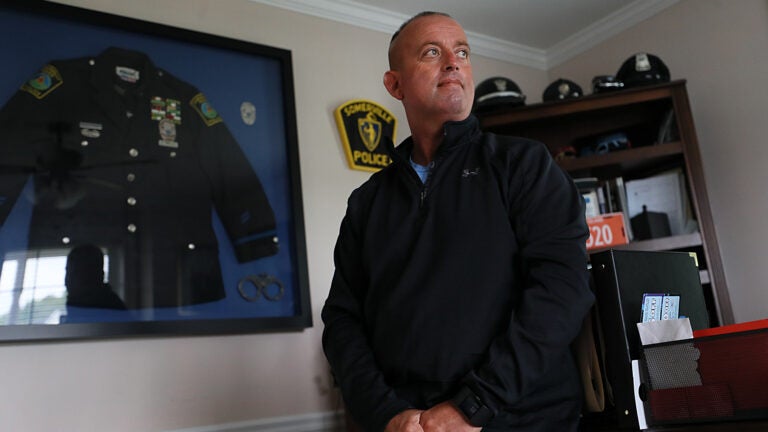

Retired Woburn police Officer Robert DeNapoli in 2017.
In September 2011, now-retired Woburn police officer Robert DeNapoli responded to a jewelry store robbery. He didn’t know at the time it would be an incident that would leave him critically injured, and cost him his career.
DeNapoli was shot six times that night by an armed suspect – at one point the suspect stood on his cruiser’s roof and shot down on DeNapoli as he crouched against the vehicle, waiting for backup that would save his life.
Now, DeNapoli, along with former Somerville Det. Mario Oliveira, who was also nearly fatally shot multiple times on the job, use their experiences to educate others through the group they created, the Violently Injured Police Officers Organization.
These days, they’re concerned proposed police reform in Massachusetts could land more officers in their shoes – continuing to recover from near-fatal injuries that forced them to end their policing careers. The two released a joint statement on July 29, calling the proposed reforms “far too reactionary and not nearly proactive enough.”
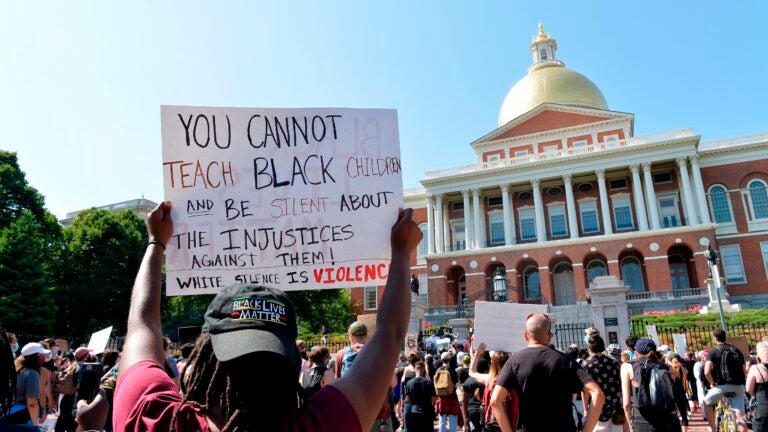
Since George Floyd was killed while being taken into custody in Minneapolis, Minn. in late May, shining a spotlight not just on his death, but on the deaths of other Black people at the hands of law enforcement, protests nationwide have called for racial justice and police reform.
Related Links
-
Politics
Massachusetts Senate passes police accountability bill
-
Politics
Ayanna Pressley is leading legislation to end qualified immunity. Here’s what that means.
-
POLICE REFORM
Municipal leaders from 18 cities and towns push state legislators to advance police reforms
-
Local News
‘Angry would be an understatement’: Mass. police unions cry foul over Senate-backed reform bill
In Massachusetts, the state House of Representatives proposed a bill that would require new certification for police, as well as ban chokeholds, among other measures. A reform bill from the state Senate includes limiting the qualified immunity that protects officers from civil penalties.
Qualified immunity is also under attack at the federal level, via Rep. Ayanna Pressley’s proposed Ending Qualified Immunity Act. “Qualified immunity shields police from accountability, impedes true justice, and undermines the constitutional rights of every person in this country,” Pressley said in a statement earlier this summer.
“It prevents accountability for the ‘bad apples’ and undermines the public’s faith in law enforcement,” added Rep. Justin Amash, a former Republican-turned-Libertarian congressman from Michigan who co-sponsored the resolution with Pressley.
But in Massachusetts, police unions have expressed their disfavor of the proposed reforms, and with the focus on qualified immunity in particular.
“Angry would be an understatement,” Lawrence Calderone of the Boston Police Patrolmen Association said in response to the Senate’s bill.
‘All I saw was flashes’
Both DeNapoli and Oliveira, who each served 17 years in their respective departments before being injured, are concerned that some of the reforms could cause officers to hesitate on the job. And if they hesitate, it could be fatal, they say.It was a split second of looking away that nearly cost Oliveira his life in November 2010.A 21-year-old man from Somerville was allegedly buying guns in New Hampshire and bringing them back to Massachusetts, removing the serial numbers, and selling them on the streets to gang members in Boston for triple the purchase price, Oliveria said. When confronting him at his home, Oliveira said the suspect left the house and got in his car. In an attempt to get him out of his car, Oliveira had his gun drawn, had grabbed the suspect by the shirt, and was giving him commands. A sergeant yelled Oliveira’s name and he briefly looked away.“And when I looked back down, all I saw was flashes,” he said. The suspect had a gun in the vehicle and that quick moment of Oliveira looking away was enough time for him to grab it and use it.Oliveira was rushed to the hospital. He had been shot six times at point-blank range.“I died twice in the hospital,” he said. “They brought me back.”After a few weeks in the hospital, Oliveira was sent home. Then, after five months home, he returned to work. Oliveira and his wife had a toddler at home, and during his recovery, found out they were expecting again. They needed more income since Oliveira wasn’t able to work overtime or details while he was out.A year after his injury, Oliveira suffered a heart attack and was forced to end his policing career. In 2015, he had a stroke. Both were attributed by medical professionals to the shooting, he said.“Officers are going to hesitate,” he said of the new proposed reforms. “If this continues we’re going to see more and more of this.”He’s worried more suspects will become “brazen” knowing that an officer may hesitate.“More cops are going to get hurt and killed,” Oliveira said.
‘We welcome training’
Both DeNapoli and Oliveira are concerned Massachusetts is jumping in too quickly on police reform in response to a national movement.“You want to be one of the states that can say we did police reform?” DeNapoli questioned. “Why do we need the recognition?”While they’re concerned, both said there are also benefits to police in the bill, including a proposed certification process and additional training.“I think certification is always a good thing,” Oliveira said. “If you want to be a doctor, you have to have certification. If you want to be a dentist, same thing. We can do that for officers. Training is another good thing, the more training they give us – cops love training. We welcome training. We know the better equipped we are, the better service we can provide to communities.”DeNapoli noted that he understands the push for use of de-escalation methods and attempting to calm people down. He said police in Massachusetts are educated, and “there’s nothing wrong with re-educating police.”But he’s worried that some of the proposed reforms, like those that target qualified immunity, could make police second guess their actions for fear of repercussions. When an officer responds to an incident, they’re tasked with bringing it under control, he said.“We’ve got to figure out what’s going on, we’ve got to control it,” he said. “So when you’re taking a lot of that away, or some of that away, and the criminal knows it, that’s the biggest thing – criminals aren’t stupid.”Police are trained in de-escalation already, DeNapoli said.
14 seconds
The night DeNapoli nearly died on the job, there wasn’t time to hesitate, he said.On Sept. 6, 2011, DeNapoli was the first on scene to a jewelry store robbery in Woburn. When he pulled up, he saw two people that appeared to match the description of the suspects. DeNapoli was getting out of his cruiser, and was taking his gun out since he knew it was an armed robbery.DeNapoli was going to approach the two when they split up, one to DeNapoli’s right and one to his left. He was still trying to get out of his cruiser when one of the suspects dropped a bag, and pulled out a gun. DeNapoli retreated to the back of his cruiser, he said.As the suspect ran in front of the cruiser, he and DeNapoli shot at each other. DeNapoli’s gun “exploded out of my hand.” He didn’t realize it at the time, but he’d already been shot twice. He saw his gun on the ground, and went to pick it up.DeNapoli tried to pick up the weapon and couldn’t. He then realized the injury to his hand. Part of his finger had been shot off, he said. At the time, he didn’t understand how that was possible.“He had shot the gun, it had hit my gun,” he said. “Thank God it hit my gun because if it hadn’t hit my gun, it would’ve hit me between the eyes.”DeNapoli heard more shots, and he felt himself being shot in the leg. He didn’t know where the shots were coming from. He crouched against the cruiser. By that point he’d been shot five times, and then he was shot in the head. The bullet, he would later learn, destroyed his left retina.The shooting stopped, and DeNapoli was still conscious. He was convinced the next shots would kill him, and he thought he was about to die in a parking lot, he said.Then, a police cruiser pulled up next to him, “and I’m like, my gosh, I’m going to live. I’m going to make it.”DeNapoli would later learn that the suspect was on the cruiser’s light bar on the roof, and was shooting down on him. The pause in the shooting came when the suspect was trying to reload his gun, and then other police showed up on scene, causing him to attempt to flee.It takes DeNapoli about 10 to 15 minutes to recount the details of that night due to all of the action and his observations. But all of that, from the time DeNapoli used his radio to say he was on scene, to the time when the backup appeared was only about 14 seconds.Fourteen seconds left DeNapoli blind in his left eye and with a portion of one of his fingers missing. He’s had surgery on his legs due to the multiple wounds there. He’s also had surgery on his injured finger since shrapnel continues to come out of it, he said.“There was so much metal in my hand still, I’ve had that taken out two or three times,” he said, noting that his recovery has “been a process.” “Being blind in my left eye is a true reminder of what happened to me.”
On Cambridge’s traffic stop proposal
Both DeNapoli and Oliveira say they’re also concerned about a recent proposal in Cambridge to reassign traffic stops from the police to an unarmed, trained civilian force, an attempt to remedy the fact that people of color have been much more often targeted by traffic stops than white people, statistics show.But between 2010 and 2016, a study from the U.S. Department of Justice found that of the 73 incidents of officers dying as a result of “self-initiated activity” — meaning an officer saw a traffic violation or suspicious activity and intervened — traffic stops accounted for 38 deaths, or 52 percent. For 21 percent of these incidents, the officer was killed before even making contact with the subject of the stop.“In these cases the officer was shot as they exited their patrol vehicle, approached the stopped vehicle, or in one case, they had not yet exited their patrol care to make contact with the driver,” the report says.Most of the traffic stop shootings were during contact with a suspect; another 22 percent happened when the officer tried to make an arrest.“I just don’t find that to be a very smart move,” DeNapoli said, noting that some people argue with officers during a stop.“I wouldn’t want to be one of those guys,” he said.Oliveira believes lawmakers should do a ride along with police officers for a few months in Boston to better understand the nature of the work, and what officers face.“I’m a little upset because I don’t like them calling the shots when they’ve never played the game,” he said. “Get out and play the game. Get out and do the job of the officer, and then you can tell them, hey, we recommend you do this, we’re recommending these changes. Get out into the field and see exactly what’s going on out there, and then you deal recommendations.”
Get Boston.com's browser alerts:
Enable breaking news notifications straight to your internet browser.


To comment, please create a screen name in your profile
To comment, please verify your email address
Conversation
This discussion has ended. Please join elsewhere on Boston.com