
‘The real Good Will Hunting’: For years he worked construction on Harvard’s campus; now he’ll be a student
After he turned 30, Nick Crimaldi said he left a lot behind to get himself accepted into a master's program at Harvard University.
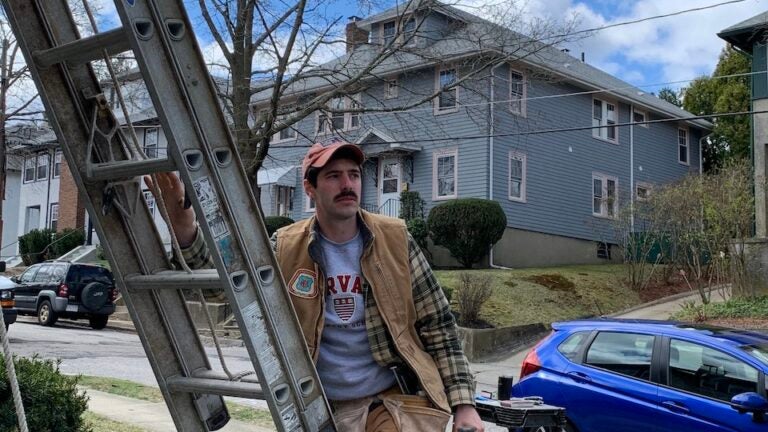
Over the past several years, Nick Crimaldi
said he’s worked a lot of jobs on Harvard University’s campus, but there’s one he’ll never forget.
Related Links
It was commencement day for graduating students, and Crimaldi said everyone was all dressed up with their families, “on the biggest highs of their life.”
He had been in his uniform, landscaping at the First Church in Cambridge and kneeling in the soil when he realized he felt shameful in their company.
“It’s kind of like this internal struggle,” he said. “It’s hard to feel like you’re on the [same] level with someone when you’re covered in mud and dirt, and on the ground like that.”
So this March, after the 33-year-old Watertown native had applied to the Harvard Kennedy School, he burst out laughing in relief as he sat on his couch, reading an acceptance letter.
“I had imagined that moment before,” Crimaldi said, “but I never imagined the sense of relief that I felt. It’s just pure joy, happiness.”
He said he also felt immense validation and pride to know that his “puzzle piece” fit in with an institution he had always held on high.
“It was like finding out that the people that you respected for so long might respect you back,” he said.
All of it felt familiar — “This is the real Good Will Hunting story,” Crimaldi said, referring to the 1997 movie with Matt Damon as the M.I.T. janitor whose math skills get him noticed by a professor at the fabled institution.
It wasn’t until Crimaldi turned 30, joined a carpenter’s union, and started an apprenticeship that he began thinking about his calling.
“I was getting some basic needs met that maybe I perhaps never had before,” he said. “I was earning an income that I could live on, and I think in a way it allowed me to start thinking about other things. It’s hard to do that when you’re really struggling paycheck to paycheck.”
He said his wife, Samantha Keating, remained a constant beacon of support and encouragement. They met while working at a summer camp in Vermont eight years back where he taught wood shop and she was a waterfront instructor.
On the first walk they ever took together, during a rare moment alone amid the chaos of summer camp, she said, “You underestimate yourself.”
Growing up in Boston, being surrounded by institutions of higher education, Crimaldi said he felt their presence like a gravitational pull. “But many of us never go to them, or they don’t really affect our lives directly,” he said. “And so for me, I just grew up in the shadow of Harvard and always had this reverence for it, but it seemed really unapproachable at the same time.”Remembering that shadow, Crimaldi said he realized that getting into the Kennedy School’s one-year mid-career master’s in public administration program would be his next goal in life. To get there, he left a lot behind.“I stopped drinking, I stopped smoking, and I just kind of became totally focused on improving my chances of getting in,” he said. The first step was getting a bachelor’s degree from Wentworth Institute of Technology, where Crimaldi, who hadn’t been in a classroom in 10 years, got straight A’s and gave his graduating class’s commencement address. His high school experience had always felt bitter, he said, like he was just trying to dodge homework and escape, but as an adult student, the dynamics changed and he craved the coursework. Crimaldi said there has always seemed to be a barrier between labor and academia. “It just seems like if you turn a wrench or do some kind of manual labor job, you’re on the opposite end of a spectrum of someone that has a more professional, academic approach to their work,” he said. “Those two things, to me, seem as separate as they ever have been.” There had been many times, working off Oxford street near Harvard’s science buildings, when Crimaldi would take his lunch pail for a break and feel the mystique surrounding the school, wondering what went on inside.“Their work just seems elevated, or more important than just putting together a wall,” he said. “What I was doing is so tangible, and so obvious, and what they were doing seemed so shrouded … I felt just a little bit basic.” But he’s focused on challenging the construct that people are just their jobs.“I don’t think it’s accurate. I think it’s easier for us to have archetypes,” he said. “But there’s nuance, and people don’t fit perfectly into packages. And so I think it’s worth mentioning, worth reminding people to do what inspires them.”Crimaldi said it takes people believing they can change for them to make their dreams real. “There are things that you won’t be able to bring with you,” he said. “The more lofty the goal is, the more ambitious it is, the more you might have to look and say, ‘What in my life now, the way that it is, is not going to help me succeed with what I want to do?’”On some days, Crimaldi said, you might achieve milestones, and on others, you might just focus on keeping the dream alive, real, and doing whatever the bare minimum is to help you get there. The only thing that mattered on those days, he said, was that he made it through without falling back. “I didn’t fall off the train, I didn’t run off the rails,” Crimaldi said. “And that was just enough.”


To comment, please create a screen name in your profile
To comment, please verify your email address
Conversation
This discussion has ended. Please join elsewhere on Boston.com