
State auditor says Environmental Police’s ‘lax practices’ make agency prone to abuse
"This is not the first time that the agency has been called out for its lax practices. I hope this audit helps ensure it is the last time.”
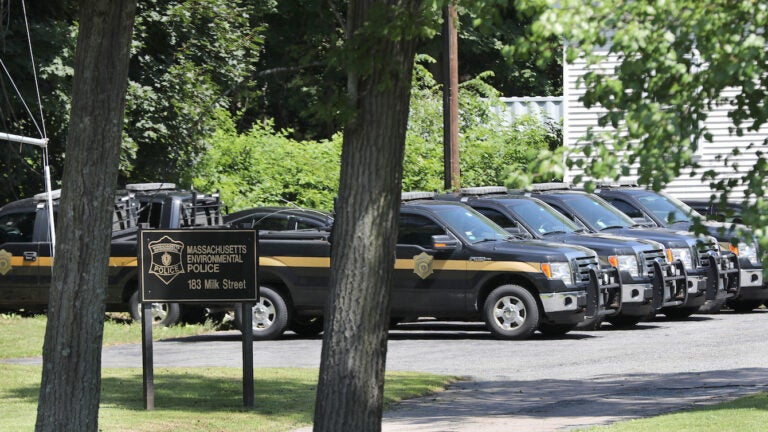
An audit released Tuesday by State Auditor Suzanne Bump says an ineffective time and attendance tracking system within the Massachusetts Environmental Police leaves the agency prone to overtime abuse.
“MEP needs to improve its technology and management accountability to ensure that hours worked are more rigorously tracked and overtime approvals and allocations are more rigorously accounted for,” Bump said in a statement. “We found many instances of poor record-keeping, including undocumented overtime approvals, as well as management practices incompatible with both wage and hour laws and the collective bargaining agreement.”
The audit looked at the period between July 1, 2016 and June 30, 2018 — two years the agency was helmed by former Col. James McGinn, who was fired in 2018 following a review that found he fixed tickets and installed unauthorized surveillance cameras.
The auditor’s report focuses heavily on the practice of split shifts, where officers pause their regularly scheduled work day to work overtime or a paid detail “with an understanding that the officer will return afterward to complete the required hours,” officials said.
The audit found 1,834 split shifts where officers earned overtime over the course of the two years. Auditors also discovered five additional instances where officers worked regular overtime without “properly documented approval.”
Split shifts are uncommon for state law enforcement agencies. The Massachusetts State Police does not allow the practice within its ranks.
Bump said “the potential for abuse is amplified” by shift splitting “because of its potential for manipulation in order to enhance overtime earnings.”
During the two-year time frame, there were 1,961 instances where officers worked more hours than allowed in a single day, including 130 times when officers remained on the clock from 100 up to 369 hours without updating their status or logging out, according to auditors.
“MEP pointed to technological issues as a primary source of the problem,” auditors said. “The audit notes this deficiency leaves MEP with limited ability to effectively track the hours officers work.”
The audit made five findings pertaining to overtime approvals, dispatch record maintenance, and split shifts, and offered recommendations, including the need to establish procedures to approve and document all overtime, monitoring protocols for all dispatch activity, and creating policies to authorize and record split shifts.
Auditors found that officers “may have improperly received as much as $42,623 in overtime,” according to the report. In fiscal year 2018, the agency, which boasts 85 officers among its 119 employees, paid $633,800 in overtime. The department received over $9.7 million in state appropriations that year.
“This is not the first time that the agency has been called out for its lax practices,” Bump said in the statement. “I hope this audit helps ensure it is the last time.”
Katie Gronendyke, an Environmental Police spokesperson, told WGBH News that the department made changes to its split-shift policy and other improvements before the audit was performed.
The switch included reducing split-shifts to 15 percent of all overtime shifts, according to the agency.
“Before this audit was conducted, MEP made improvements to the agency’s operations, including changes to the split shift policy,” Gronendyke told the news outlet. “The MEP approves and pays overtime in full compliance with the collective bargaining agreement and the governing law … There are times that the audit team misinterprets the governing agreements, and the audit methodology used does not correspond to the legal requirements for paying overtime.”
State Attorney General Maura Healey’s office told WGBH it will review the report.


To comment, please create a screen name in your profile
To comment, please verify your email address
Conversation
This discussion has ended. Please join elsewhere on Boston.com