
Mass. General doctor pens moving essay on the sense of duty felt by health care workers
“I don’t consider myself a brave person. But it is part of my professional identity that when people need help, I show up."
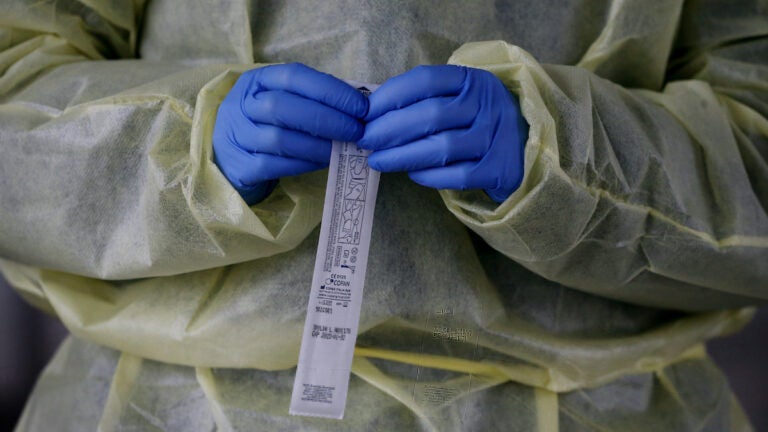
Initially, Suzanne Koven deleted the email that landed in her inbox.It was a message from Mass. General Hospital, where she has worked for 30 years as a primary care physician, looking for volunteers to staff a triage clinic for people with fevers, coughs, and other symptoms possibly attributable to the coronavirus. It felt to her like the range of other new initiatives that often arrive in her inbox — one that didn’t quite apply to her, given the stage she is in with her career.But she couldn’t shake a bothering feeling afterwards.“Over the next 48 hours, though, I paced around my house uneasily, as if I had a pebble in my shoe,” Koven, who is also the writer-in-residence at Mass. General, wrote in an essay published in the New England Journal of Medicine. “When the pebble became a rock, I decided that I needed to volunteer for the new clinic, that I couldn’t live with myself if I didn’t.”The primary care physician told Boston.com she felt moved to write about that impulse to help, to delve into the moment of discomfort she experienced, and reflect on what drives health care workers to help.

Dr. Suzanne Koven.
“Most of the time, we’re not risking our own safety in answering that call … but this happens to be a case where health care workers are routinely risking their own safety,” she said in an interview. “And they’re doing it anyway. They’re showing up. Even somebody like me who is older, and believe me not particularly a risk taker by any stretch of the imagination, even people like me are showing up. And I wanted to better understand why that is.”
The writer and physician said she hoped her essay would resonate with other health care workers and let them know they are not alone.
“What I hope they felt reading it was my admiration for them and my pride in them,” she said. “And I would also hope that they see themselves in it and feel their own choice is validated.”
https://twitter.com/SuzanneKovenMD/status/1249807586922201091
In her essay, “They Call Us and We Go,” which published Monday, she wrote:
… in the hours after the message about the Covid-19 screening clinic arrived, I felt that however much I feared for my physical safety, the psychological distress I’d feel if I didn’t volunteer would be far greater.
Where did this feeling come from? Medical school. Part of the curriculum, no less essential than anatomy and physiology, was the teaching that physicians do not turn away from human suffering. Others may avoid the sickly smell of bloody stool, the sight of a festering wound, the sounds of a grieving parent’s wails — but not us. This is the doctor’s and nurse’s equivalent of the firefighter running into a burning building.
That reflex, to show up, is what prompted her to retrieve the email and sign up to volunteer, she wrote.For herself, she emphasized to Boston.com, the impulse is not rooted in bravery.“Courage isn’t lacking fear,” Koven said. “It’s that you acknowledge it, but that you feel that you have to press on because that’s what you do, because that’s not only your job, but it’s your identity.”The first time she went in to volunteer, she was struck by how she felt less anxious being in the clinic than at home.“That was the kind of irony of it,” she said. “Because even though in many ways the circumstances, to say the least, are extraordinary — in some ways it’s just kind of like another day at work. People show up and they make jokes and they put their shoulder to the grindstone and they’re just doing their jobs. It feels very natural and very normal for people to be doing what they’re doing even though they’re doing it in goggles and gowns and masks in a clinic that has been repurposed. It still is very normal. It is not so very different from what I’ve been doing all these decades.”Koven said she doesn’t want to “over-dramatize” her own role, pointing out that she is not facing the same risks that many of her colleagues are facing working in the emergency rooms or in intensive care units. She described the well-run clinic where she is working as “quite safe” and “tightly contained.”“I don’t consider myself a brave person,” Kovan said. “But it is part of my professional identity that when people need help, I show up. I don’t turn away. That is something that I think is deeply rooted in doctors, nurses, and other health care workers.”
Read Koven’s essay at the New England Journal of Medicine.



To comment, please create a screen name in your profile
To comment, please verify your email address
Conversation
This discussion has ended. Please join elsewhere on Boston.com