
Charlie Baker’s old think tank takes issue with state’s standards for rationing coronavirus care
"What I see is not equitable."
The free market-minded Pioneer Institute and the increasingly liberal Boston City Council don’t always find themselves on the same side.
However, the two groups were in unison Wednesday calling on Gov. Charlie Baker’s administration to overhaul its guidelines for how hospitals should ration care if the COVID-19 outbreak overwhelms the system, albeit from slightly different perspectives.
“The guidelines need re-thinking and a thorough vetting with the citizens of Massachusetts,” Barbara Anthony, a senior fellow at the Pioneer Institute, which was directed by Baker in the 1980s, wrote in a report released Wednesday.
“There are too many variables involved to accurately forecast a person’s lifespan—or the value of that life,” Jim Stergios, the think tank’s current executive director, added in a statement.
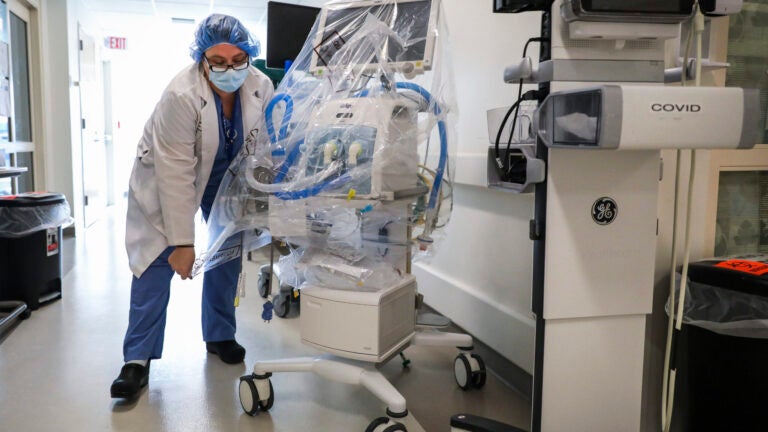
The standards released last week advise hospitals, if at capacity, to allocate supplies like ventilators using a point system that generally prioritizes healthier, younger patients, based on the goal of “saving the most lives” and “saving the most life-years.” Officials say they hope those “tragically difficult” decisions never have to be made, and Baker told reporters Wednesday that Massachusetts is “pretty well positioned” to deal with the current surge in COVID-19 cases.
Still, the point system, which down-ranks patients with preexisting conditions, has stirred concerns that the standards would “exacerbate existing health disparities and disproportionately impact communities of color and individuals with disabilities,” as Rep. Ayanna Pressley wrote in a letter to Baker this week. Even though the standards explicitly say that race and disability — among other social factors — should not be considered, a growing chorus of critics note that people of color are more likely to have preexisting conditions due to decades of systemic racism and unequal access to health care and housing. Pressley also said she’d heard concerns from the disabled community that the standards would de-prioritize them by nature of their disabilities.
The groundswell comes amid evidence that the COVID-19 outbreak has disproportionately affected communities of color.
“I think one of the things we’re hearing with respect to these guidelines is that, ‘We’re not taking race into consideration,’” Boston City Councilor Andrea Campbell said during a teleconference hearing Wednesday, according to The Boston Globe. “That’s a total mistake.”
In a phone interview Wednesday afternoon, Anthony told Boston.com that the standards appear to largely draw from a Centers for Disease Control and Prevention report in 2011, a time when social determinants of health were “not as strongly recognized.”
“What I see is not equitable, and the thinking in it needs to be brought up to what we understand about the social determinants of health,” she said.
In her report, Anthony suggested the standards should have included more input from the “vulnerable populations most likely affected.”
However, she said there’s “no easy answer” to the question of how to ensure that people of color wouldn’t be systemically de-prioritized due to the history of racial inequality; Campbell suggested that officials use “a racial equity and resiliency lens,” according to the Globe.
Health and Human Services Secretary Marylou Sudders, who is leading the state’s coronavirus response, urged hospitals to use the guidelines as “as a framework, and adapt them in accordance with their own standards of care, and in a manner that limits any inequitable impact on individuals and communities of color, immigrants, people with disabilities, and other vulnerable and historically marginalized communities.”
Anthony’s report also raised broader issues with the state’s crisis standards of care. While she applauded the Baker administration for a good job overall responding to the pandemic, she questioned whether it was the government’s role to release such “unsettling” guidelines, especially given the Boston area’s “world class” health care institutions.
“These guidelines place the state in the godlike position of setting forth mechanisms for making life or death decisions about its citizens,” Anthony wrote.
Massachusetts officials say the standards — which are strictly voluntary — were requested by locals health leaders since some hospitals did not have any in place. The guidelines were developed by a committee of medical and ethical experts from local hospitals and universities. In Italy, which unfortunately did have to ration COVID-19 care, similar guidelines were published by the country’s Italian College of Anesthesia, Analgesia, Resuscitation and Intensive Care.
Whatever their view of the standards, there’s a consensus that the state must do everything it can to make sure they won’t have to be invoked — hence the efforts to obtain more ventilators and urge residents to stay at home.
“We’ve been planning, and continue to plan, for the worst scenario, with the fervent hope that these guidelines are never used,” Sudders said.




To comment, please create a screen name in your profile
To comment, please verify your email address
Conversation
This discussion has ended. Please join elsewhere on Boston.com