
Charlie Baker steps up efforts to ensure coronavirus response doesn’t leave Spanish speakers behind
The state is ramping up outreach, amid calls for increased focus on the Latino community.
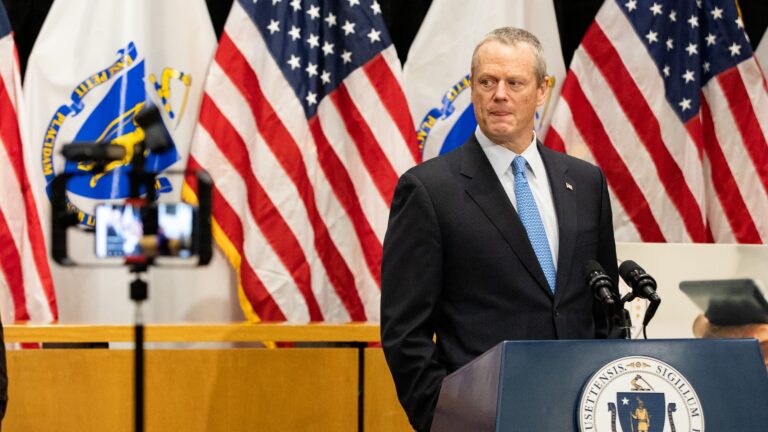
Amid mounting evidence that the coronavirus outbreak is taking a disproportionate toll on the non-English speaking community, officials in Massachusetts are working to ramp up outreach to Latinos.Gov. Charlie Baker’s administration announced Friday afternoon that the state’s COVID-19 text message alert system is now available in Spanish and, on Saturday, launched a Spanish-languge application for unemployment benefits. Baker himself also did a Facebook Live interview Saturday afternoon with El Mundo Boston, during which the host immediately translated the governor’s answers on a range of topics into Spanish.“I kind of wish we did it two weeks ago,” Baker said.
https://www.facebook.com/elmundoboston/videos/1298743007143075/
The effort follows reports showing that largely Hispanic communities, like Chelsea and Lawrence, are experiencing the highest rates of coronavirus cases. Massachusetts General Hospital recently reported that 40 percent of its COVID-19 patients were native Spanish speakers, a significant uptick compared to usual. Boston Mayor Marty Walsh told reporters Thursday that the message the city got from hospitals was to increase communication efforts about the disease for non-English-speaking communities.
“They think — and I agree — that we need to focus more on the Latino community around Boston,” Walsh said.
The state’s Spanish text alert system is one of several steps in that direction.
Users can subscribe to the service by texting COVIDMAESP to 888-777. And while officials noted that the state’s website and other coronavirus resources were already available in many different languages, Baker said the translated alert service “builds on our efforts to keep people in all communities across the commonwealth informed as we confront COVID-19 together.”
“We have consistently reminded residents to get their information from trusted sources, and with the expansion of the AlertsMA text alert system, we are making it easier for Spanish-speaking residents to access important updates from the commonwealth,” he said.
During a press conference Saturday afternoon, Baker added that the new unemployment insurance portal would “ensure that Spanish-speaking residents who are struggling with the economic disruption associated with this virus can access unemployment services and benefits.”
Census data indicates that 42 percent of Massachusetts residents who are not fluent in English speak a language other than Spanish, as the Massachusetts Immigrants and Refugees Advocacy Coalition noted Saturday.
“The new [Spanish unemployment insurance] site will make a big impact,” the group said Saturday. “There’s just a lot of unmet need still for language access.”
The share of Mass. residents who aren’t fluent in English who speak Spanish is 42% per Census data. So the new UI site will make a big impact. There’s just a lot of unmet need still for language access. https://t.co/GRCHGlNPDb pic.twitter.com/nKBMBkpXTH
— MIRA Coalition (@MIRACoalition) April 11, 2020
The governor’s office said Saturday that applications would be made available in Portuguese, Haitian Creole, Chinese, Vietnamese and additional languages in the coming days, as they work to handle the unprecedented waves of unemployment claims.
In his interview with El Mundo, Baker also agreed that the fact that undocumented immigrants in Massachusetts were ineligible for unemployment insurance was a “giant problem.” The Swampscott Republican said the state’s COVID-19 Relief Fund, which has raised $15 million, was set up with that population in mind.
The fund’s website says it will channel money to local foundations and non-profits to support “immigrant and undocumented populations,” among other vulnerable groups.
“One of the main reasons for doing this was because we knew we had a big community out there of people who weren’t going to qualify for any of these benefit programs and we wanted to have a vehicle through which we can make resources available to them,” Baker said.
Baker said his office is also working on more targeted initiatives to respond to local COVID-19 hotspots, like Chelsea and Lawrence, and hoped to soon sign legislation to pause evictions during the crisis.





To comment, please create a screen name in your profile
To comment, please verify your email address
Conversation
This discussion has ended. Please join elsewhere on Boston.com