
Some estimates predict Mass. hospitals could be overrun by April 16. Can Baker’s new order forestall that outcome?
"The reality is we don't have good evidence on what precisely needs to be done and when, but you almost always have to be doing things earlier than you think you do."
Related Links
-
Local News
What you can and can’t do under the new social distancing rules in Massachusetts
-
Local News
Here’s the full list of businesses that are allowed to stay open in Massachusetts under Charlie Baker’s order
-
Coronavirus
Gov. Baker just ordered all nonessential businesses to close. What does that mean for restaurants?
Taking further steps aimed at flattening the curve of the coronavirus, Gov. Charlie Baker announced a new emergency order Monday closing locations of all non-essential businesses, and issued a stay-at-home advisory, again urging residents to keep to themselves.
Officials have repeatedly said that although the local health care system can handle the current influx of patients battling COVID-19, the public must take steps to help stem the tide of a surge that would leave hospitals without enough beds and resources.
According to models on CovidActNow.org, Massachusetts would need to go beyond social distancing and into a three-month shelter-in-place order to keep the rise at bay through the spring.
The site — which was launched by engineers, designers, and data scientists “in partnership with epidemiologists, public health officials, and political leaders” — says by taking no action, the commonwealth would surge to 150,000 patients by April 20, overrunning the number of available hospital beds by April 4.
Even with social distancing measures like the ones in place before Baker’s latest order, that day would come by April 16, according to the models.
A “point of no-return for intervention” is estimated for between March 21 and March 26.
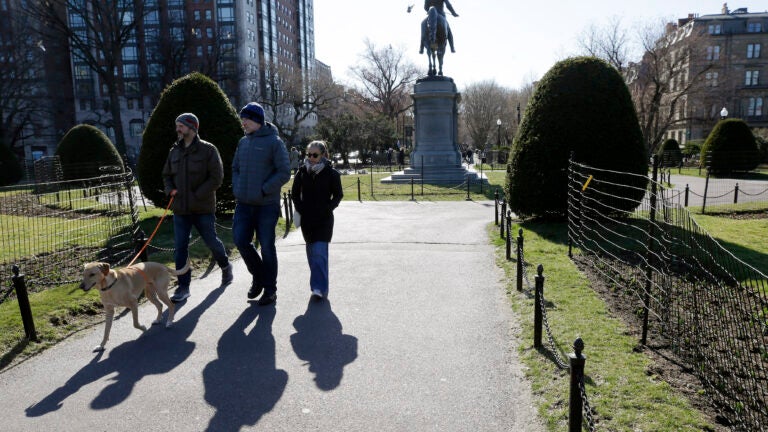
Baker’s shelter-in-place advisory urges residents to stay in their homes, but does not prevent them from trips to pick up groceries and prescriptions, and from taking the occasional walk around the neighborhood park.
The advisory is in place through April 7.
“Acting now to prevent more person-to-person interaction and the spread of the virus will buy us more time so our health care system can better prepare for a challenge unlike any they’ve seen before,” Baker said.
“A concerted effort now will help us get back to work and back to school,” he added.
Dr. Helen Jenkins, an epidemiologist at Boston University, said she’s glad Baker took those steps.
She noted that although the public transit system remains up and running, Baker discouraged non-essential travel on it, and pointed out that even though parks remain open, visitors should keep their distance from one another.
But there remains a question of how much more is really feasible, Jenkins said.
“He may have to enforce something more,” Jenkins said in an interview. “The reality is we don’t have good evidence on what precisely needs to be done and when, but you almost always have to be doing things earlier than you think you do.”
In a statement to Boston.com, the Massachusetts Health and Hospital Association, which represents 70 hospitals throughout the state, called Baker’s advisory “a necessary step in flattening the curve and helping our health care system manage a quickly accelerating demand for care.”
“Research indicates that extreme social distancing can slow the potentially explosive growth in COVID-19 cases and we implore all Massachusetts residents to comply to their greatest ability,” the association said. “The situation remains dynamic and while we expect to see a sudden spike in COVID-19 diagnoses due to a recent increase in testing, we remain hopeful that the public has taken this guidance to heart and that we will flatten the curve in the weeks ahead.”
According to the CovidActNow.org model, a second coronavirus spike is possible even after social distancing practices end.
“Our models show that it would take at least 2 months of Wuhan-style Lockdown to achieve full containment,” says the site, last updated on March 19, referring to the draconian measures taken by the Chinese government in the province where the virus was first detected. “However, it is unclear at this time how you could manage newly introduced infections.”
Jenkins said many models are based on sparse data, though.
Even CovidActNow.org notes right at the top of its website that the charts are not intended to predict the future.
But Jenkins said models like that one can still be useful, particularly when it comes to having people consider “what (their) actions can cause, and think carefully about how much outbreaks can grow and really overwhelm the system.”
Even if people feel silly about what the precautions they’re taking, Jenkins said they have to remember the infections that happen now won’t hit hospitals until three weeks down the line.
However, there are also a few, smaller moves that can be made, even before any more drastic actions are taken, according to Jenkins.
In some places around the globe that are battling COVID-19, shoppers at grocery stores are required to use shopping carts as a way to ensure distance among their fellow customers, she said. Some stores also limit the number of people allowed inside at a given time.
Jenkins said individuals can do a whole lot on their own, too.
“The less interaction you have with other people, the better,” she said.



To comment, please create a screen name in your profile
To comment, please verify your email address
Conversation
This discussion has ended. Please join elsewhere on Boston.com