
Nurses union sends letter to Charlie Baker calling for 13 actions amid coronavirus outbreak
“I think it would be a misnomer to say anyone is well prepared."
Related Links
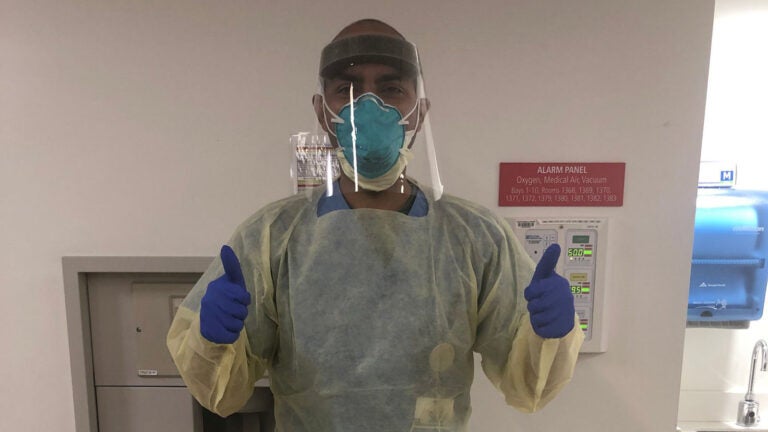
As coronavirus continues to bear down on Massachusetts, nurses and health care workers are concerned about if they’ll have enough equipment to care for patients, as well as to protect themselves.
The Massachusetts Nurses Association, a union that represents 23,000 nurses and health care workers throughout the state, is calling on Gov. Charlie Baker for additional protections for nurses and those working on the front lines of caring for coronavirus patients.
In a letter dated Wednesday, MNA President Donna Kelly-Williams, who is also a registered nurse, praised Baker for “taking proactive steps,” like canceling procedures deemed “non-essential” to lessen the number of people headed to hospitals and stopping the closure of the MetroWest Medical Center.
But there’s still more to be done, Kelly-Williams wrote. Concerns remain that staff will run out of personal protective equipment, tests for the virus “are still not widely available,” people who may have the virus are headed to hospitals that are not ready to test and take care of them, and nurses are concerned there won’t be enough space to handle all of the patients.
“After years of closures of beds, units and hospitals, and reductions in frontline health care staff, hospitals lack the space and staff to deal with an unprecedented outbreak of this highly contagious virus,” she wrote. “This puts patients, health care workers, and the general public at risk.”
Judith Pare, a registered nurse and MNA’s nursing division director, told Boston.com that no health care facility is well prepared.
“I think it would be a misnomer to say anyone is well prepared,” she said. “We certainly have hospital settings that are better prepared than others.”
However, she noted that the lack of personal protective equipment, or PPE, is not just in Massachusetts; there’s a shortage nationally.
As a nurse for 41 years, and an educator for the past two decades, Pare said different situations call for different equipment. Viruses, like COVID-19, require staff to wear different PPE than those working in a different area.
But regardless of the situation, Pare said nurses provide care in the most dire of situations. She described how she had students working 90 to 100 hours a week following the Boston Marathon bombings.
“As a nurse, you are raised in the profession to provide safe patient care that will met your patient’s need at the moment, no matter what,” she said, questioning who will step in to take care of patients if nurses become ill.
Kelly-Williams asked Baker to enact a list of measures to help nurses, including placing a limit on staff treating COVID-19 patients by placing these patients in specific areas, which would help drop the amount of PPE being used.
Other measures included making certain hospitals designated to treat coronavirus patients, one or two per geographic area, increasing PPE manufacturing within the United States, as well as providing housing outside the home for health care workers who are concerned about infecting loved ones they live with. Kelly-Williams called on using dorms from now-vacant college campuses.
Once the pandemic subsides, Pare said MNA hopes to have a summit with lawmakers to discuss everything, and figure out what’s best for the future.
But for now, the focus is on the nurses and providers working with patients, and to relay to lawmakers what’s going on at hospitals.
“We really are trying to work with the hospitals and with the legislators, and I believe they are as well, to keep an open line of communication,” Pare said. “We know what’s going on at the front lines. Our obligation is to communicate what is the reality to walk into the hospitals with the influx of patients, and to let our leaders know.”
Pare said she’s concerned about potentially losing health care workers.
“My God, what a tragedy,” she said. “That’s a tragedy on top of a tragedy.”
Read the MNA’s full letter to Gov. Charlie Baker:
Dear Governor Baker:
Thank you for taking proactive steps to address the novel Coronavirus (COVID-19). The decision requiring hospitals to cancel all non-essential elective procedures will free up resources to address confirmed and suspected COVID-19 patients and reduce the number of people coming in and out of our hospitals, thereby limiting the spread of the virus. The halt to the closure of the MetroWest Medical Center was also a positive development. As we move forward in this unprecedented time, I wanted to follow up on my letter from last week to let you know what frontline nurses and health care professionals are seeing and experiencing as they care for potentially infected individuals as well as vulnerable patient populations.
What nurses are seeing
The situation in our health care facilities is constantly changing as our public health officials and frontline caregivers work to meet the increased demand brought on by COVID-19.While progress is being made, it remains important to provide an honest assessment of where we are falling short:
• Health care facilities still do not have enough Personal Protective Equipment (PPE) for frontline health care staff and are recommending that nurses reuse PPE without taking the proper safety requirements.
• Tests are still not widely available.
• Potentially infected individuals are presenting at hospitals that are still not equipped to triage, test, and properly treat them in an appropriate setting.
• Nurses continue to be concerned about capacity to treat the potential influx of individuals with COVID-19. After years of closures of beds, units and hospitals, and reductions in frontline health care staff, hospitals lack the space and staff to deal with an unprecedented outbreak of this highly contagious virus. This puts patients, health care workers, and the general public at risk.What must be done
As the frontline health care staff who are working to provide care for the COVID-19 patients as well as meet other ongoing patient needs, we call for the following actions:1. Protect frontline health care workers. Hospitals and other health care employers have the duty and responsibility to protect patients, and staff. All health care staff caring for confirmed and suspected COVID-19 patients must be provided with: gloves, gown, fit-tested NIOSH certified disposable N-95 masks, goggles and disposable face shields. This protective clothing should be donned and doffed on location. Additionally, Power Air-Purifying Respirators (PAPRs) are recommended for procedures that are likely to generate respiratory aerosols. Unfortunately, as the CDC has chosen to weaken PPE standards, some Massachusetts health care facilities are following suit, by not providing proper PPE or telling staff to reuse PPE without following strict and proper procedures for that. We have seen from the experience in Italy the high number of health care workers contracting COVID-19 when proper PPE and strict protocols were not maintained. All Massachusetts hospitals must act to limit the number of staff triaging patients by creating or erecting designated triage areas to segregate patients and to help conserve the limited supply of PPE. Health care facilities should also test all staff with exposure to patients who test positive or who are triaging patients with COVID-19 symptoms.
2. Designate specific areas to address suspected and confirmed COVID-19 cases. Designated floors with limited access by designated, properly trained and equipped personnel should be in place at every health care facility in order to assure we have a proper location for suspected positive or tested positive patients in need of in-patient care. Isolating confirmed and suspected cases can stop the spread among patients and health care workers. We are encouraged to see that some hospitals are mobilizing to create designated units. Further recommendations include: establishing ante-room triage; designating one or two specific hospitals per geographic area as triage hospitals; designating floors and ICUs specifically for COVID-19 patients or suspected patients as well as designating staff to provide care and services to these floors. This includes everyone from doctors and nurses to housekeeping and food service employees. Creating a fully, self-contained unit designated staff could also reduce the amount of PPE needed.
3. There should be an immediate mobilization of domestic manufacturing of PPE and ventilators. We know there is a shortage of PPE as well as Ventilators. Any and all efforts at the state and national level should be made to increase production.
4. Support frontline health care workers. In order to provide care to patients, health care workers need additional resources at this time, including housing and childcare options. For staff who are caring for patients and cannot return to their home without causing undo risk to household members in a high-risk category, there should be temporary housing provided – such as a designated hotel or dormitory at one of the vacant college campuses. This should also apply to personnel placed on quarantine due to exposure. Health care facilities and the state should create childcare centers for personnel who do not have alternative care arrangements and are needed on the frontlines of this pandemic. Hospital scrubs should be provided to assure personnel are changing out clothes before leaving the area. Finally, these frontline health care workers who become infected with COVID-19 should not have to use their own sick time or paid time off to self-quarantine and recover. We are putting them in the direct path of this novel virus and we should be supporting them in doing so.
5. Halt all bed, unit and facility closures. While we are encouraged by the halt to the MetroWest Medical Center closure, the potential surge in volume of patients with possible exposure to or symptoms of COVID-19 illness still very much has the capacity to overwhelm our health care system As our letter stated last week, this is not a time to be eliminating capacity at our health care facilities. The state should direct health care facilities to halt all planned bed, unit and facility closures. We should instead be looking at ways to increase capacity. Facilities such as Union Hospital, Quincy Medical Center and North Adams Hospital could be re-opened for the designated purpose of treating COVID-19 patients. At this time we should be looking to increase capacity, not reduce it.
6. Halt all staff reductions. Last week, under the powers granted to you and your office under the declaration of a State Emergency (Executive Order No. 591: Declaration of a State of Emergency to Respond to COVID-19) you moved to have the Board of Registration in Nursing (BORN) grant out-of-state nurses a license in Massachusetts in just one day, anticipating the need for additional registered nurses. However, as you did this, Leominster Hospital announced it would continue its plan to reduce its Emergency Department (ED) nurse staff. And just this morning, at least one hospital has announced plans to furlough nurses without pay as a result of the cancelation of non-essential elective surgeries. This is at best counterproductive. This is not the time to be eliminating frontline health care workers. In the coming weeks we will need all of them, and possibly more.
7. Cessation of all elective procedures to free up health care resources. In addition to the directive from the Department of Public Health (DPH) for hospitals and ambulatory surgical centers to postpone or cancel all non-essential, elective invasive procedures until the State of Emergency has ended, clinics and all other health care facilities should follow suit. This would free up personnel needed for other locations and assure all equipment and supplies can be directed to those in need when the inevitable surge in COVID-19 patients arises. Extending this order to all other health care facilities would further reduce the risk of spread, allow for triaging of potential patient needs without inundating EDs, and prevent problems arising from non-essential, elective cases that could take up valuable health care resources needed for COVID-19 patients.
8. Support vulnerable hospitals and health care organizations. We recognize that non-essential elective surgeries are a vital part of how hospitals and health care facilities maintain their bottom line and that canceling them may cause a short-term cash crunch – particularly for vulnerable safety-net hospitals. However, it is necessary to cancel or postpone non-essential elective procedures. And unfortunately, these beds and other resources will not be underutilized for long, as we know that a flood of COVID-19 patients will likely fill them in short order. In the meantime, state and federal officials should do whatever is necessary to keep these resources available. We have heard concerning reports of hospitals and health systems that may need to close or furlough large numbers of health care workers. The state and federal government must make the necessary decisions to provide financial support during this critical phase as we prepare for a surge in our in-patient capacity.
9. Discharge all current inpatients as soon as practicable. Discharging patients who are not positive for or suspected of COVID-19 will free up resources and reduce those individuals potential exposure.
10. Prescreen all individuals presenting at Massachusetts hospitals. Prescreening of all allowed visitors and vendors coming in and out of health care facilities can help to reduce the spread of COVID-19 through that facility.
11. Drive through testing widely available. We are encouraged to hear about drive up testing sites being created around the state. This capability should only increase in the days and weeks ahead.
12. Further curtailing public transportation. The recent announcement that the MBTA will run reduced schedules for buses and trains was welcome news. However, we believe the state should go a step further and shut down all public transportation except for essential personal or individuals cleared to travel, similar to the restrictions imposed during the blizzard of ’78. This would allow those who must use public transportation to do so, while imposing social distancing standards. We understand this will require thoughtful planning for those whose food and other needs will require alternative assistance or distribution mechanisms. Shuttle bus services at health care facilities should also be curtailed to be in compliance with social distancing recommendations and where it must still be used to transport staff, regularly cleaned in compliance with appropriate standards. In lieu of shuttles, parking should be made available at no cost for health care workers wherever possible.
13. Use of National Guard for public transportation areas to assure large public congregation of non-essential personnel is dissuaded. National Guard members should also be posted at hospitals to assure restricted visitation is followed without having to pull direct care staff away from patient care. Unfortunately, we cannot rely on all members of the public to adhere to all directives issued by the state and federal government. Bringing in the National Guard will free up staff resources from having to police these issues.
We will continue to reach out to hospitals to work directly with them, but recognize the important role your office and state government have to play in mitigating the spread of COVID-19 while helping to manage the care of those who do become infected as well as the health care staff who treat them.
Finally, we recognize that this situation is fluid, changing by the day if not the hour. We will continue to be available as a resource as things progress and we look forward to working together in service to the citizens of the Commonwealth.
Thank you.
Donna Kelly-Williams, RN
President, Massachusetts Nurses AssociationCc: Secretary Marylou Sudders
Massachusetts Legislature
<hr>
<h2>What are the symptoms of coronavirus, and how is it treated?</h2>




To comment, please create a screen name in your profile
To comment, please verify your email address
Conversation
This discussion has ended. Please join elsewhere on Boston.com