
Author and former Somali refugee who settled in Maine will become U.S. citizen this week
Abdi Nor Iftin chronicled his journey from Mogadishu, Somalia to Yarmouth, Maine, in the 2018 memoir, “Call Me American.”
Abdi Nor Iftin already considers himself an American.
Related Links
But on Friday, what has been true for years in the heart of the author and former Somali refugee living in Yarmouth, Maine, will become official when he swears the oath of allegiance to the United States and becomes a naturalized American citizen.
“It’s the beginning, it’s not the end,” Iftin said of the latest step in his journey and life in the United States. “It’s the beginning. My nickname, ‘Abdi American,’ is becoming my nationality and my citizenship. And from there, there’s a lot of work to do. I will keep telling my story and talking about what America means, and why I chose to take the oath of allegiance to the United States flag.”
Good news!! Nailed the questions. I am officially one of you. Naturalization ceremony is January 17th in Maine. pic.twitter.com/SRUD6txn5p
— Abdi Iftin (@Abdi_Iftin) December 2, 2019
As a child growing up in the war-ravaged city of Mogadishu, Iftin taught himself English by watching American films, pressing his ear close to the television in a movie shack to hear the actors, like Arnold Schwarzenegger, deliver their lines. His love for American culture and perfect pronunciation earned him the nickname “Abdi the American” among his friends.
Years later, living as a refugee in Kenya, he won his “golden ticket” — the opportunity for a green card through the U.S. Diversity Visa Program. His story was shared across the globe by This American Life, the BBC, and The Atlantic. He settled in Maine in August 2014, and in 2018, he published his memoir with the apt title, “Call Me American.”
Since his book came out, Iftin said he’s been mostly on the road, touring across the country to share his story at colleges, high schools, and other public events. He’s also studying comparative politics and political science at Boston College and hopes to graduate next year.
Even after visiting more than two dozen states in recent years, Iftin said he remains convinced “there’s nowhere better than New England.”
He considers himself a son, not only of Maine, but of Vermont, New Hampshire, and Massachusetts as his network of friends and “family” has grown.
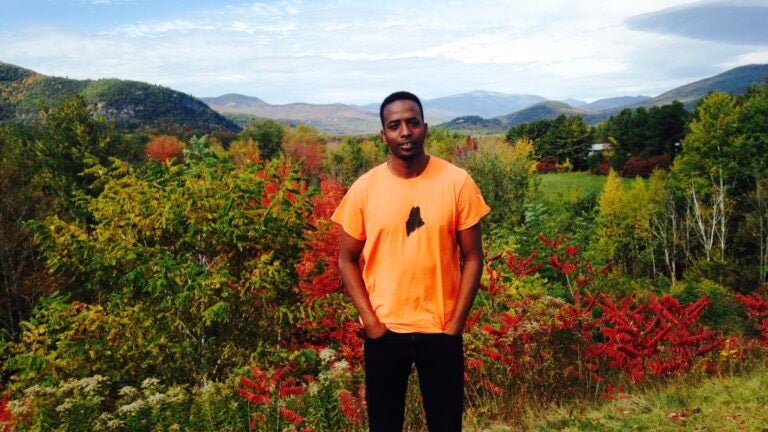
“Like my mother with the nomadic Somali culture, I love to look up in the air and I like to see clouds building up,” Iftin said of his love for the northeast region. “I like to smell rain, I like the feeling of snow coming. I like the feeling of gray — driving on 95 when the sky is gray and all that. I’m not a big fan of the sun as much as many New Englanders are.”
In New England, there is an “abundance of the heavenly feeling” of rain that was so often prayed for during his childhood in Somalia, the 34-year-old author said. Crowds would fill Mogadishu’s streets begging for rain — sometimes it did, sometimes it didn’t.

Abdi Nor Iftin poses near the Appalachian Trail.
“Here in New England, the trees are tall, green, beautiful in the summertimes, and then in the fall, it’s just that amazing feeling of colors changing,” Iftin said. “And in the wintertime it also has its own — I’m not a big fan of cold, but I like the feeling of snowy, cozy and gray. That’s why I love New England much better than anywhere else.”
It’s not mandatory that he become a citizen, he pointed out. But he was drawn to become a citizen of the U.S. by his love for the country and the freedoms it extends to its people.
He can’t wait to exercise his right to vote — a process he has never participated in and one, he pointed out, many Americans take for granted.
“I want to be able to participate,” he said of becoming a citizen. “To exercise one of my American rights … Being able to vote, being able to serve on a jury, being able to run for office if I want. And most importantly, I can sponsor my family with the American citizenship. I could not sponsor my family with a green card.”
And with a green card, there was still the constant fear of being deported, he said — that something could happen to change his safety in the U.S.
“As a non-American, anything can happen to you,” he said. “You could be deported. You never know what the tweet that’s coming tomorrow is going to look like.”
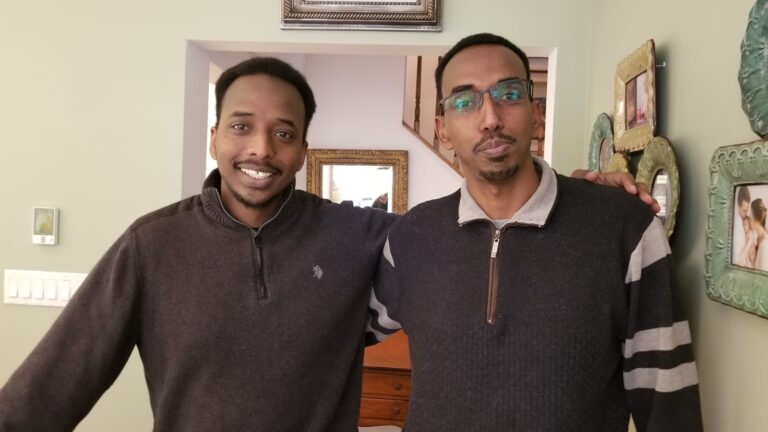
In December, Iftin celebrated another the milestone along with his path to American citizenship. He reunited with his brother, Hassan Iftin, who was resettled with his wife and three children in Toronto, Canada, after living undocumented as refugees for years in Nairobi, Kenya.
“It’s something that none of us really expected would happen,” Iftin said of seeing his brother settled safely in North America. His brother, he said, was one of those impacted by President Donald Trump’s travel ban, which restricts people from predominantly Muslim countries from entering the United States.
When Hassan arrived in December, Iftin drove from Maine to Toronto to pick the family up from the airport. The last time they’d seen each other, six years ago, was at another airport, when Iftin was on his way to America.
“It was such a wonderful reunion,” Iftin said.
I can’t remember the last time I had ever been this excited. My brother and his family have just boarded a plane in Kenya headed to Toronto, Canada. It had been years of efforts, disappointments and rejections but we never gave up. Good bye that refugee life. Welcome home brother
— Abdi Iftin (@Abdi_Iftin) December 17, 2019
Happiest reunion of my life ever. My brother Hassan Iftin is finally safe in Toronto, Canada. Couple years ago the United States rejected his resettlement case probably due to the travel ban. But Canada opened its doors for him. Welcome to your new home. pic.twitter.com/CTTUDzM3i6
— Abdi Iftin (@Abdi_Iftin) December 20, 2019
A few days later, the brothers went on a walk through downtown Toronto for more than two hours.
It was the first time they’d been able to walk together on a street without the risk of threats of violence or fear of the authorities because of their immigration status.
They called it their “walk of freedom,” Iftin said.
“I know people around us didn’t pay attention, because they didn’t know us,” Iftin said. “But he and I enjoyed that freedom, for the first time in our whole lives, being born in Somalia and together in Kenya, this is the first time we had this opportunity … We truly truly enjoyed this freedom and liberty and pursuit of happiness that both of us have received here.”

Abdi Nor Iftin, right, and his brother, Hassan, in downtown Toronto.
While he has savored the moments of happiness and excitement he has gained through his life in America, Iftin said he is still not free from his past.
He hasn’t seen his mother and sister, who live in a camp for displaced people in a region of Somalia controlled by the terror group al-Shabab, in 12 years. Their connection to him puts their lives at risk, he said.
“I want to share my story in public on social media, but I also don’t want to put at risk my mother’s life,” Iftin said. “I understand that most of my followers would assume that it’s a great thing, I’m posting a picture of my brother and I and we’re happy and all that. But then there’s the fear that that moment of posting this thing, could endanger the life of my family. But I don’t have a choice.”
Iftin provides financial support for his mother, sister, and his sister’s five children. It’s all he can do, he said. He can’t provide safety or peace. He follows news out of Somalia closely, checking for reports of violence.
Every time his mother calls, he gets nervous butterflies in his stomach.
“It’s usually my mother telling me, ‘There’s a bomb and your sister’s not here and we don’t know if she’s one of those killed or wounded, but we’ll keep you posted,’” Iftin explained. “And then she hangs up. And now I have the rest of the day to not consciously think about anything else. It just takes me down — it gives me this constant panic attack that I have, these sleepless nights that I have, these nightmares that I have.”
As an American citizen, Iftin said he plans to continue sharing his story and his work advocating for refugees and displaced people around the world.
He hopes that his story opens the eyes of people who frown on immigrants and the resettlement of refugees in the United States, and reminds his fellow Americans of the “exceptional place” the country is for the freedoms and protections it offers to its citizens.
“I hope that readers or the general American public will realize the privilege that they have, the things that they have in life that millions out there, including my own family today, are struggling and fighting for,” Iftin said. “For instance, the right to speak, the right of movement, the right to do things your own way — which we do in the United States here every single day. It’s something that my own family cannot do today. They can’t even mention my name as their son in the United States because that could get them killed. And I hope that Americans will fight and fight for these freedoms that we have, that we don’t lose what we have today.”
He also still has hope that he’ll reunite with his mother and sister, that he’ll be able to sponsor them to the United States once he’s a citizen — that they too will get to experience the beauty of fall, winter, spring, and summer in New England.
“I think they would just love it,” Iftin said.


To comment, please create a screen name in your profile
To comment, please verify your email address
Conversation
This discussion has ended. Please join elsewhere on Boston.com