
‘He had such a big heart’: Friends mourn Gary Gilreath, longtime Spare Change News vendor who recently died
“I think Boston has a lot of these great wonderful voices, and, if nothing else, talking about somebody like Gary hopefully will make people aware of the voices that are around them in the city."
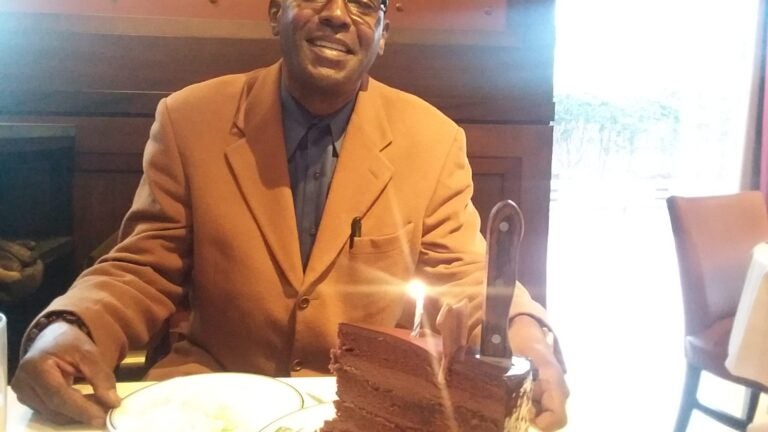
For years, anyone walking past Haymarket and the nearby New England Holocaust Memorial would hear his calls for “Spare Change newspaper!,” or, if he knew a passerby, a warm, “Hey, friend! How are you?”But for the past couple of months, the corner of Congress and Hanover streets has been eerily quiet as commuters trek past in the morning, devoid of the cheery Spare Change News vendor who, standing there with his coffee, brought his smile and warmth.Gary Gilreath, 58, of Boston, a longtime vendor for Spare Change News, died back on Sept. 22. He had a stroke earlier that month and, while in the hospital, suffered a fatal blood clot in his lungs, according to his obituary.
Forming friendships in an unexpected place
While some may simply remember Gilreath for his presence during their morning or evening commutes, to others, he became much more. Those who knew him said Gilreath had a talent for striking up conversations, and for also caring about the people who he chose to call his friends.It was an interaction like that that fostered a friendship between Gilreath and Sara Lavado, a series of quick greetings in the morning that led to Lavado volunteering for Spare Change and eventually getting on its board, and a bond with Gilreath that led to her becoming close enough to him to write his obituary.What cemented the two together came during a particularly challenging time in Lavado’s life, and Gilreath could tell something was up by the way Lavado looked during her morning walk one day.“What really connected us was one day he saw me walking by, and he was like, ‘What’s wrong? Are you OK?,’ and I was like, ‘I’m not doing very well,’” she said. “And he said, ‘Let’s sit down and talk.’”Gilreath recommended a nearby coffee shop. He finished selling papers for the day and sat down with Lavado. What he found out was that she’d had a miscarriage.“He just turned to me, and he was like, ‘Sara, you’re not the only one who this has happened to,’” Lavado recalled. “I don’t know if it was, like, the right timing or the right person to hear it from, or what it was, but it was what I needed to hear, and what pulled me through, and it was like my mantra for the next few weeks.”It was in this way — being friendly, caring, and compassionate – that Gilreath grew many other friendships with people walking past his post where he sold Spare Change News, a newspaper originally founded in 1992 by a group of homeless people and that now provides a source of income for those in the same or a similar situation; vendors, like Gilreath, buy the paper for 35 cents — they then turn around and sell it for $1.
‘It was sudden’
Long before this chapter of his life, Gilreath grew up in Boston and served in the U.S. Navy from 1980 through 1984, his obituary said. He was stationed in San Diego. After his time in the service, he did amateur modeling and then worked for Amtrak. When Gilreath and Lavado met, he was living in a homeless shelter. At one point, he moved on to the Veterans Affairs’ shelter, where he got a job and eventually moved to a place of his own, according to Lavado. She shared a photo of him proudly holding a paper that says “Lease” written across it, a grin spread across his face.After the day that Gilreath gave Lavado the talk that she needed, she knew she wanted to support Gilreath.“Any way that I could help, I was like, ‘Just tell me what you need and we’ll figure it out,’” she said.When Gilreath died, he had conquered homelessness, was a business student at Northeastern University, and continued to sell for Spare Change.“It was sudden,” Lavado said of her friend’s death. “And it felt like he was in such an upturn in life, too. He had everything laid out for him, exactly the path he wanted to do.”
‘Anything is easier than what I’m doing now’
But going from homelessness to being housed, employed, and a student, all at the same time, takes a lot of work and clearing many hurdles.George Gilpatrick, another of Gilreath’s friends who he met while selling the newspaper and who knew him for about four years, spoke of the lengthy processes of working with Gilreath to get his driver’s license back to apply for Section 8 housing.Gilpatrick became closer with Gilreath beyond the daily morning greetings after Gilpatrick walked to work and Gilreath said he needed to make an appointment at the VA and asked for help.After moving through that, Gilpatrick became Gilreath’s advocate – they worked on the driver’s license. It turns out Gilreath had a parking ticket from decades ago for which “ludicrous interest had accrued,” Gilpatrick said. Other barriers sprung up elsewhere, things that Gilpatrick said most don’t think about unless you’re facing them yourself, or watching someone else face them — the day-long wait to apply for Section 8 housing, teaching Gilreath how to sign on to a student portal when he transferred from Harvard Extension School to Northeastern.Most of their friendship was spent moving through these bureaucratic processes or learning things, like computer work, that for someone like Gilreath was key since he was self-taught.“It was almost like there was a just struggle in this to give someone back his dignity or something like that,” Gilpatrick said. But no matter the number of barriers and resulting frustrations, Gilreath kept at it. “He kept his chin up the whole time, he was on the right track.”In the center of it all was Gilreath’s desire to just be a taxpaying, contributing member of society.“He wanted nothing more than to work, pay taxes, and go about his life,” Gilpatrick said.The two would talk about Gilreath moving into his own place, and Gilpatrick remembered reflecting on it with him once.“And he said, ‘Anything is easier than what I’m doing now,’” Gilpatrick recalled. “And he was right.”
‘Gary was very optimistic’
Along the way, and through the many barriers, were the friendships Gilreath had cultivated. Another was with Buck Dowdelle, who met Gilreath as a Spare Change vendor and would grab lunch with him every so often. The two were friends for several years.“Gary was very optimistic,” he recalled. “He was always working hard to make a better future for himself, and that was a very nice, and just a striking, characteristic of him.”Dowdelle also said that Gilreath believed in Spare Change News and its mission.“He knew what an important bridge that was for him to be able to sort of come out of a bad situation, being homeless, and get on his feet and have an income,” he said.Dowdelle recalled helping Gilreath pay his phone bill, and Gilreath sometimes asking to borrow money from him.“[He] wanted to pay me back, but I wasn’t asking for that,” he said. “I was just trying to help him.”But in turn, Dowdelle recalled how Gilreath wanted to better himself, get a better job, and to help people.“He had such a big heart, and he wanted to help anybody he could, and help in any way that he could,” he said. “It’s just that his means were so meager that he wasn’t really able to do all the things that he wanted to do, and was trying to fix that.”Gilreath was also a budding writer — he had articles published by Spare Change — and friend Dave Veling remembers Gilreath telling him about them. The two were friends for about four years.“In addition to everything else with getting into a better place with his housing situation, [and] going back to school, he was, I think, developing as a writer, and I think that was something he was certainly proud of professionally,” he said.Gilreath also paid attention to the news – Veling recalled a conversation they had over Boston public schools, spurred over an article Gilreath had read at the time. They would sometimes grab hot apple cider from the nearby Boston Public Market and talk for awhile.“We would just hang out and chat,” he said. “We were just two guys checking in and it was really great.”But there were simpler things that Veling said Gilreath would talk about — the fact that he was proud enough of his home to invite people over.“It’s not a big deal for us, for people who almost take housing for granted,” Veling said. “In the context of somebody who has struggled with housing and homelessness, having pride in where you’re living to the point of wanting to invite others into your space and, you know, considering it your space, it’s a big deal, it’s such a big deal.”
‘He was so excited to get back to everything’
The day before he died, Lavado said she went to visit Gilreath in the hospital.“He was in really good spirits,” she said. “He was like, ‘I’m doing all this physical therapy, they’re just working me to death.’ And I was like you’ve just got to keep up with it. I know you can do this Gary, and he was like, ‘I can’t wait to get out of here,’ and he was so excited to get back to everything, all he’s been doing.Veling, who no longer commutes to downtown Boston, visited the city about a month ago. He took the Green Line to Government Center and walked across City Hall Plaza, and crossed the street to where Gilreath used to stand. It made him sad, he said.“I think Boston has a lot of these great wonderful voices, and, if nothing else, talking about somebody like Gary hopefully will make people aware of the voices that are around them in the city and that they’ll appreciate them,” he said.





To comment, please create a screen name in your profile
To comment, please verify your email address
Conversation
This discussion has ended. Please join elsewhere on Boston.com