
‘I’m just defeated’: Vape retailers, consumers, experts urge Mass. officials to end sales ban
"We ain't getting anywhere with this. It's sad."
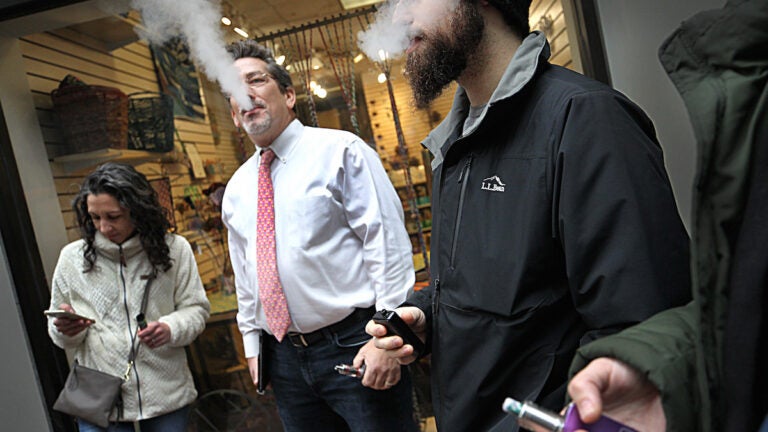
Karen Brennan Fontana sat before two Massachusetts public health officials in the department’s downtown Boston offices Friday morning and told them how she was born right here in the city, how her family has lived here for generations.
Then she said, “I’m done.”
“I’m really looking at other resources and other alternatives because I just can’t do it here anymore. And I really feel like nobody cares.”
Brennan Fontana founded Brennan’s Smoke Shop, a small, South Coast chain of tobacco stores based in Brockton back in 1993. Her son, Geoff Yalenezian, serves as its chief operating officer.
“I’m just defeated,” she said in an interview.
She wants to move the business up to New Hampshire.
“I’ve been fighting for 27 … years. I follow all the rules, all the regulations, and I just can’t seem to win in this state,” she said.
Her exasperation was echoed from dozens of other smoke and vape shop owners, advocates, and industry experts who spoke at a Department of Public Health public hearing held to collect feedback on the ongoing sales ban on all vaping products.
Gov. Charlie Baker rolled out the policy in September, declaring a public health emergency amid a national outbreak of vaping-associated lung injuries. The ban prohibits the sale of all products — including those containing THC, the psychoactive chemical in marijuana — both in retail shops and online.
This week’s hearing came after Suffolk Superior Court Judge Douglas Wilkins ruled last month the Baker administration overstepped its authority when it failed to follow the required process in crafting the ban on nicotine vape sales. He required officials — should the state want to keep it in place — to hold a public hearing to help determine how it would effect business owners and consumers.
On Friday, many sprung at the chance to oblige, in clear terms.
“My life has changed upside down,” said Behram Agha, owner of Vapor Zone, who closed all four of his stores in September.
Agha, one of the first business owners to sue state officials over the ban, said he’s had to lay off his 11 employees.
“They cannot get new jobs overnight. They have to learn new skills,” he said. “They have mortgages, they have rents to pay.”
Lou Rebello, owner of GoodFella Vapor in Swansea, said he started his business six years ago, after leaving a career in construction. He opened up shop in memory of his mother, with a mission to help people leave combustible cigarettes behind.
GoodFella Vapor swelled to four locations, but these days, Rebello is back down to one shop, he said. He let his employees go.
“Christmas is coming — real hard, sad time,” he said. “We had people coming into our shop crying in tears, adults — we’re talking 50-, 60-, 70-year-old people.”
Rebello believes the hearing was only a formality.
“We ain’t getting anywhere with this. It’s sad,” he said.

Kyle Oliva brought his vape to the Massachusetts Department of Public Health public hearing. He opposes the ban, saying he has vaped for the past six years and vaping was able to get him to quit smoking cigarettes.
So far in Massachusetts, three people have died from vaping-associated lung illnesses, according to the Department of Public Health. A man in his 50s from Worcester County died earlier this month after reportedly vaping both nicotine and THC, officials said.
In October, two women, who both vaped only nicotine products, died after becoming sick with vaping illnesses.
As of Nov. 6, over 200 cases of suspected vaping illnesses had been reported to DPH, of which 68 cases were reported to the federal Centers for Disease Control and Prevention.
The CDC has since marked vitamin E acetate as “a chemical of concern” among those who were diagnosed with the injury.
Tests of fluid samples collected from the lungs of 29 patients detected the acetate, often used as an additive to thicken THC-vaping products.
Local store owners and industry experts have long said the acetate is commonly found in products sold illicitly on the black market.
“This policy is akin to banning drinking because someone was handed a Solo cup of bleach and chose to ingest it,” John Nathan, president of the New England Vapor Technology Association, said at Friday’s hearing.
The CDC has not made a distinction on whether legal, regulated products are safe, though.
“The latest national and state findings suggest THC-containing e-cigarette, or vaping, products, particularly from informal sources like friends, or family, or in-person or online dealers, are linked to most of the cases and play a major role in the outbreak,” the agency’s website says.
The CDC has also not been able to gather sufficient evidence to rule out other possible chemicals that could be to blame for the illnesses.
At the hearing, Massachusetts Cannabis Control Commissioners Steven Hoffman and Shaleen Title, speaking as individuals outside their official roles, requested that DPH provide the commission any information it has about what substances local patients used and where they obtained them before becoming sick.
“If that information has not been tracked, we are requesting you to update the mandatory vaping illness reporting form with an additional question asking where the product was obtained,” Title said.
Chairman Hoffman and I (as individuals) testified following up on our requests asking one question:
Where did people who became sick after using THC products obtain them?
And if they have not been asked that, would you please ask now?
Thank you for your consideration @MassDPH pic.twitter.com/bc88D8vhwp
— Shaleen Title (@shaleentitle) November 22, 2019
The CCC ordered shops and dispensaries to quarantine cannabis oil vaporizers after Wilkins ruled earlier this month that the commission, not the governor, had the authority to regulate the ban on medical marijuana vaping products.
Flower vaporizers are not included in the quarantine.
Other speakers Friday said shutting down the legal industry has and will continue to force consumers to the black market, effectively penalizing business owners for damage done by street sellers.
Many consumers shared personal stories about how they managed to kick their longtime smoking habit by switching to vaping, including Chris Ravin, of Billerica.
Ravin said he smoked for 20 years and tried numerous times to quit to no avail. A week after he started vaping, he was off tobacco for good.
Vaping has provided many with an alternative from cigarettes, “yet it’s banned over moral panic and hysteria,” he said.
“I can’t scientifically fathom why public health professionals are anti-vaping,” said Ravin, a scientist in the biotech industry. “It makes no sense.”
David Sailer, of North Attleborough, smoked for decades before picking up vaping over five years ago, he said. He hasn’t picked up a cigarette since.
“The vape shop really saved my life,” he said.
Nathan, of the New England Vapor Technology Association, told officials the ban, simply put, “isn’t who we are.”
“We are Massachusetts,” he said. “We trail blaze off progress, and progress does not include haphazardly enacting prohibition efforts.”




To comment, please create a screen name in your profile
To comment, please verify your email address
Conversation
This discussion has ended. Please join elsewhere on Boston.com