
Mock-up of safe injection site on display at MGH Charlestown health center
“I’ve just lost too many patients, and I’m tired of this happening.”
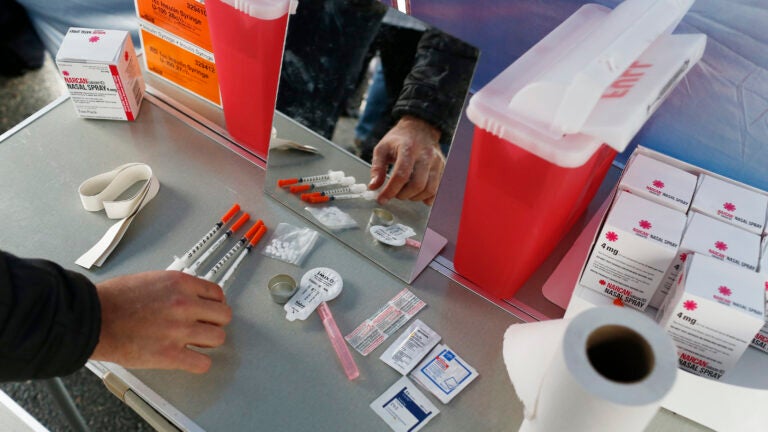
For three days this week, members of the public will get the chance to see what a supervised consumption site could look like in Massachusetts.
Related Links
A model of the sites, where people struggling with addiction could inject drugs under medical supervision, will be on display at the MGH Charlestown HealthCare Center on Wednesday, Thursday, and Friday.
Dr. Mark Eisenberg, a primary care physician at the health center, said the mock-up of a booth at a supervised consumption facility will feature a tent with a table of sterile injection equipment and a mirror.
He said the goal of the display is to “demystify” the sites for the public and emphasize that they are locations where people who are using drugs can inject in sterile conditions under medical supervision.
“Rather than the current condition, where they’re injecting in the bathroom of a fast food restaurant or in an alleyway or in a street where they can’t wash their hands, they have don’t have access to clean water, they’re perhaps reusing or re-sharing equipment,” he told Boston.com. “All the things that put people at risk for getting HIV, Hep C, endocarditis — as well, of course, as overdosing.”
There will be no demonstrations or simulations — it’s just to show the public what such a site could look like. A panel will also be held to discuss the sites from 5 to 7 p.m. on Thursday. Panelists will include Eisenberg, Tehya Johnson, a nurse practitioner student at the Institute of Health Professions at MGH, Michael “Smokey” Cain, who lost a child to an overdose, and Aubri Esters from the Boston Users Union.
The model site has been touring throughout Boston over the last few years, organized by the group SIFMA NOW, of which Eisenberg is an active member. Stops have included Harvard Medical School and Northeastern University.
Eisenberg said he got involved with advocating for the consumption sites because of his professional work and his patients.
“We have a wonderful addiction program at the health center where I work,” he said. “We prescribe all the medications that are available for addiction, we have a recovery coach, we have a full-time addiction nurse, we have a group of social workers. We have a lot of supports around our patients — but despite that, it’s just not always enough. I’ve had patients who’ve had this wonderful team around them and have been on medication but even despite that have a slip, and that slip has often been fatal.”
The opioid crisis — and the push for the supervised injection facilities — is personal for him.
“I’ve just lost so many patients to needless overdose deaths that if they had gone to a place and been under supervision of people who had Narcan they wouldn’t have died that day,” the doctor said. “They’d still be with us.”
“I have a lot at stake here,” he added. “I’ve just lost too many patients and I’m tired of this happening.”
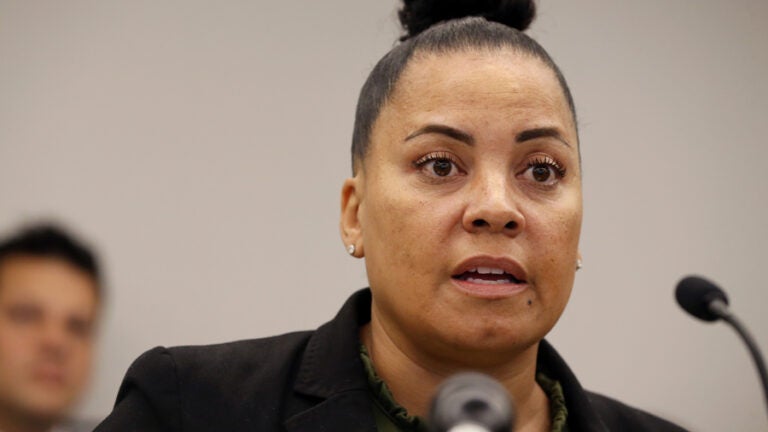
The physician said the topic of safe injection facilities appears to have gained attention in Massachusetts in recent weeks, with the ruling by a federal judge in favor of a nonprofit that wants to open such a site in Philadelphia. Locally, Somerville Mayor Joe Curtatone has said a safe injection site will open next year in his city, and last week, Suffolk District Attorney Rachael Rollins urged the state Legislature to institute a pilot program for the sites.
Gov. Charlie Baker says he is opposed to the sites, and U.S. Attorney Andrew Lelling has said any efforts to open the facilities in Massachusetts will be met with prosecution.
Eisenberg emphasized that the facilities are just “one tool in the toolbox” for battling the opioid crisis. He said he hopes the governor and U.S. attorney take note of the growing momentum around the issue.
“This is not going to be the answer to our overdose epidemic,” he said. “It’s just something in addition, it’s not instead of. We need more treatment, we need more doctors and nurse practitioners prescribing buprenorphine. We need better housing for the homeless population, we need jobs that pay a living wage. There’s lots of interventions that are necessary and this is just one additional one.”
But it is a method that the state can’t afford to push off, he said.
“We first began this process two years ago, and since the time we first testified in front of the Legislature, 4,000 more people have died,” the physician said. “Every day, five people die in Massachusetts. So I just can’t see why we should be delaying when this is a scientifically-proven intervention that’s been shown to save lives.”
The public can view the model at the Charlestown health center on Wednesday and Friday between 9 a.m. and 12 p.m. and then again between 1 p.m. and 5 p.m. On Thursday, it can be viewed between 1 p.m. and 5 p.m.


To comment, please create a screen name in your profile
To comment, please verify your email address
Conversation
This discussion has ended. Please join elsewhere on Boston.com