In death sentence appeal, Dzhokhar Tsarnaev’s lawyers argue his trial in Boston was unfair. Here’s what to know.
"Jahar Tsarnaev was tried in a community still suffering from his crimes."
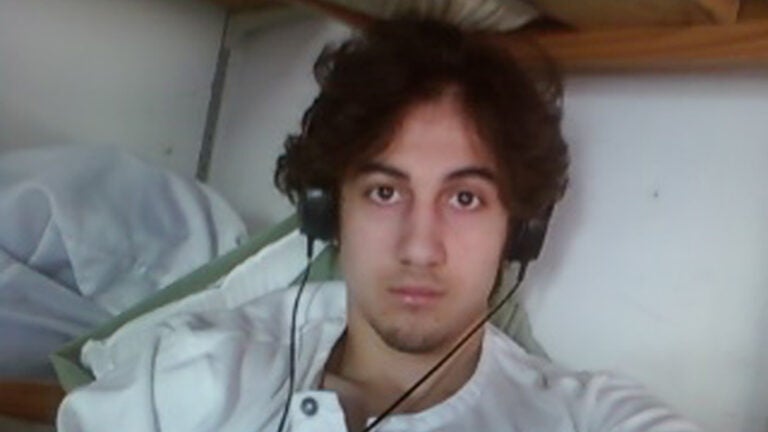
A 200-plus-page court filing in Dzhokhar Tsarnaev’s death sentence appeal argues the Boston Marathon bomber did not receive a fair trial because the city was still reeling from the well-publicized attack.
The massive briefing, filed Thursday in the U.S. First Circuit Court of Appeals, says the April 15, 2013 finish line bombings affected so many people in the region that Tsarnaev couldn’t have had a fair trial when the case was brought before a jury in Boston federal court two years later.
“Damning coverage of the bombings flooded newspapers, radio stations, and television programs in the Eastern Division of the District of Massachusetts,” Tsarnaev’s attorneys wrote. “Accounts of the victims’ terrible losses, the lockdown, and Tsarnaev’s arrest and confessions saturated the [potential jurors’] Facebook and Twitter feeds. So did the opinions of civic leaders, survivors, and ordinary people that Tsarnaev should die.”
Tsarnaev and his older brother, Tamerlan, set off the bombs that killed 8-year-old Martin Richard, of Dorchester; Krystle Campbell, 29, of Medford; and 23-year-old Boston University graduate student Lingzi Lu, from China. Over 260 people were injured.
Days later, the brothers murdered a Massachusetts Institute of Technology police officer, Sean Collier. Tamerlan was shot and killed by police in Watertown.
In 2014, Boston Police Sgt. Dennis Simmonds died after sustaining a head injury in the Watertown shootout.
Among over a dozen points raised in Thursday’s filing, defense attorneys say virtually everyone in the Greater Boston area knew of the incidents prior to Tsarnaev’s trial.
They say 99.7 percent of the people pooled for jury selection — included the 12 jurors — said they were aware of the case through publicity, 69 percent said they already believed Tsarnaev was guilty, and “only 4.88 percent could definitely say they had not already formed an opinion.”
Of that group, 21.63 percent said they had not yet decided whether Tsarnaev should be killed, according to the document.
“Not only were many of the victims from towns within the Eastern Division, but several lived in the very same neighborhoods and towns (Dorchester, Franklin, Malden) as seated jurors,” the appeal says. “The entire venire of the Eastern Division was affected.”
Tsarnaev’s lawyers also allege two jurors lied during the selection process, including the foreperson, who they say failed to tell officials she and her family sheltered in place in their Dorchester home while authorities were searching for Tsarnaev.
“Juror misconduct and judicial inaction tainted this verdict,” the attorneys wrote. “Asked if she had ‘commented on this case …. in an online comment or post,’ Juror 286, the foreperson, hid 22 Twitter posts in which she had mourned the victims, praised police officers who would testify at trial, and called Tsarnaev a ‘piece of garbage.'”
According to defense lawyers, the concerns were brought to the court before the jury was seated, “but the court undertook no investigation, declining to ask either juror a single follow-up question.”
During Tsarnaev’s May 2015 trial, the defense acknowledged he was one of the bombers, but asked the jury for a sentence of life imprisonment.
In Thursday’s filing, attorneys argue Tsarnaev’s death sentence should be thrown out and a new trial should be held elsewhere.
“Jahar Tsarnaev was tried in a community still suffering from his crimes,” they wrote.