3 ways the City Council is responding to fallout surrounding the ‘Straight Pride Parade’ protests
"I want to have a conversation that really gets at getting away from this 'us versus them,' which I see play out too often."
The Boston City Council is mulling over a proposal to ban masks and other face-concealing clothing in public places — a direct response to the clash between protesters and police at last month’s “Straight Pride Parade.”
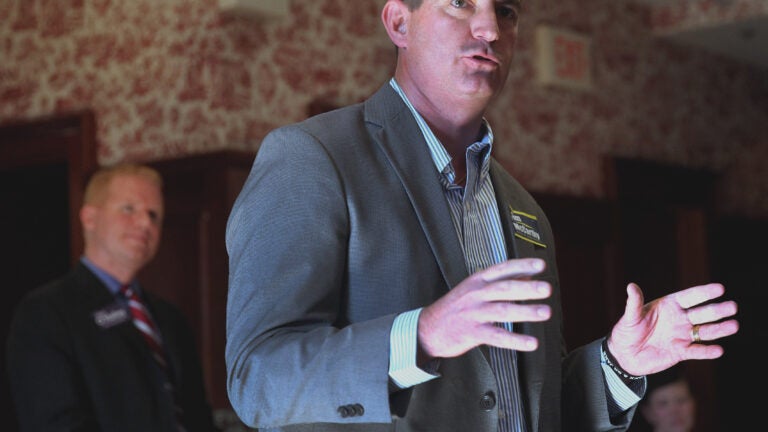
Councilor Tim McCarthy, presenting his request for a hearing on the idea Wednesday, swiftly rejected the notion such a regulation would infringe on free speech rights.
The measure, instead, would further protect public safety and law enforcement officials against demonstrators determined to create havoc with authorities, he said.
“That’s what this ordinance is based on: The common sense legislation that people should not be allowed to do what happened last week,” McCarthy said. “That is not First Amendment speech. That is violence.”
It’s one of a handful of actions the council is pondering, as ramifications from the Aug. 31 parade ripple and raise questions from city leaders about policing tactics and the public permitting process, among other factors.
Here’s what the council discussed this week:
Officials would seek certain exemptions under the potential mask ban
Of the 36 people arrested at the “Straight Pride Parade,” most faced charges such as disorderly conduct and resisting arrest; however, nine were charged with assaulting officers.
Four police officers suffered nonlife-threatening injuries, authorities said. Hundreds of officers were reportedly on the scene.
“Many protesters came from outside of Boston and many wore masks disguising their faces,” McCarthy’s hearing request reads. “These protesters were not in Boston for a peaceful comment on a certain parade, they were here to cause violence, they were here to attack Boston Police Officers, attack the City of Boston itself.”
The request points to a Boston Herald report of the confrontations that quotes a member of Antifa, the anti-fascist protest movement.
“We’re covered in black so when we attack these guys we can’t be prosecuted,” Jon Crowley, an Antifa member, told the Herald.
Crowley said “he felt violence was the only way to deal with the people marching in the parade,” the newspaper wrote.
“They were fascists, 100 percent,” Crowley said. “How else are you going to get them to shut up?”
Prosecutors opted to dismiss cases against protesters facing nonviolent charges — a move that led to last week’s legal tug-of-war between Suffolk County District Attorney Rachael Rollins and Boston Municipal Court Judge Richard Sinnott, who repeatedly rejected the requests in court.
The Supreme Judicial Court sided with Rollins’s office Monday.
Rollins has said her office will continue to prosecute people charged with violent crimes, including those accused of assaulting police.

Anti-parade demonstrators protest during the “Straight Pride Parade” on Aug. 31.
“My personal opinion is that the mask emboldens people to do things that they probably wouldn’t do if they didn’t have that mask on,” McCarthy told reporters after Wednesday’s council meeting. “Also, when you have people, four or five people deep, it’s easy to throw a D battery at a police officer and put your head down behind other people and disappear into the crowd, and that’s what was going on with this protest.”
McCarthy’s request offers that several states have laws “governing the wearing of [masks] or face coverings.” More specifically, it cites a Virginia state law that prohibits anyone over the age of 16 from wearing a mask, hood, or “any device whereby a substantial portion of the face is hidden or covered” in an effort to conceal their identity on public property.
If such a cover-up is worn on private property, the wearer must receive written permission from the property’s owner, the law says. Exemptions include holiday costumes, workers wearing professional equipment, performers in theatrical productions, and masks worn for medical reasons.
McCarthy said the council would seek similar exemptions.
“I had one person ridiculously say to me, ‘What about Tuukka (Rask) masks for the Bruins? Are you going to take his mask away?'” he said. “Let’s not get silly.”
Some of the nation’s oldest laws prohibiting public face hiding date to the mid-1800s in New York’s Hudson Valley, where tenant farmers disguised themselves as Native Americans in an uproar against law enforcement over lease fees.
This kind of legislation gained momentum and popularity after the rise of the Ku Klux Klan, the white supremacist group whose members act in the shroud of their white hoods.
While McCarthy and others have argued a local ban would hold under the First Amendment, Jack Beermann, a Boston University law professor and civil rights litigation scholar, said the legality of the proposal may not be so clear cut.
“There is very little law on whether this violates the First Amendment,” Beermann told Boston.com. “Normally, it would violate the First Amendment to tell people what clothing to wear.”
Beermann pointed to the U.S. Supreme Court’s 1958 ruling in NAACP v. Alabama, which determined that the organization did not have to release its membership rolls because of its fears members could be harassed and therefore their right to freedom of association would be compromised. The exemption to the law depends upon whether the government can provide a “compelling state interest.”
“I think you could say the same of this (case), that (the ordinance) would be a serious enough hinderance of people’s right to protest,” Beermann said, adding though that with little case law on the issue, he thinks it’s hard to predict which way such an ordinance would fall.
Councilor Josh Zakim said if the council is going to consider a mask ban, it must do so thoughtfully. Officials must consider exemptions for health-related and religious attire, he said.
He cautioned, however, that he does not believe discussing and framing the proposal as a direct response to the parade protest is the appropriate context for the conversation as citywide tensions remain.
It’s a difficult conversation to have, especially with the city’s own history of masked protests dating back to the Boston Tea Party, Zakim said.
“I’m of the opinion that carefully considered, carefully drafted, and I think outside the context of reacting to one specific event, this is something that this body can and maybe should consider,” he said.
The proposal was sent to the Committee on Public Safety and Criminal Justice for a hearing.
A proposed resolution declaring support for police has divided the council
The aftermath of the parade has sparked debate over police tactics and whether the strategy taken by the department to handle crowds exacerbated the tension and quarrels with protesters.
Last week, Councilor Michelle Wu questioned why so many officers were needed at the parade and were equipped with riot gear, arguing the videos and feedback she’s received “reinforces why militarization of police is harmful.”
Boston Police Commissioner William Gross defended his department Monday, saying in a statement, “I could not be more proud or impressed with the high levels of restraint and professionalism displayed by my officers tasked with safeguarding and protecting all who either attended, participated or protested at the parade.”
On Wednesday, Councilor Althea Garrison pushed for councilors to go on the record by signing a resolution to offer their “unwavering support” for the department and the Boston Police Patrolmen’s Association.
The measure, which said officers feel unfairly criticized for doing their jobs, sought to “unequivocally condemn any and all violence and disrespect towards Boston Police Officers.”
“While freedom of speech and right to peacefully protest must always be respected, committing the crime of assault against Boston police officers must not be tolerated,” Garrison said.

— Boston City Council
Councilor Lydia Edwards, citing her own family’s service in law enforcement, said that although she strongly supports local police, she could not support the resolution.
“I don’t believe it’s actually intended to support the police,” Edwards said. “I think it’s intended to support a political agenda and to kick those who were protesting or (who) call or hold the police accountable, to make them really the perpetrators.”
Wu also raised objections and requested the resolution go to a public hearing.
The matter was sent to committee review.
“All of us who are elected officials … do have to recognize that the LGBTQ community in particular has a history with conflicts with law enforcement, with police violence,” Wu said. “And that’s not about our day-to-day interactions in Boston throughout the year. It is a history that we all have to be aware of.”
Others, however, came to the defense of law enforcement.
“The police aren’t taking a stance out there on the streets. They’re there to protect us,” Councilor Frank Baker said. “And I wonder when is it OK to do things like yell in your face? I mean … we go to meetings and we have verbal fecal matter thrown at us all the time. These guys (the police), literally, bottles of urine thrown at them. When is that not OK?”
A hearing on police tactics and conduct will be held

Boston police officers use pepper spray on anti-parade demonstrators during the “Straight Pride Parade.”
Councilor Kim Janey wants the council to have a better understanding of Boston police protocol around handling large crowds.
During the parade protests, police deployed pepper spray and riot gear.
“We need to make sure that everyone is safe, that our officers are equipped to do their job and have the appropriate training, and that protesters are not coming with ill will toward police officers or toward others — that when we talk about peaceful protest that it is in fact peaceful protest,” Janey said. “And so I as a councilor … really want to understand what the protocols are when dealing with large crowds.”
Janey believes there is opportunity to have a deeper discussion about how law enforcement builds trust in the community, she said.
She filed a hearing request that was sent to committee review.
“I want to have a conversation that really gets at getting away from this ‘us versus them,’ which I see play out too often,” Janey said.