This time, the road to New Hampshire might run through Iowa
Nineteen presidential candidates are scheduled to speak Saturday.
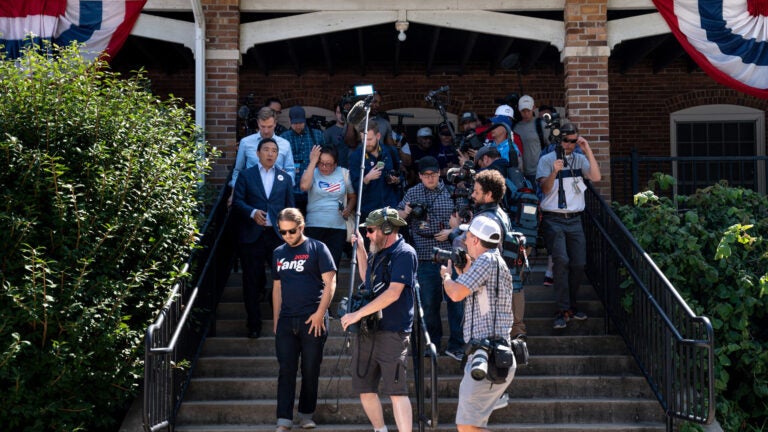
The New Hampshire Democratic Party’s convention on Saturday will feature the largest gathering of presidential candidates appearing on the same stage in state history.
Nineteen candidates — mayors, representatives, senators, businessmen, a governor, and a spiritual guru — are scheduled to speak inside a 12,000-person arena. While there, they might ask what exactly they need to do to win the state’s first-in-the-nation primary in February.
Traditional answers — showing up early and often, wooing local activists, and buying television advertising — still apply. But this year, there is a growing belief that the path to winning New Hampshire might actually involve doing well somewhere else: Iowa, which is expected to hold its caucus eight days before the New Hampshire primary.
This is especially true for the frontrunners: former vice president Joe Biden and Senators Elizabeth Warren of Massachusetts and Bernie Sanders of Vermont.
And it’s a dynamic quite different from the past, when Iowa and New Hampshire voters have generally gone in different directions.
“I think it is going to be very hard for all three of these candidates to come into New Hampshire with a full head of steam,’’ said New Hampshire Democratic Party chairman Ray Buckley. “At least one of them is not going to fare well in Iowa, and that is going to directly impact their chances in New Hampshire.’’
Biden never survived past the Iowa caucuses in his previous two runs for president. And for a campaign that is based on electability, losing Iowa could puncture his frontrunner status in a way that would make a New Hampshire comeback unlikely. And while many campaign analysts and donors believe New Hampshire will make or break Warren and Sanders, the way one could get a leg up is to best the other in the Iowa.
The campaigning so far this year has already reflected this reality. The campaigns are spending more time in Iowa than in New Hampshire. They have more staff there, and seven candidates are running television ads in Iowa, compared to one, businessman Tom Steyer, in New Hampshire.
To be sure, since 1972 when Iowa was placed ahead of New Hampshire on the presidential primary calendar, candidates who have fared well in Iowa have used momentum to buoy their campaigns back in New England.
But more often than not New Hampshire picked someone else for president. After George H.W. Bush won the 1980 Iowa caucuses, he declared he had “the big mo’’ — but then Ronald Reagan won the New Hampshire primary and eventually the Republican nomination and the presidency.
The two early states have split their votes ever since, with just two exceptions: Democrats Al Gore in 2000 and John Kerry in 2004, who swept both states. No Republican has won both Iowa and New Hampshire in a competitive primary season.
But this time around, with such a large field, and with Democratic voters emphasizing electability, the notion of a candidate winning both states and quickly becoming the Democratic nominee is more likely than in past cycles.
This is especially concerning to those who support Biden, whose has long found his best early state is South Carolina, the fourth state to vote in the process.
Worried that Biden might not even make it to South Carolina if another candidate runs through the early states, the International Association of Firefighters, the first union to back Biden, will spend at least three weeks camped out in Iowa ahead of the vote there.
“Iowa is nothing less than huge,’’ said Harold Schaitberger, the union’s longtime president general, who concedes Biden might be at a disadvantage in New Hampshire against local candidates Warren and Sanders and need to put a win on the board. “We are going to be entirely focused on Iowa and doing what needs to be done, hoping that gives him a strong finish in New Hampshire.’’
As for Warren and Sanders, while New Hampshire is a must-win, they might be looking to Iowa to settle the New Hampshire grudge match.
“Both Warren and Sanders are evenly matched in New Hampshire and both know they need to win the state to survive, so I can see how they both are looking at Iowa as to how they are break their stalemate and get an advantage,’’ said University of New Hampshire professor Dante Scala.
Indeed, both are heavily invested in Iowa. Sanders narrowly lost Iowa in 2016 to Hillary Clinton and still has the largest network of staff and volunteers there. Warren, meanwhile, has one of largest staffs in the state and visits there nearly as often as she goes to New Hampshire, which is a short jaunt from her home in Cambridge.
That said, former New Hampshire Democratic Party chairman Joe Keefe is skeptical about the success of a New Hampshire-win-via-Iowa strategy in 2020.
“Sure, if a candidate can win both, that will be hard for anyone else to overcome,’’ said Keefe, who is backing Senator Kamala Harris of California. “But an Iowa caucus voter is just different from the wide New Hampshire electorate made up of both Democrats and independents and probably more focused on electability.’’
However, Keefe and others all said that while Iowa could shift the playing field among the top tier of Democratic candidates, for the 15 or so other candidates it might be Iowa or bust.
“Given that only five or six candidates will even be able to continue their campaigns after Iowa, I think the most interesting thing to watch in the months ahead will be whether more of the minor candidates just shift to spend the majority of their time in Iowa as opposed to being 50-50 with New Hampshire,’’ said Scala.