An ambitious swim from Nantucket to Martha’s Vineyard came up short — but only in the water
"There were places where it just felt like we were swimming through jellyfish soup."
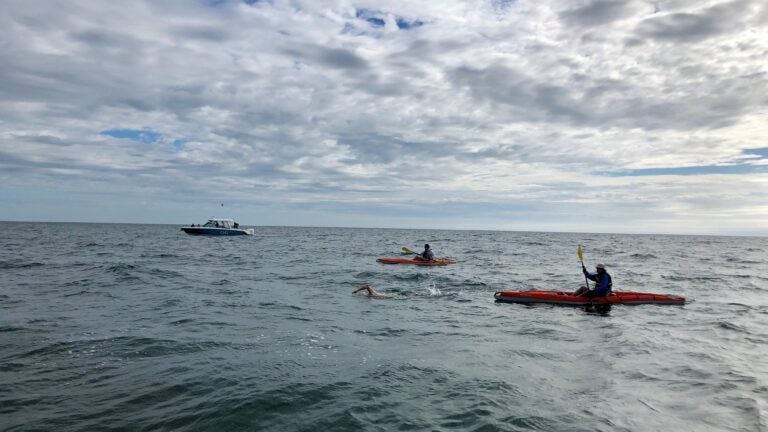
Doug McConnell could see the shore.
He could even make out the cars and trucks on Chappaquiddick Island.
Yes, the finish was in sight.
But a large rip current loomed, even after a full day of trudging through heaps of jellyfish, and managing shifting winds, not to mention the sharks — the kinds of challenges a veteran marathon swimmer like the 61-year-old Illinois resident knows well.
Still, every swim is different.
Traversing the current would have been treacherous for the two motorboats and kayaks carrying McConnell’s support team in tow. Jeopardizing the safety of those onboard was too big a risk to take.
And so ended his effort to swim to Martha’s Vineyard from Nantucket, where McConnell and his team had booked it out of Eel Point that morning, some seven hours earlier.
“According to the GPS, we were three tenths of a mile from the beach,” McConnell told Boston.com Thursday, the day after his swim. “It got me close enough to tell what model trucks were on the beach. We couldn’t quite read the license plates, but we very well could identify the trucks.”
Is he disappointed? Sure.
“I think everybody who’s even a little bit competitive wants to finish the race,” he said.
But McConnell’s swim was in no way a wash.
His journey across Nantucket Sound has so far brought in approximately $80,000 for A Long Swim, the nonprofit McConnell’s family launched to raise money for amyotrophic lateral sclerosis, or ALS, research — the disease that took the lives of both his father, David, in 2006 and his sister, Ellen McConnell Blakeman, last year.
A play on the ALS acronym, McConnell’s sister coined the phrase and co-founded the group, with McConnell, in 2011.
And since then, McConnell, an avid swimmer since childhood, has literally turned himself into the vehicle behind the rising tide of cash the organization has brought in: roughly $600,000 within the last decade.
An investment banker by trade, McConnell swam the English Channel in 14 hours back in 2011, and, three years later, he circled Manhattan island — two of several, marathon endeavors he’s taken over the years in hopes of propelling scientists closer to a cure.
“ALS is a neurodegenerative disease where the patient gradually loses their ability to move their muscles to the point where they even lose the ability to literally draw a breath,” he said. “Of course for swimming, you need to use all your muscles all the time. So we thought it was a real good contrast there.
“And I think it’s resonated with people,” McConnell added. “We’ve been extraordinarily lucky with fundraising.”

Doug McConnell, third from right, with his family after Wednesday’s swim.
While McConnell hails from Barrington, Illinois, a suburb about 30 miles outside Chicago, the father of four and his family have been spending their summers on Martha’s Vineyard for years.
“It’s a very dear place to us and so we thought it would fun to do some kind of an open water, marathon swim on the Vineyard,” he said.
McConnell would not be the first to swim the sound, however. Deb Taylor Blair and James Pittar were the first to swim from Chappaquiddick to Nantucket — the opposite direction of McConnell’s route — in 2000.
“Deb was just an extraordinary resource to us as we started to plan and plot charts and maps because, again, no one had ever done this one, and the two swims are very different because of the way the tidal currents move,” McConnell said.
But while sharks have swarmed around Cape Cod and the islands this summer — perhaps unbelievably to some — McConnell was not worried.
Strapped to one of his ankles was a device created by E-Shark Force that emits an “electrical impulse” to jam signals sharks use to hunt their prey without harming the creatures, he said.
The bracelet is designed to keep the ocean predators at a 50-foot distance from its user, according to McConnell.
“Frankly I didn’t really think about it,” he said. “I put a lot of reliance in this device, and it’s worked for us before. It’s just one thing I could take out of my mental checklist.”
Around 7:20 a.m. Wednesday, McConnell and his team — which includes his adult children and his wife and team captain, Susan — set out from Nantucket with plans to make it across the water, around Cape Poge, and into Edgartown Harbor — an 18-mile trek in total.
While the first couple of hours brought ideal, calm conditions, significantly strong currents came into play once McConnell made it past Muskeget Island and into the channel, he said.
“As luck would have it, we were progressing faster than we expected, so the first part of that tidal flow hit us much later than expected,” he said. “It swept us way south instead of continuing to head northwest to the point that it looked like we were headed towards the Atlantic Ocean.”

-A Long Swim
The crew decided to set its sights on landing on Chappaquiddick’s eastern shore instead.
McConnell, after all, had also been battling another force: jellyfish.
Their stings were all over his forearms, legs, and — close to the end — his face, he said. He’s also allergic. (McConnell prepared beforehand with medication.)
“I’ve been stung by jellyfish any number of times, but, boy, there were places where it just felt like we were swimming through jellyfish soup,” he said.
“I was pretty itchy … and it just makes you tired,” he added.
Just as he could see the beaches of the island, though, a rip current prompted the team to pack it in, according to McConnell.
“It’s one (thing) to put a swimmer in there. It’s another one to have a kayak follow you or a motor boat that has a bunch of people on it,” he said. “So we thought that just in the interest of keeping the greatest number of people safe, we probably ought to pull the plug.”
Even so, McConnell anticipates the endeavor, which is still bringing in donations for A Long Swim, will probably see a fundraising sum of over $100,000, all for ALS research.
While he may have come up a fraction of a mile from the finish line, it’s clear McConnell is grateful for the journey.
“I feel so fortunate to be able to do this. …. At 61 years old, I haven’t been injured. I still love it. I love the training, and so forth, and I love the challenge,” he said.
“I think back to how my father and my sister, who were very robust physically, and strong, and great athletes, wasted away to the point they couldn’t even feed themselves,” he added. “And the fact that I’m able to do this and continue to do this, it’s a real gift.”