Boston wants to rebuild this downtown bridge to the Seaport. The question is how.
Here's a look at the four potential concepts the city is considering.
Nearly everyone wants to rebuild the Northern Avenue Bridge. The hard part is deciding how exactly to do it.
The aging but beloved swing bridge — connecting downtown Boston with the booming Seaport district since 1908 — was closed to vehicles in 1997, before it was closed to everyone over safety concerns in 2014. Since the Coast Guard warned in 2015 that the decrepit, rusting steel span could collapse into the Fort Point Channel, it has been left in the open position, languishing in disrepair in view of the cars and pedestrians crossing the busy Moakley Bridge.
However, last year the City of Boston launched an effort to reconstruct the Northern Avenue Bridge and proposals for its replacement are beginning to take shape.
The project has opened a vigorous, if at times heated, debate among elected officials, transportation advocates, historic preservationists, and Seaport residents and commuters about how the bridge should support the rapidly developing Seaport district and who would be able to use it. While some, including Mayor Marty Walsh, say the bridge needs to carry vehicles in at least some capacity to relieve rush-hour congestion, others say the city would be better served with a pedestrian-and-bike-only span. Attendees at the community meeting on the project Monday night came armed with several dozen paper “People First” signs and ominous warnings of “induced demand.”

Chris Osgood, the mayor’s chief of streets, says the public feedback has been “invaluable,” even if the final say rests with city officials. And as much as functionality is a priority, Osgood says they can’t ignore how their decisions will affect the bridge’s intimacy and the connections people make with it.
“A lot of what our architect is actually looking for is almost that emotional response,” he told Boston.com. “Functional is really critical for us, but as too is understanding what type of feeling do we want this bridge to evoke.”
The project’s leaders are currently focused on the new bridge’s general design and width — two points of feedback that will have a big impact on both the functional and emotional fronts, as well as the total cost of the project. Depending on the direction they choose, city officials say the reconstruction efforts could cost anywhere between $40 million and $150 million.
The most costly of the directions — and the one preferred by preservationists — would be to raise and restore the historic 64-foot-wide structure. Officials say it would cost upwards of $150 million.
Three other design options were presented to the public Monday, all of which could range from 12 to 56 feet in width and $40 million to $110 million in price. Wider versions of each of the concepts would allow for more potential uses, such as emergency vehicle access to and from the Seaport (and the bridge-adjacent Moakley federal courthouse); a one-way bus or vehicle lane; or even room for retail or event space on the bridge and the island pavilion it traverses.
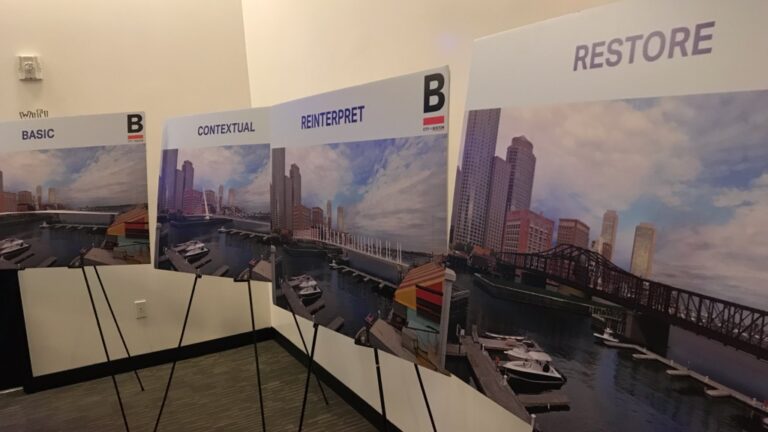
The “reinterpret” replacement bridge concept would marry the desire to pay tribute to the historic truss bridge with the Seaport’s more contemporary style. The “contextual” design, meanwhile, would effectively move on from the feel of the Northern Avenue Bridge in favor of a hybrid suspension-cable stayed bridge that would evoke the sails of the tall ships and sailboats in Boston Harbor. Finally, the cheapest alternative would be a “basic” girder bridge that, while it could include some stylish aspects, would look similar to the less inventive but practical Moakley Bridge.
Here’s a look at the four preliminary concepts. The city is accepting public comment on the design options through June 20.
1. Restore

2. Reinterpret

3. Contextual

4. Basic