‘We cannot squander this moment’: 5 key quotes from Anita Hill’s graduation speech at Wellesley College
"I am here because in 1991, under the glare of intense political scrutiny and media scrutiny, I shared more of the whole of what it’s like to be a woman, to be black, and to be a black woman facing sexual harassment."
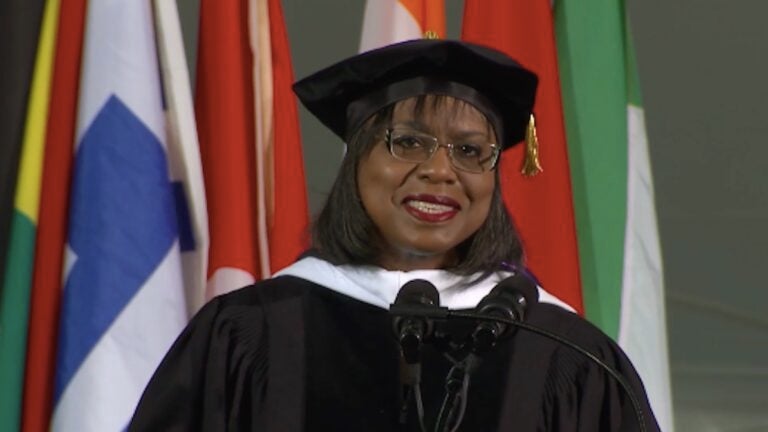
Anita Hill stressed the importance of harnessing the power of #MeToo and using it to its full potential during a powerful commencement address Friday to the Wellesley College class of 2019.
“We cannot squander this moment,” the Brandeis College professor, who The Washington Post called a “leading face of the #MeToo movement,” told the 571 graduates.
Here are five key quotes from Hill’s remarks:
1. ‘More hate is not the answer.’
Hill told graduates that no matter where they go, she recommends they engage in inclusive lives.
“Even as we’ve seen hate crimes rise, more hate is not the answer. No matter where you live or work or go to school, for those of you who are continuing your education, you can always make the choice to engage in inclusion,” Hill said. “It is a choice that you have, and it is one that I urge. Just as you must reject isolationism, you must also resist cynicism in these troubling times. Taking stock of the world today, I know that you are going to — at some times — be disheartened. In my work, I get discouraged, but when I take the long view, I see not only how far we have to go, I also see how far we’ve come.”
2. ‘We still have lots of work to do.’
As Hill witnessed the social upheavals of the 1960s and 1970s, she thought sexism, inequality, and poverty could finally be defeated, but she said progress didn’t move as quickly as she’d hoped.
“Well, we still have lots of work to do, and what I once thought was a sprint to equality has turned out not to be so. I no longer even think it is a marathon. I now see it as a relay, and I now see that the baton that will point the way to social justice must be passed from generation to generation,” she said. “And it must continue no matter how long it takes us to reach our goal. As our understanding of what true equality means has expanded, we now know that my parents’ generation definition of equality and the tactics that worked in the 20th century must evolve to address the challenges of the 21st century.”
Hill described how in the past, the “touch points” of discrimination were thought to be race, gender, and poverty, but she said that list now includes sexual identity, gender identity, disability, class, age, and religion.
3. ‘Sex misconduct deniers have friends in high places.’
On “gender violence,” Hill said the statistics are high for women and non-binary people who have experienced it on college campuses. She said it’s also an issue for men — even though it happens less frequently — and in the military, too. “And yet there are those that would have us believe that the stories and statistics showing the prevalence of sexual misconduct are a hoax,” she said. “They prefer to believe in their own myths, often misogynous about the behavior. And despite the evidence, sex misconduct deniers have friends in high places. … One high-profile pundit criticized campus assault policies as the invention of progressive feminists to promote victimhood as a coveted status. And deniers and enablers — we know from the news — include boards, corporate leaders, and attorneys who engage in symbolic compliance and refuse to reform the cultures and structures that support sexual harassment, abuse, and exploitation in their own institutions when they know they exist.”Hill noted that it’s the behavior coupled with those who allow it to happen that’s the problem.“But we are fortunate, we outnumber them,” she said. “We are louder than they are, are we? And we are ready to take them on.”
4. ‘We cannot squander this moment.’
It’s easy to become frustrated, Hill noted, when it comes to “disinformation” or those who deny sexual misconduct happens.“But here’s where we are today, and this is what I want you to remember: We cannot squander the powerful voices of the millions whose individual and collective voices have become known as the #MeToo movement,” she said. “We cannot squander this moment.”Hill detailed how the #MeToo movement not only endeavored to show how gender or economic class can affect whether a person is taken seriously, it also fueled conversations about the “dangerous notions” of masculinity.“By capturing the language and taking command of a stage that had been hostile to women’s voices — the internet — the movement allowed an unprecedented public conversation to happen,” Hill said. “For me, the movement became the bridge to what can become the policies and practice that eradicate gender violence once and for all. But our leaders must engage and respond by passing laws to protect against it, and to prevent it from happening.”
5. ‘I must never, ever give up my voice, and I will not.’
Hill didn’t mention her 1991 testimony against Clarence Thomas, then a Supreme Court nominee, until the very end of her address. She didn’t need to — her remarks showcased how that moment was just the beginning of her evolution of thought on how to take on gender discrimination in the workplace.
“… I am here because in 1991, under the glare of intense political scrutiny and media scrutiny, I shared more of the whole of what it’s like to be a woman, to be black, and to be a black woman facing sexual harassment,” she said. “Certainly more than my grandmother or mother could share, and more, unfortunately, than women, many women, and men, and people of all genders, can share today. Twenty-eight years later, I have the privilege to speak my mind freely, having found my voice. My ancestor stories remind me that I must never take it for granted, and that I must never abuse it. Today when I look to the future, I look to you and I am reminded by you that I must never, ever give up my voice, and I will not.”
Watch Hill’s full speech below: