
Maura Healey is not a fan of Martha Coakley’s new employer
"This announcement has no impact on our efforts to keep young people healthy and safe in Massachusetts.”
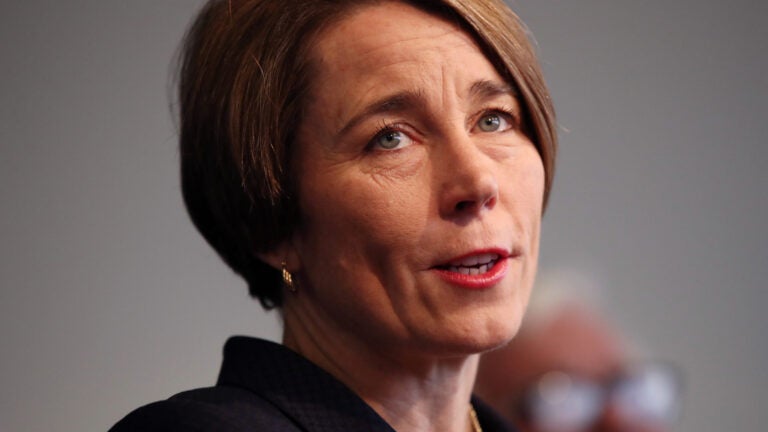
Martha Coakley has a new job, and it’s at a company her successor is investigating.
The former Massachusetts attorney general is joining the government affairs team at the e-cigarette giant Juul, the company confirmed Tuesday — just hours before the state’s current attorney general, Maura Healey, gave a speech about the dangers of their product.
“Juul accounts for two-thirds of the $2 billion e-cigarette market in the United States — they’re so popular that vaping is also known as ‘Juuling’ — and way too much of their product winds up in our schools,” Healey said at a forum Tuesday night in Newton about the vaping “health epidemic.”
“It’s a highly addictive product that shouldn’t be anywhere near the lungs or brains of a 12, 14, or 16-year-old child,” she said. “Worst of all, many of them have no idea that they’re taking any health risk at all — up to two-thirds think they are just vaping flavoring.”
Coakley — who called on the federal government to ban e-cigarette sales to minors in 2013 over similar concerns about the addictive effects of nicotine — may largely agree with those points. As Politico first reported Tuesday, the former prosecutor and Democratic gubernatorial and U.S. Senate nominee is joining Juul to bolster awareness about their efforts to combat youth usage and eliminate tobacco-laced combustible cigarettes.
Coakley had already been working as a consultant for Juul for several months while she was a partner at the Boston-based law firm Foley Hoag. But she will begin in-house work at the company in mid-April.
“JUUL has an incredible opportunity to switch adult smokers and I look forward to working with stakeholders from the private and public sectors as we fulfill that mission and prevent youth from ever using vapor products like JUUL,” Coakley said in a statement.
Juul has pitched itself as a safer alternative to smoked cigarettes, which remain the number one cause of preventable death in the United States. The company cites research showing that 47 percent of adult smokers will fully switch from combustible cigarettes after 90 days of using their tobacco-free products.
However, e-cigarettes and other vaping devices still do contain nicotine, a highly addictive drug that is derived from tobacco. And there’s rising concern about their appeal to teenagers, especially in Massachusetts.
“It turns out that a lot of vaping companies have pulled a page right out of the playbook from Big Tobacco: Get ’em hooked while they’re young,” Healey said Tuesday in Newton.
The Bay State attorney general launched a state investigation into Juul and other e-cigarette retailers last July over concerns about the marketing and availability of their products to minors, amid the recent dramatic rise in youth vaping. The Federal Drug Administration estimates that more than 28 percent of high school students used e-cigarettes on at least 20 or more days last year, an increase of 78 percent compared to 2017. Healey cited anecdotal estimates at local schools that were significantly higher.
According to Healey, one vape cartridge contains the same amount of nicotine as a pack of cigarettes. Singling out Juul’s sleek labeling and sweet-flavored pods, she said at the time that some of their products “seem targeted to get young people hooked on nicotine.”
Asked about her predecessor’s new job, Healey’s office said Tuesday that their investigation will proceed as usual.
“Juuling and vaping in schools has reached epidemic proportions, and our office will continue to investigate this company’s role in creating this health crisis,” Jillian Fennimore, a spokeswoman for the attorney general, told Boston.com. “This announcement has no impact on our efforts to keep young people healthy and safe in Massachusetts.”
The concern about youth vaping is one area where Healey, who is a Democrat, and Republican President Donald Trump’s administration — which is advancing new policies to reduce teenage usage — are in alignment.
In a Washington Post op-ed last month, FDA Commissioner Scott Gottlieb and Health and Human Services Secretary Alex Azar wrote that while e-cigarettes may be effective in switching adult smokers, there’s also evidence that “a young person who tries an e-cigarette is more likely to try a regular tobacco cigarette.”
According to a comprehensive report last year by the National Academies of Sciences, Engineering, and Medicine, the long-term net impact is still unclear. However, Gottlieb and Azar warned that if youth usage keeps rising this year, they may consider “more drastic regulatory action.” Gottlieb has reportedly even floated the idea of temporarily pulling all pod-based nicotine products off the market.
“Absent a reversal in the trends of youth e-cigarette use, we envision a world where the FDA will continue to narrow the off-ramp for adults seeking a less harmful alternative to combustible cigarettes, in order to close the on-ramp that has resulted in the widespread and increasingly frequent use of e-cigarettes by teens,” they wrote in the Post.
Juul, for its part, says it has already taken actions — and supports some additional government regulations — to reduce the number of teenagers using their products. In a piece responding to Gottlieb and Azar in the Post last week, Juul CEO Kevin Burns noted that the company has stopped selling flavored pods in retail stores, shut down its Facebook and Instagram accounts (which had come under fire for its advertising), strengthened their online age-verification process, and would crack down on retailers selling to customers under the age of 21.
Burns said the company also supports an industrywide ban on “kid-appealing flavors,” such as those that mimic candies or children’s foods. And while the national age minimum for buying e-cigarettes, like regular cigarettes, is 18, Burns said the company supported moves by states, like Massachusetts, to raise it to 21.
“We’ve led our industry in support of raising the minimum-purchasing age for all tobacco products, including vapor products, to 21,” he wrote. “Tobacco 21 laws fight one of the largest contributors to this problem — social sourcing by legal-age peers — and they have been shown to dramatically reduce teen-use rates.”
Still, Healey says she has serious questions for the company, including how they track underage use of their products and whether the increasing rates are an “intentional outcome of their own marketing.” Despite the state’s move last year that requires people be at least 21 to buy cigarettes, tobacco, or vaping products, Healey said Tuesday that e-cigarette use is now the “number one issue I hear about from parents and teachers in every community: urban, suburban, and rural.”
“I was in a middle school visiting with 20 students –12, 13 years old – and I asked them, ‘How many of you have a friend that vapes?'” she said. “Every hand went up.”


