What you need to know about the proposed changes to turkey hunting in Massachusetts
Officials say the updates don’t have anything to do with those “problem turkeys” haunting the streets of Boston’s suburbs.
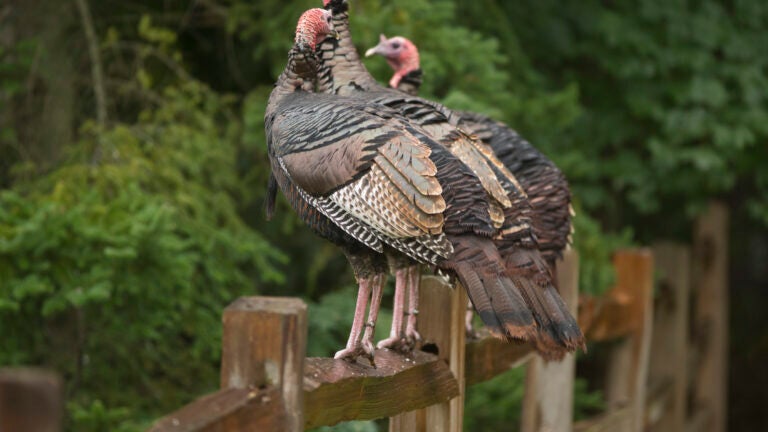
Hunters may soon be allowed to bag more turkeys in Massachusetts, but state officials caution that the updated regulations aren’t expected to help with the problem toms in your neighborhood.The state’s Division of Fisheries and Wildlife, or MassWildlife, announced the proposed changes on Friday. State wildlife biologist Dave Scarpitti said the updates are part of the department’s periodic review of hunting regulations and wildlife populations and they won’t impact the number of turkeys in suburban and urban areas. “I don’t expect to see any change in the number, unfortunately, the number of problem turkey situations that we encounter,” he told Boston.com. Below, three questions and answers about the proposed changes.
Why are the regulations being changed?
Turkeys, abundant during colonial times in the state, became extinct in Massachusetts in 1850. In 1972, wildlife officials worked to reintroduce the birds, starting with 37 animals. Now, officials estimate “conservatively” that there are between 30,000-35,000 turkeys across the state, making their presence known in virtually every Bay State community. Scarpitti said the state last made changes to the turkey hunting regulations in 2012. He said the new updates are largely “unrelated” to the abundance of turkeys in the state’s urban and suburban neighborhoods. “Turkeys are doing well, but they’re doing well everywhere,” he said. “And where all these problem turkeys are, those tend to be in areas where hunting is just not an option. They’re in very, very developed areas. So extending hunting regulations is not going to have any effect on the density of turkeys [in] the suburbs, in urban areas, where the majority of those problems exist.”

In this Sept. 27, 2017, photo, wild turkeys walk along a street in Brookline.
The only relation to the proposed changes is that state officials know that there is a “very robust population” of turkeys across the state.
“We wanted to take a look at that and see if there were other novel ways or opportunities for turkey hunting that we could expand upon for the sportsmen,” Scarpitti said.
What is being proposed?
To come up with the updates, Scarpitti said he and other officials went through an internal process to explore “every tangible option” that existed for expanding the duration of the hunting season and bag limits (the number of turkeys each permitted hunter can harvest).
“What we came up with is this series of regulations that we think will do a couple things,” he said. “They significantly enhance opportunities for youths, which has been a focus of our Youth Turkey Program for a couple of years, but through some of the current regulations we just weren’t providing as much opportunity as possible. So I think that was a significant component. Beyond that, all the other changes are just looking at trying to provide more opportunity where we think the opportunity exists.”
The state ended up with five proposed changes:
Hunters would be allowed to “bag” three turkeys each year, up from two.
Currently, hunters can choose between harvesting two turkeys in the spring, or one in the spring and one in the fall. The update would allow sportsmen and sportswomen to bag two bearded turkeys in the spring and another bird of either sex in the fall.
In the spring season, hunters could harvest two turkeys in one day, rather than the one currently allowed.
Scarpitti said this change will bring more consistency to the regulations since most the state already has a similar rule for deer hunting.
“We just didn’t see any reason to prohibit someone from being able to harvest a second turkey on that same day given that we allow them to harvest two during that spring season,” he said.
Expanding the fall season to allow hunters to harvest turkeys with archery equipment over six to eight weeks, up from a current two-week season.
The state has seen a surge in the popularity of archery hunting, according to Scarpitti, and officials found through speaking with hunters that most are bagging turkeys opportunistically while using archery equipment to deer hunt.
“That fall season is currently quite short,” Scarpitti said. “We have a two-week fall season where you can use shotgun or archery tackle. And so the proposed change would just allow archery hunters the entire archery deer season, which is, depending on where you are in the state, anywhere from six to eight weeks.”
Increase the Youth Day turkey hunting hours to a half hour before sunrise through 5 p.m.
The Youth Turkey Hunt Day, which typically has more than 250 participants, currently lasts from just a half hour before sunrise until noon on the Saturday before the last Monday in April.
Let youth with turkey hunting permits hunt during the fall season.
Currently, Youth Turkey Permits are only valid on the Youth Turkey Hunt Day and the rest of the spring season.
When will they go in effect?
 The state is holding two public meetings — on Feb. 7 in Westborough and Feb. 13 in Palmer — where Scarpitti will go over the proposed changes, gather feedback, and answer questions. “That’s not really part of the formal regulatory process, that’s just something that we want to do to get public involvement and feedback as much as we can,” Scarpitti said. If you can’t attend the meetings, feedback can be submitted in writing, either through the mail or an online form. Then the final recommendations for the changes will go to the state’s Fisheries and Wildlife board for approval. If confirmed, the updates would go in effect for the 2020 hunting seasons. Last year, about 3,000 turkeys were harvested during the hunting seasons in Massachusetts. “We expect more turkeys to be harvested, but certainly not in any great abundance that would be detrimental to the population,” Scarpitti said of the changes.