What’s it like being a clinic escort for Planned Parenthood? Meet Sue Fish, an experienced volunteer.
“I want to be a cheerful, welcoming presence that they see when they come around the corner."
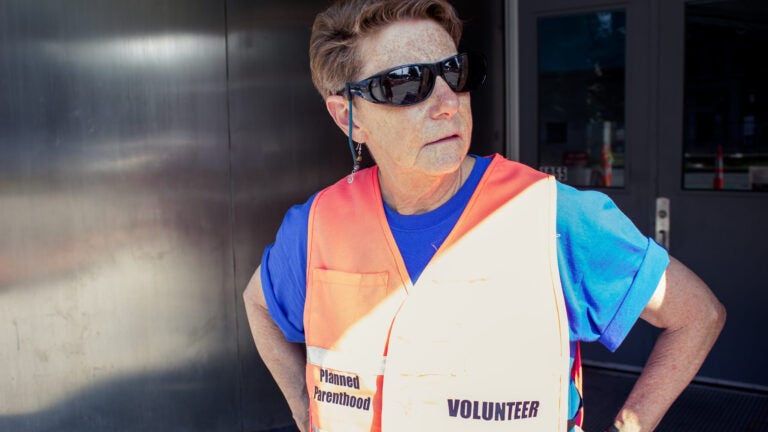
Sue Fish, an experienced clinic escort at the Greater Boston Health Center, first grabs a morning beverage — maybe a coffee or a water — and then checks herself in for her usual shift. Marked by her neon “volunteer” vest, she faces however many protesters will be accompanying her for the day — ranging from a few to a sea of them — and she doesn’t flinch.But there was one instance, just one, the 69-year-old recalled, in which she had to briefly excuse herself, step inside, and take a deep breath. While volunteering, she had made eye contact with a young boy sitting in the nearby Caffe Nero with his father. Soon, the pair began making friendly exchanges — waving at each other and playing hide-and-seek through the window.Within moments, things took a turn. “[The father] stopped to chat, and one of the protesters came over and started saying horrible things to him about that I ‘kill babies’ — and there was a child there,” Fish said. “I was so angry. Because this is a child. That’s not right.”Standing on the corner of Commonwealth Avenue and Alcorn Street in Allston is one of many Planned Parenthoods that, in recent years, have been reinforced as a key battleground in a war waged long before the birth of Roe v. Wade, the landmark 1973 decision legalizing a woman’s right to abortion.And positioned outside the entrance and exit to this center are volunteer clinic escorts like Fish, who are responsible for helping patients in and out of the building safely. On the morning of August 28, the city was in the midst of an oppressive, four-day heat wave. But, just as Fish and other escorts show up rain or shine, winter storm warning or heat advisory, the protesters, with literature and rosary beads in hand, also arrive like clockwork. Fish had short, cropped brown hair and was sporting an electric blue shirt, the bright peachy-pink vest emblazoned with the word “VOLUNTEER” on the back, and had paired her cuffed denim shorts with brown hiking sneakers. With temperatures set to reach 97 degrees that day — she donned black sunglasses, which she balanced with dangling peace-sign earrings. Her fair skin was sprinkled with freckles, and she often flashed a smile or cracked a joke — a means, she said, of releasing the tension and making those entering the center feel more comfortable.Working the shift alone, Fish stood no more than several yards from the protesters — one man and two women, “regulars,” she said — who repeated Catholic prayers like the “Our Father,” and encouraged incoming patients to seek alternative options, as opposed to receiving care from Planned Parenthood. That Tuesday was, however, what Fish would later describe as “mild,” referring to both the protesters’ targeting of patients and passersby, as well as the graphic nature of the signs, which said things like: “When they tell you that abortion is a matter just between a woman and her doctor … They’re forgetting someone.”

A protester outside of the Commonwealth Avenue clinic in 2014.
Even on days when signs depict “bloody dismembered pictures of fetuses” or compare the services offered by the clinic to the actions of ISIS, or when the language being directed at escorts and patients is particularly derogatory, Fish said the protesters are not her focus. After entering her “zen space” — a way to compartmentalize — her concern lies solely with making sure that patients and their companions can enter the building safely to access care.
“I want to be a cheerful, welcoming presence that they see when they come around the corner, and make sure that they are safe from the protesters,” she said. “By that I mean: safe from the harassment.”
And to do so, Fish actively watches for those heading in the direction of the clinic: making eye contact, offering to walk them in or out of the center and past the protesters, and engaging in carefree conversation about topics like the Red Sox — a team, she joked, she knows nothing about — to distract them.
As a 19-year-old college student, Fish dove headfirst into the widespread advocacy efforts that would later define the period. It was the season of protests — the age of the Vietnam War and Flower Power.
“When I was in college, it was before Roe v. Wade, and contraception was not legal. It was not legal to provide contraception to unmarried women,” she said. “Bill Baird was in Massachusetts trying to change the law so that contraception was available to unmarried women. It was the Vietnam War and Bill Baird. Vietnam War, Bill Baird. Back and forth.”
For 50 years now, Fish has continued to be politically active, and volunteers for a number of causes. At the Greater Boston Health Center, where she has been involved since the U.S. Supreme Court’s decision to revoke Massachusetts’s buffer-zone law in 2014, Fish devotes one morning every week to escorting patients, and also serves as a captain, which requires her to supervise other volunteers as well, one Saturday a month — the clinic’s busiest day.
“I’ve been told that I am burning in hell more times than I can count,” she said. “And that I am responsible for dead babies — I personally am responsible for dead babies. And that I have no respect for life. Whatever you want to think: Go ahead. I don’t care.”
Jennifer Childs-Roshak, president and CEO of the Planned Parenthood League of Massachusetts, said under the presidential administration of Donald Trump, the current political climate surrounding reproductive rights and other health issues has become especially “toxic.”
“What we know for sure, it’s been clear from the beginning that the Trump administration is out to reduce or eliminate various health care services in general, basically civil rights,” she said. “We’ve seen this nationally as well that, I think if the leader of your country is a bully and a liar and an anti-fact and anti-science person, people are emboldened to behave poorly enough.”
An overview of the buffer-zone law
Prior to 2014, reproductive health care centers throughout the state were protected by a 2007 law that established a 35-foot protest-free buffer zone, which was designed to prevent patients from experiencing the onslaught of harassment Fish described witnessing. There was also a sense of safety provided to escorts upon its passing. Since 1993, 11 individuals involved in reproductive health care have been murdered by anti-abortion protesters, including two at a pair of abortion clinics in Brookline — a result of a 1994 shooting attack that also left five injured.At the time, Massachusetts was only one of three states to have this “protected bubble zone” mandated. But in 2014, the U.S. Supreme Court’s ruling in McCullen v. Coakley determined that the law was too broad, and it was struck down. Within hours of the decision, Deval Patrick, who was governor at the time, signed into effect the Safe Access Law, which says that protesters cannot block access to the centers’ doors. There is a line marking the boundary outside the 1055 Commonwealth Ave. location.
“Before, they had to stay back. It created a cooling down point,” Childs-Roshak, who volunteers as an escort herself, said. “And now there’s no break. I would love a zone that offers protections.”
The majority of regulars, Fish said, are aware of the law and respect it — maybe pushing the envelope on occasion — but others, like the raucous and unexpected group from Florida that visited this past summer, ignore the mutually accepted standards completely, she said. When this happens, security guards — who are monitoring the situation at all times — step in.
“I know at least one of the protesters — because I recognize him — was around in those days,” she said. “After those clinic murders happened, there was a willingness for the sides to come together and try to figure out how everyone’s rights can be respected and that there won’t be violence because I don’t think anybody wants violence. These folks from out of town may not have been of the same mindset. But nobody wants the violence that occurred.”

The 35-foot protest-free buffer zone that was previously in place at the clinic.
The nomination of Judge Brett Kavanaugh to the U.S. Supreme Court — who has been championed by pro-lifers as the key to overturning Roe v. Wade — is “one of the latest in a long line of attacks from the Trump administration,” Childs-Roshak said. And while those involved in the right-to-life movement have been galvanized by the actions taken against — and threats to strip funding from — Planned Parenthood and women’s health services in general, she pointed out that over 70 percent of Americans support access to abortion.
In addition, Childs-Roshak emphasized, there is a lack of understanding surrounding the services offered by the health center, not only statewide but nationally. About 97 percent of the health care provided nationally is birth control, STI testing and treatment, contraception and other health services, cancer screening and prevention, gender hormone treatment — and around just three percent is abortion care. The country is at a 30-year low for teen pregnancy and abortion care, but she said this has gone unnoticed by the “anti-choice” movement.
“It’s not just Trump supporters, but sort of that extreme group of supporters or subset who are amplifying the incivility,” she said. “It’s explicit. Things like walking well beyond the entrance to try to confront people with literature, hurtful language. They are often very close to people and get right in people’s faces — calling people names and making stigmatizing comments.”
Blocking out this rhetoric has become second nature for many clinic escorts like Fish. But she cautioned that to be able to perform the job to task, you need a thick skin. Some protesters make a habit of targeting male escorts, those who are visibly pregnant, people of color, and newer volunteers who may not be as equipped to control their emotional response — all for the purpose of trying “to get under people’s skin,” she said.
“When they tell you, ‘You’re burning in hell for killing babies,’ you go, ‘Ha, yeah right.’ It rolls off your back,” she said. “And if you can’t move into that space — it’s the wrong job.”
While Trump’s presidency may have emboldened protesters, the clinic has also seen a tremendous wave of support, whether it’s passersby stopping to express gratitude or asking how they can become involved — to which Fish said she always directs them to Planned Parenthood’s website.
Shortly after the 2016 election, and on a Saturday — when the most aggressive of protesters crowd the sidewalk — Fish was prepared for a scene similar to the only episode that truly rattled her. It’s particularities echoed as an older man, looking “very determined,” walked straight toward her without hesitation.
To herself, she thought, “Oh, here we go. I’m going to get the rhetoric.”
But her stereotyping, which she labeled as “bad, bad, bad,” proved wrong.
“He handed me a $25 cashier’s check as a donation,” Fish said. “I was blown away.”
And she said it’s both these small acts of kindness and the particularly rough shifts that strengthen the bonds of the clinic escort community.
“Every political setback seems to bring out more volunteers and more young volunteers, which just warms my heart,” she said. “Because us old folks, we’re going to die off. There will always be protesters. And so you young people have to take over for us.”
The most fulfilling aspect of the job though, Fish said, is feeling like she has made a difference. And for as long as she can stay standing, she doesn’t plan on giving up the gig.
“At least once a shift you know that you’ve made it easier for a person — either coming in or going out,” she said. “But the best is when a patient says, ‘Oh, thank you so much. I don’t know that I could have done this without you.’ That’s really remarkable, and that’s what makes it worth it.”