This historic lion head was saved from demolition during Green Line construction in Somerville
The artifact will possibly be featured in the new Gilman Square in Somerville.
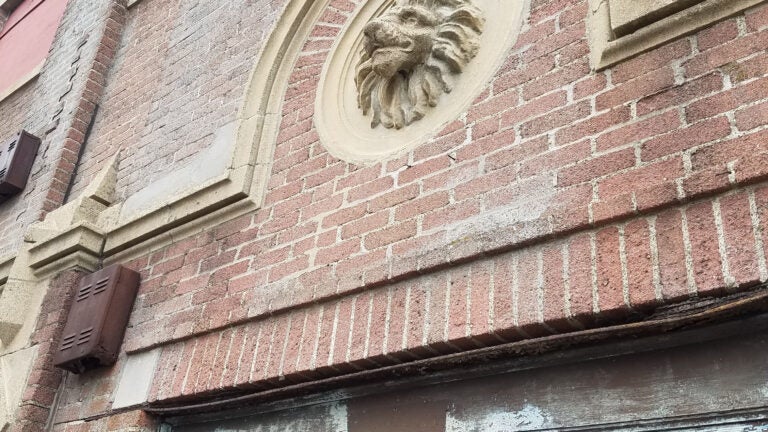
After quietly guarding the Homans Building for nearly a century, the lion head that graced the facade was recently removed and could become part of Somerville’s redesigned Gilman Square.
The lion’s move is part of the overall Green Line Extension project and a “commitment to historical preservation,” according to Lisa Battiston, a spokeswoman for the state Department of Transportation. The city’s Historic Commission oversaw the work.
Meanwhile, the Homans Building, located at 358 Medford St. behind Somerville High School, is slated for demolition next month to make way for the Gilman Square redesign — a new train station and park, according to plans presented by the city.
The entire process of moving the lion was documented by Above Summit, a Somerville-based video production company, via a 30-second time lapse.
There’s always something new and exciting happening with the #GreenLine extension project, and we have front row seats in Somerville. Our whole building is delighted #GLXConstruction was able to remove the 91-year-old lion head in one piece! @SomervilleCity @MBTA @JoeCurtatone pic.twitter.com/NUWZ0EmRok
— Above Summit (@AboveSummit) September 19, 2018
“It is currently in storage in a safe and secure location,” Somerville Mayor Joseph Curatone said on Twitter last week. “I have been informed that we are feeding it healthy foods.”
It is currently in storage in a safe and secure location. I have been informed that we are feeding it healthy foods 😉 https://t.co/dfldAvzJxn
— Joseph A. Curtatone (@JoeCurtatone) September 20, 2018
The building has been in the city’s hands since 1999 when it was purchased for $1.4 million, according to Curatone. At one time, it served as a warehouse for Reid, Murdoch & Co, a Chicago-based wholesale grocer, according to a Public Archaeology Lab report cited by the City of Somerville.
The City purchased the building in 1999 for $1.4M. https://t.co/kF9MbpUrUB
— Joseph A. Curtatone (@JoeCurtatone) September 20, 2018

Workers stand with mold of Homans Building lion head.
After demolition, the area where the Homans Building was will be used for “construction staging,” according to the Green Line Extension project website. When it’s finished — completion is slated for 2021, according to the MBTA — the project will bring train access to Somerville and Medford.
The area will then be home to the new Gilman Square T station and a park, according to Alan Bingham, chairman of the city’s Historic Preservation Commission.
Workers were also able to save other parts of the entranceway, like the columns, he said, noting that the building was “all art deco” style.
The city hasn’t determined yet where it will place the lion’s head, Bingham said. But two options for the lion and other elements include putting them in the park with information on the history of the site or working them into the new train station.
Before removal, workers made a cast of the lion’s face just in case something went wrong during removal, Battiston said. That mold will also go to the city.
While now in its final days of existence, hopping back in time nearly 100 years, the Homans Building was built by Reid, Murdoch & Co, according to The Boston Globe.
The year was 1929 when the building first opened its doors. The grocery company made Monarch food products — there was coffee, cocoa, and other kitchen staples packaged in colorful tins. In the middle of the packaging was an illustration of a lion, Monarch’s logo, according to the Made in Chicago Museum website.
“Several generations have now passed since the last of Monarch’s ‘Finer Foods’ were shipped out to retailers in the 1960s, and Reid-Murdoch’s once ubiquitous lion-head logo and kitchen cabinet cachet have been almost entirely forgotten in the process,” according to the site.

The Monarch lion logo.
The city used the building for storage for a time, according to Denise Taylor, the city’s director of communications and community relations. But the building wasn’t structurally sound and past plans to rehabilitate it were abandoned.
“The important thing is we’re preserving,” Bingham said of what could be saved from the site.

The lion head after it was removed from the side of the Homans Building.