DA, police at odds over Somerville detective’s fate
The detective and the drug dealer were looking for the same man.
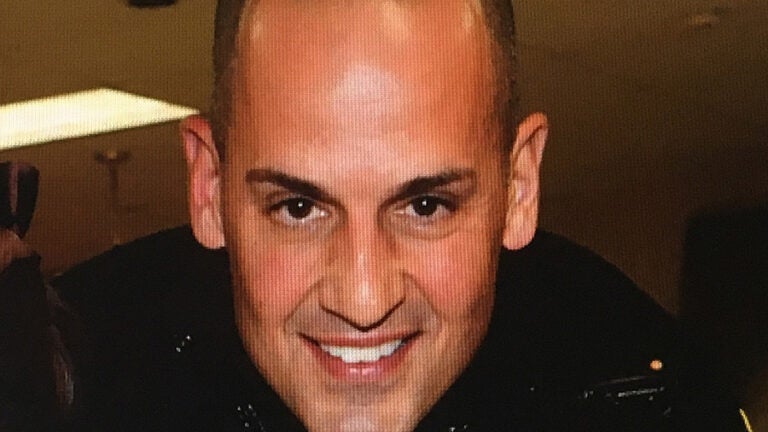
Somerville Police Detective Dante DiFronzo wanted to question the man about a home invasion.
The dealer, meanwhile, believed the man had stolen his marijuana, according to internal city documents.
On March 1, 2015, DiFronzo texted the dealer, Jonathan Machado, who was also one of his street sources, according to the documents. The detective gave Machado an address on Alston Street, and the following day Machado and an accomplice allegedly stormed into an Alston Street house armed with machetes, and confronted the man. He was stabbed eight times and left bleeding in his living room.
DiFronzo, a decorated officer in the Somerville department, would later say he instructed Machado not to hurt the victim, who survived the assault. But city Police Chief David R. Fallon said DiFronzo’s actions were tantamount to a crime and he should be fired, according to transcripts of a disciplinary hearing earlier this month.
The Middlesex District Attorney’s office, whose prosecutors learned of DiFronzo’s texts during the stabbing investigation and notified Somerville police, has refused to charge the detective — opening up an unusual rift between police and prosecutors.
The district attorney cited a conflict of interest in refusing to pursue charges. Attorney General Maura Healey has also declined to prosecute.
“The detective has numerous pending cases with this office and has had a close working relationship with many senior assistant district attorneys in Middlesex County,’’ First Assistant District Attorney Stephen Loughlin wrote in a March 2017 letter that referred the case to the state attorney general’s office.
To the dismay of city officials, prosecutors also refused the city’s request to testify at the detective’s disciplinary hearings, which stretched over four days between February and April.
“I’m in disbelief that they wouldn’t come and support us,’’ said Somerville Mayor Joseph Curtatone. “It was conduct that could shock the conscience of people. Someone almost died.’’
The behind-the-scenes dispute between the police hierarchy and prosecutors, typically allies in law enforcement, has raised questions about when it is appropriate for prosecutors to investigate officers in their own county.
Middlesex prosecutors in recent years have investigated several police-involved shootings in their jurisdiction, including the 2013 shootout in Watertown that led to the killing of one of the Boston Marathon bombers and injured an MBTA police officer.
Meghan Kelly, a spokeswoman for Middlesex District Attorney Marian Ryan, said in an e-mail that the office does not intervene in local personnel matters. Kelly did not cite prosecutors’ “close working relationship’’ with DiFronzo as a reason for not filing charges against him.
The Globe obtained city records in the case through a public records request.
She said DiFronzo’s role as a witness in the case presented a conflict of interest because the investigation into the stabbing remains open. Machado was charged in 2015 with armed assault with intent to murder in connection with the Alston Street confrontation.
“Our office evaluates potential conflicts of interest on a case by case basis,’’ Kelly said.
Curtatone said DiFronzo’s lawyers used the prosecutors’ absence to try to weaken the case to the hearing officer, who is an attorney appointed by the city to determine whether DiFronzo should be fired. A decision by the hearing officer is expected soon. If the officer recommends DiFronzo be fired, he can appeal the decision to the state civil service commission, a process that can take months.
The case has also cast a light on the uneasy relationships police officers develop with street sources, usually criminals who provide tips on other criminals law enforcement officials are seeking.
DiFronzo, a 44-year-old father of three who was twice named the city’s police officer of the year, has argued through his lawyers that the text messages tell only part of the story. He said he gave Machado several locations to find the victim in the hopes it would help police track him down.
“Do what you got to do,’’ DiFronzo texted Machado the day before the assault. “He’s with his girlfriend.’’
But DiFronzo said when the men spoke by phone, he told him not to do anything violent, said Timothy Burke, who represented DiFronzo at his disciplinary hearing.
“This was never intended to be an act of encouragement,’’ Burke said. “It’s street language. He’s using him for information and that’s the way the process works. It’s far from a perfect world. You’re dealing with a criminal element, not by choice but out of necessity.’’
DiFronzo has accused Somerville officials of bias, working to fire him at the same time that they tried to promote an officer with a long history of disciplinary problems. DiFronzo has never been disciplined and at his hearing, at least 100 police officers packed the room to support him, Burke said.
Burke said Middlesex prosecutors convened a grand jury to investigate the stabbing and that DiFronzo testified about his actions around that night.
“If [prosecutors] had thought for a moment that there was any evidence sufficient to charge him, they would have charged him,’’ Burke said.
Curtatone called the accusation of bias “absurd.’’ And Fallon said at the hearing he believed DiFronzo’s actions amounted to acting as an accessory to a crime.
“It’s exactly what a police officer shouldn’t do,’’ he said. “You don’t involve yourself in that type of situation where it could lead to putting a citizen of Somerville in danger.’’
In March 2017, Middlesex prosecutors referred the case to Healey’s office, citing the conflict of interest. Healey’s office also declined to prosecute. A spokeswoman for Healey’s office declined to comment.
Because of the close working relationship prosecutors often form with officers, particularly detectives, it makes sense to refer police misconduct allegations to an outside agency, said Thomas Nolan, a former Boston police lieutenant who now teaches criminology at Merrimack College.
But citing a conflict of interest with a detective could create problems if prosecutors choose to investigate police in other matters, Nolan said.
“I think you open yourself up to some justifiable criticism in the future,’’ he said. “In any county, because we have results that are consistently reported that favor the police, rightfully or wrongfully, I think the public has some justifiable and understandable skepticism.’’
It was DiFronzo who responded to the stabbing on March 2.
According to the police report he wrote, two men forced their way into the house, holding machetes. One of the men, later identified as Machado, held a knife to the head of a man and threatened to kill him if he moved, according to the report. Machado’s accomplice turned to the man Machado had accused of stealing the marijuana and screamed “Where’s everything at?’’ as he stabbed him in the torso and shoulder.
In another room a 1-year-old girl and her father, who called 911, hid.
Three weeks later, DiFronzo arrested Machado but did not tell supervisors about the texts he exchanged with the suspect, Fallon said during the hearing.
City officials learned about the texts the following year, when prosecutors told them that State Police had found the messages.
DiFronzo was placed on paid administrative leave, where he remains.
Nolan questioned terminating the detective, given DiFronzo’s strong record and the often murky relationship between police and their informants.
“Mistakes happen,’’ Nolan said. “We’re second-guessing his judgment and at some point if this is someone who is a decorated detective . . . that has to be taken into consideration.’’