Aaron Hernandez led a ‘horrendous existence,’ lawyers in CTE lawsuit filed against the NFL say
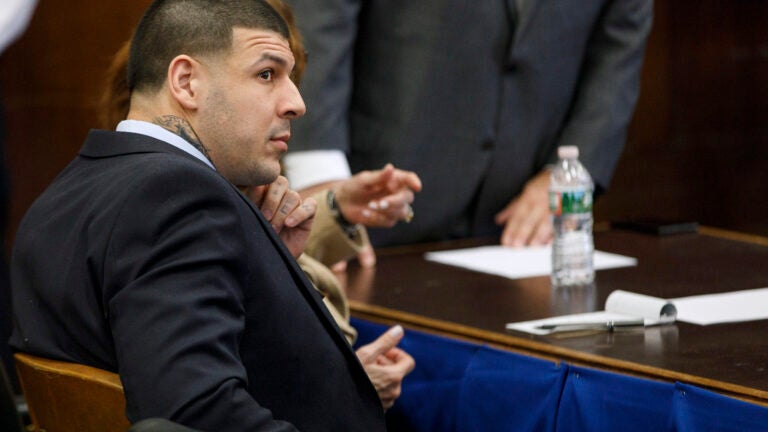
Aaron Hernandez wallowed in a “horrendous existence’’ brought on by head trauma before he killed himself in prison, attorneys for his estate said in their refiled lawsuit against the National Football League.
The stark phrase was used repeatedly in the 86-page civil complaint filed in Norfolk Superior Court in Dedham against the NFL and the Riddell company, the league’s official helmet provider from 1989 to 2013.
The estate claims Hernandez, a New England Patriots tight end from 2010 to 2013, suffered chronic traumatic encephalopathy, a brain disease commonly known as CTE, after sustaining blows to the head while wearing Riddell helmets during a period that spanned from youth football to his professional career, which ended when he was arrested in 2013 for murder.
“Aaron experienced a chaotic and horrendous existence in many respects, due to his [previously] undiagnosed brain injury,’’ the complaint said, adding that CTE symptoms include “aggression, explosive behavior, loss of concentration, mood swings, depression, apathy, and cognitive impairment.’’
The lawsuit asserts the NFL, Riddell, and affiliated entities are liable for Hernandez’s condition because they concealed and later downplayed the health risks of playing football with the equipment maker’s helmets.
A Riddell spokeswoman said Monday that the company will defend its products, arguing the manufacturer began a concerted effort more than 15 years ago to “enhance concussion mitigation [in helmets] and awareness.’’
The NFL hasn’t responded to requests for comment on the new lawsuit but said when Hernandez’s estate filed a similar action in federal court that it would “contest the claim vigorously.’’ The estate dropped the federal lawsuit last week, saying it would refile in state court.
Hernandez was acquitted in April on charges of killing Daniel de Abreu and Safiro Furtado in a drive-by shooting in Boston in 2012. He hanged himself five days after the acquittal in his Shirley prison cell, where he was serving a life sentence for the 2013 killing of Odin Lloyd.
The families of all three murder victims have wrongful death lawsuits pending against Hernandez’s estate.
Douglas K. Sheff, a lawyer representing Lloyd’s family, said he wouldn’t take issue with describing Hernandez’s life as chaotic, citing published reports that detailed brushes with the law dating back to his college years.
“We’ve all heard stories,’’ Sheff said. “Everything comes down to really understanding brain injury, really understanding when it’s there. … And this is a matter of great study and evaluation by teams of experts that we use in our cases.’’
William T. Kennedy, a lawyer for the families of de Abreu and Furtado, said his clients remain focused on the memories of their slain loved ones.
“As far as commenting on the chaos in the life of Mr. Hernandez, I don’t know that they would have any real comment,’’ Kennedy said. “The natural order of things is that parents would pass before the children. [The death of a child] is a loss that’s felt every day. … It’s a very painful loss.’’