Stars collide, and scientists — for the first time — could see and ‘hear’ it
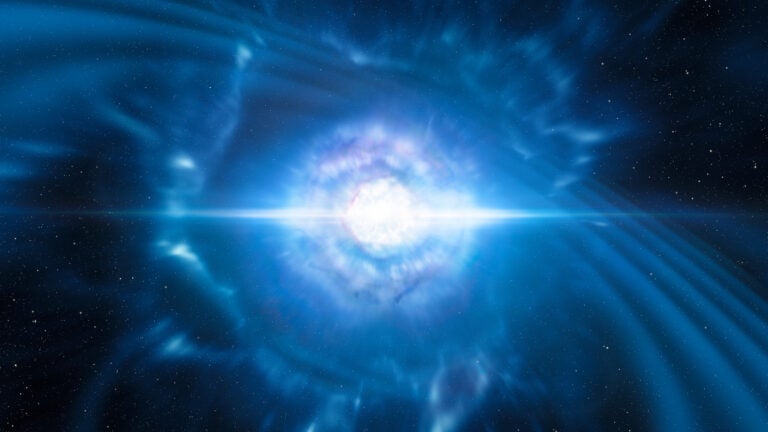
For the first time, scientists studying the universe have detected gravitational waves and observed visible evidence from the same cataclysmic collision — a neutron-star merger — providing rich new detail for understanding the cosmos and marking the beginning of a new era of coordinated astronomy.
The discovery, published Monday in the journal Physical Review Letters, was made possible by the massive, laser-based gravitational wave detectors first envisioned by MIT physicist Rainer Weiss half a century ago and by an international network of partner observatories that responded by quickly aiming telescopes and scanning the night sky in search of the light and other electromagnetic radiation that shot across space from the same collision that emitted the gravitational waves.
The twin, Weiss-inspired detectors in Louisiana and Washington, known together as LIGO (the Laser Interferometer Gravitational-Wave Observatory), first made a splash in early 2016 with the announcement that they had recorded evidence of gravitational waves, the faint, fast-moving ripples in space-time that Einstein first predicted a century ago and that are cast off by any accelerating bodies with mass.
That finding captured the public’s imagination and earned Weiss and two collaborators the 2017 Nobel Prize in Physics, awarded two weeks ago. But that detection and three more that followed all came from the collisions of paired black holes that were orbiting each other — a phenomenon not previously known to exist and one that could not otherwise be observed directly, because the gravitational pull of black holes is so powerful that even light can’t travel fast enough to escape. This discovery takes that finding to another level, researchers said.
“At the time, we said, ‘This is only the tip of the iceberg. This is going to launch the era of gravitational-wave astronomy, and open a new window onto the universe,’ ’’ said Nergis Mavalvala, an MIT physicist who won a MacArthur “genius grant’’ for her improvements to the LIGO design, and a former Weiss graduate student. “Today we’re seeing that promise being fulfilled.’’
Neutron stars are collapsing stars that become so mind-bogglingly dense as they burn up that they manage to cram more mass than our own sun into a sphere just a few miles in diameter, eclipsing everything but black holes in density. But unlike black holes, their powerful gravity is not enough to prevent gamma rays from shooting out when they collide. And that gamma-ray fireball is followed by a lingering trail of light and other radiation known as a kilonova.
In this case, the scientists announced, LIGO recorded gravitational waves that reached earth Aug. 17 from a collision 130 million light-years away. Less than two seconds later, NASA’s Fermi Gamma-ray Space Telescope, orbiting the earth, detected a burst of gamma rays.
Immediate, coordinated computer analysis showed that was probably not just a coincidence, triggering partner networks operating scores of other telescopes to start looking for whatever phenomenon caused both. And the presence of a new, LIGO-inspired observatory known as VIRGO in Europe played a critical role in helping to triangulate the patch of sky where the gravitational waves originated, helping astronomers narrow down the direction to point their telescopes.
“We’ve always said gravitational-wave detectors are like the ears of the universe, and telescopes are the eyes of the universe,’’ Mavalvala said. “And until now the eyes and ears weren’t working together.’’
Over the ensuing two-week period, that rapidly responding telescope network captured images and other evidence of the kilonova that shot across space from this neutron-star merger, the light and radiation emitted by a process so violent that some of the neutrons formed gold, silver, and other heavy elements as they were smashed together and ejected as stardust.
Astronomers and physicists who had studied similar patterns in the sky previously could only theorize that it came from a neutron-star merger; analysis of the unique gravitational-wave signature that accompanied this one confirmed it for the first time, said Marcelle Soares-Santos, a Brandeis physicist who helped design the 570-megapixel camera mounted on the Blanco Telescope at the Inter-American Observatory in Chile, which helped photograph and identify the visual trail.
“This one event has produced a wealth of information that is absolutely incredible,’’ said Soares-Santos, who is interested in unpacking information from this collision and others to come to study the expansion rate of the universe; until now, her research as a cosmologist has been rooted in cosmic surveys, meaning systematic efforts to photograph the sky patch by patch, while “exploring the possibility’’ of doing so with a new kind of astronomy five decades in the making. “Now I can say it’s cosmology with gravitational waves as part of the portfolio, too.’’