Democrats’ lock on Mass. politics means party’s young stars are locked out
Quentin Palfrey started in early July, dialing political strategists and top labor union officials, fund-raisers, and members of Congress, sounding out potential support for his bid to become the Democratic nominee for lieutenant governor in 2018.
He quickly learned he was just about the only one.
“I was a little surprised,’’ said Palfrey, a former Obama White House aide and Weston resident. “When you have a bunch of conversations and people tell you that you’re the first person who’s called them . . . maybe you’re filling a need.’’
Palfrey’s lonely quest is likely the result of a larger issue among state Democrats: There’s little turnover among those in higher office.
In the age of President Trump, when Democratic passions burn hot, internal party dynamics and external forces have limited career opportunities for younger members. And since few of the state’s top Democrats are moving anywhere, it’s hard for other political aspirants to move up.
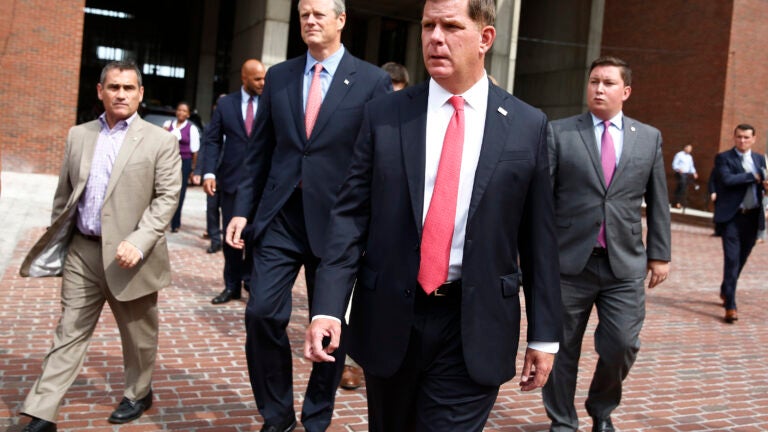
“We hold a lot of the high offices, but I think there needs to be a system in place on how we continue to move talent through,’’ Mayor Martin J. Walsh, who spent nearly two decades in the state House before the city’s top job opened in 2013, said in an interview this week. “If the Democratic Party wants to take control of the governor’s office, or make sure we keep control of all the congressional offices, I think we need to do a better job of organizing within the different parts of the state.’’
Analysts attribute the recent stagnation to a handful of factors.
The Democratic hegemony in the congressional delegation means challengers win few points within the party for trying to take on an incumbent.
Republican Governor Charlie Baker’s popularity has fueled some frequently mentioned prospective candidates’ decisions not to take a shot at the governorship.
Baker’s standing is such, party insiders say, that it partially explains Palfrey’s lack of rivals, too. Not only has the first-term governor discouraged competitors for the top job, senior Democrats acknowledge, but even those seeking to join a ticket against him are thinking twice.
Third, among party insiders, there is an underlying concern that, nearly three years after Deval Patrick left the governor’s office, a power vacuum remains.
Looking ahead to the 2018 elections, only one of the state’s nine US representatives has so far said they’ll leave their post, and the state’s senior US senator, Elizabeth Warren, is running for reelection. The Democrats who hold four of the six constitutional offices have all signaled they plan to stay put, and it’s rare for party members to oppose one of their own in a primary.
It’s a sharp contrast with the Republican Party, where relative newcomers are encouraged to take on the state’s all-Democrat Congressional delegation or seek statewide office. Opportunities to buck incumbents are everywhere, thanks to the GOP’s tiny numbers here.
But for Democrats, it’s also a far cry from just a few years ago, when months after John F. Kerry left the US Senate to become Secretary of State, mayor Thomas M. Menino said he would not seek another term, followed by governor Patrick’s decision not to run for a third. The floodgates opened, allowing several Democrats — US Senator Edward J. Markey, US Representative Katherine Clark, and Walsh — to ascend to their current roles.
With Patrick and his team relinquishing the party’s levers of power, Walsh and then-party chair Thomas McGee, a Lynn Democrat, convened strategy meetings among the state party’s top figures as far back as early 2015, but those sessions have since subsided.
Similar party leadership vacancies, in the past, have been filled by governors, Boston mayors, and US senators. It’s a role Edward M. Kennedy played for years. But both Warren and Markey appear more focused on Washington and national affairs.
“[Warren] has got a national constituency that she’s concerned about,’’ said University of Massachusetts political science professor Ray La Raja.
Back at home, some party leaders and strategists have fretted that none of the Democratic candidates for governor has the status to give Baker a fight.
The state has a crop of young Democratic stars. In Congress, Clark, Seth Moulton, and Joseph P. Kennedy III have all built strong profiles within the party. As a second-term congressman, Moulton has sparked speculation that he could run for president in three years. Attorney General Maura Healey, too, has cultivated national attention by confronting Trump on legal grounds.
Democrats couldn’t convince any of themto take on the popular GOP governor.
“They didn’t put anybody up to really challenge Baker,’’ said La Raja. “The party organization itself is not really strong in this state. They’re not recruiting anybody, and it’s a big risk to take on Baker. But a strong party would say, ‘Hey, we’re taking them on anyway, to get our message heard.’ ’’
US Representative Niki Tsongas’s announcement this month that she would step down at the end of her term created some volatility, flushing out elected Democrats and other party heavyweights. But Warren’s plans for a second term and the widespread expectation that Markey, too, will seek another term in 2022 have further crimped the party pipeline.
Before Moulton knocked off a long-term incumbent in 2014, it had been over 20 years since a Democratic congressman lost a primary here.
Some in the party point out the virtues of incumbency.
“When you face what we’re facing federally now, with Trump trying to cut programs and change things, you do want people who know how to get it done, how to challenge things in courts, how to make sure that the state government knows how to fill in the gaps,’’ said Andrea Cabral, a former state public safety chief and now a WGBH radio host.
But in recent years, a string of young Democratic legislators widely seen as ambitious for higher office has stepped out of the electoral jetstream entirely, often for more lucrative careers.
Last week, state Senator Jen Flanagan, viewed as an eventual candidate for one of the chamber’s top posts, accepted a job as commissioner on the state’s new cannabis policy panel. Her former colleague Ben Downing, also marked for ascent, left earlier this year for the private sector.
State Democratic Party chairman Gus Bickford calls the logjam “a good problem to have,’’ adding, “I think it’s a very healthy bunch of Democratic elected officials who are in a lot of great places.’’
Bickford said the opposition to Trump has stirred up unprecedented grassroots intensity, and expects it to produce a string of first-time candidates across government in next year’s statewide election.