Brigham uses videos to help tighten security
The video is spine-tingling. A hospital employee, busy chatting with a co-worker, enters an elevator and scans her identification badge to go to a restricted floor. They don’t seem to notice that a stranger has stepped on, too. The doors close.
That lapse allows the stranger to gain access to the maternity unit, and walk away with a newborn.
Brigham and Women’s Hospital employees acted in this 90-seconds dramatization, which will air starting Friday as part of a new program to tackle a vexing — and potentially dangerous — security problem called “tailgating.’’
The Boston teaching hospital was shaken in December when a woman posing as a doctor snuck into its operating rooms over at least two days. She did so by tagging along behind employees during shift changes, blending in as operating room staffers held the door for one another.
New hospital security efforts – Be aware campaign
Brigham and Women’s Hospital is increasing security efforts after woman roamed around in the hospital for two days earlier this year.
Cheryl Wang, 42, was not a doctor. She was a former surgical resident who had been dismissed from Mount Sinai St. Luke’s Hospital in New York City after a verbal altercation with a colleague, according to a hospital spokeswoman.
While Wang did not harm any patients, hospital officials said, the security breach prompted the hospital to take a deeper look at its practices. Wang has not reappeared at the Brigham, said Dave Corbin, director of security and parking.
It’s unclear how often tailgating occurs, Corbinsaid, mainly because hospitals usually don’t discover a lapse unless someone is threatened or injured.
“It is something every health care organization recognizes is an issue,’’ Corbin said.
Martin Green, president of the International Association for Healthcare Security & Safety, said he estimates “this happens at least once every day in almost every facility,’’ although he believes there is rarely criminal intent by the person who gains entry to a hospital.
The Brigham plans to hold 30-minute sessions throughout the day Friday and next Tuesday for its 18,000 employees that include screening two warning videos and role-playing scenarios.
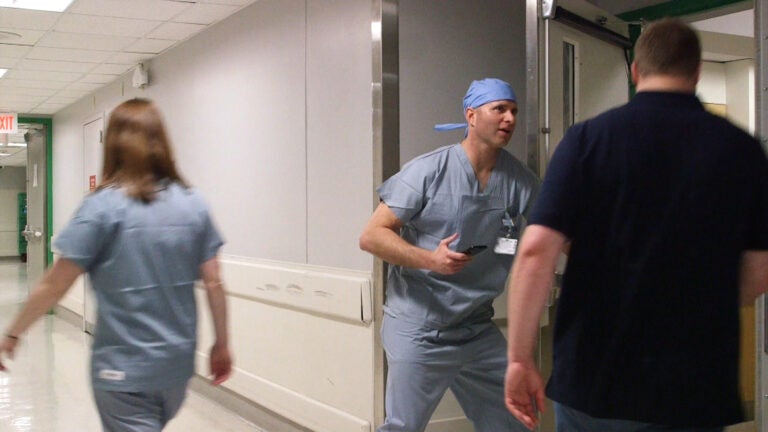
The second chilling video depicts a doctor holding open a door to the operating room suite for a man. While viewers are not certain what happens next behind a curtain, it is clearly violent, or bordering on it. Hospital spokeswoman Erin McDonough said the videos were designed to hit an emotional chord so the messages sticks in employees’ minds.
Hospital ups security efforts – Don’t Hold the Door
Brigham and Women’s Hospital is increasing security efforts after woman roamed around in the hospital for two days earlier this year.
The hospital will post signs at each of 1,200 sites that require an identification card to access, reminding employees to look behind them and be aware of strangers. The Brigham will provide badges with language that staff can use if someone tries to access a restricted area. And a new policy will hold employees responsible if someone enters a restricted area on their badge.
While some large companies rely on turnstiles to prevent tailgating, Corbin said, they are not practical for hospitals, in part because employees need easy access for stretchers. Green said hospitals use various approaches to the problem, but the key is staff education.
“They are a critical component to any successful security program,’’ he said.