
Here’s where parking in Boston just got more expensive
The city is testing two different pricing models in a pilot program throughout 2017.
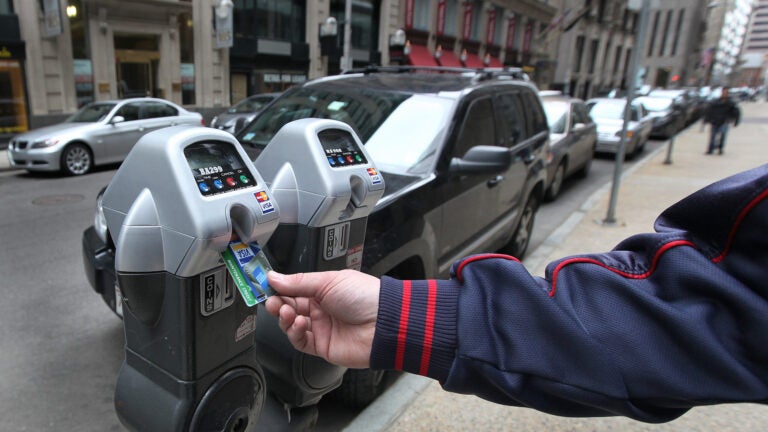
Boston officials are trying out a basic economic approach to address the shortage of parking in the city’s busiest neighborhoods: Make meters more expensive.
After exploring options for more than a year, the city launched a test program Jan. 3 that substantially hikes the $1.25-an-hour parking rate in specific parts of downtown Boston. Here’s a guide to how this decision will impact your wallet.
Which neighborhoods are affected?
Fortunately for frugal Bostonians, the rate isn’t going up everywhere. The city is implementing the pilot program only on the infamously stuffed streets of the Back Bay and in the Seaport.
As The Boston Globe reported, officials hope the surge will induce drivers who park in metered spaces all day to consider parking garages or public transportation.
In the Back Bay, roughly 1,650 spaces will be affected in an area enclosed by Beacon Street, Arlington Street, Stuart Street, Mass. Ave., and Charlesgate.

Parking meter rates in the Back Bay will increase to $3.75 an hour after New Year’s.
The city released online maps outlining the zones where the new rates will be tested. In addition to the steep price increase in the Back Bay, officials said they will “step up enforcement of double parking, meter time limits, and illegal parking in commercial spaces” in order to free up space.
The situation in the Seaport is a little more complicated. The program will affect 591 spots in a 40-block zone bordered by Seaport Boulevard, D Street, Cypher Street, and W 2nd Street.

Map of where Boston will test “flexible meter pricing” beginning in 2017.
How much more will I be paying?
In the Back Bay, the hourly rate will triple from $1.25 to $3.75. In the Seaport, the city will test flexible metered pricing.
First, base meter prices will increase from $1.25 an hour to $1.50 an hour. However, prices will go up and down depending on the time of day—somewhere between an hourly rate of $1 and $4.
According to the city, the rates will vary by four time periods:
- Weekdays from 8 a.m. to noon
- Weekdays from noon to 5 p.m.
- Weekdays from 5 p.m. – 8 p.m.
- All day Saturday.
The city will post a monthly price schedule for the time periods on its website at least a week before any change. Price changes will also appear on the city’s parking app, ParkBoston.
Additionally, the city will use sensors to analyze parking patterns and usage on each block in the zone. Every two months, prices on each block will be adjusted according to use. For blocks with more than 90 percent of spaces used, the city will increase the rate 50 cents per hour. For blocks where less than 70 percent of the spaces are used, the city will drop the rate by 50 cents.
“Prices will stabilize when occupancy reaches the target of 85 percent, about one space open per block,” officials said.
The flexible price model is being tested in the Seaport because the neighborhood sees more change in parking demand throughout the day compared to the Back Bay, where street parking averages a 90 percent occupancy rate each day, according to the city.




To comment, please create a screen name in your profile
To comment, please verify your email address
Conversation
This discussion has ended. Please join elsewhere on Boston.com