
Harvard strike could be seen as a battle against the 1 percent. It’s not.
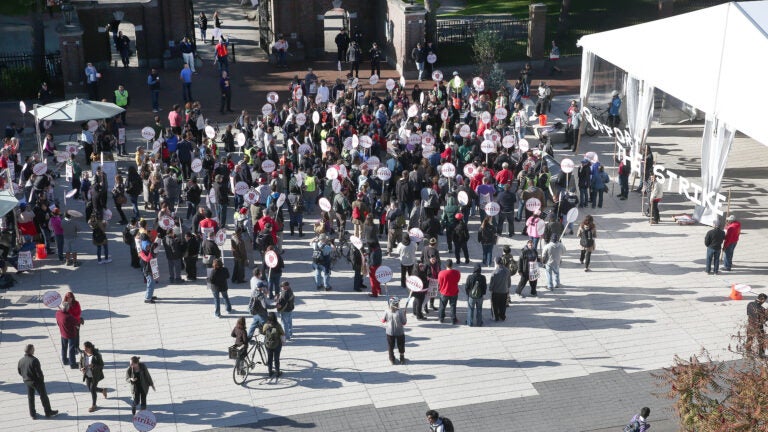
The first strike at Harvard University in more than 30 years pits the world’s richest university against hundreds of food service workers who walked off their jobs Wednesday after months of negotiations failed to produce a new contract.
The dispute could easily be seen as a showdown between the 1 percent and low-paid service workers: Harvard’s $35.7 billion endowment is bigger than the economies of nearly 100 countries, while the striking union members are among millions of Americans struggling in a era of growing income inequality.
But the situation is far more complex, and raises questions of fair off-season compensation and who should bear the ever-rising costs of health care.
Harvard is quick to point out that its average dining hall worker makes nearly $22 an hour. The latest offer to workers would increase wages to more than $24 a hour by the end of the five-year contract, according to university spokeswoman Tania deLuzuriaga.
The national fight for a $15 minimum wage and Bernie Sanders’s presidential campaign brought income inequality issues to the fore of public discussion, said Robert Nakosteen, an economics professor at the Isenberg School of Management at the University of Massachusetts Amherst. Yet compared to the broader food industry, where employers may not provide any health care benefits and the average wage in Massachusetts was $10.69 last year, the pay at Harvard appears good, he said.
Read the complete story at BostonGlobe.com.
Don’t have a Globe subscription? Boston.com readers get a 2-week free trial.



To comment, please create a screen name in your profile
To comment, please verify your email address
Conversation
This discussion has ended. Please join elsewhere on Boston.com