
MBTA has made progress but has a long way to go, Baker says
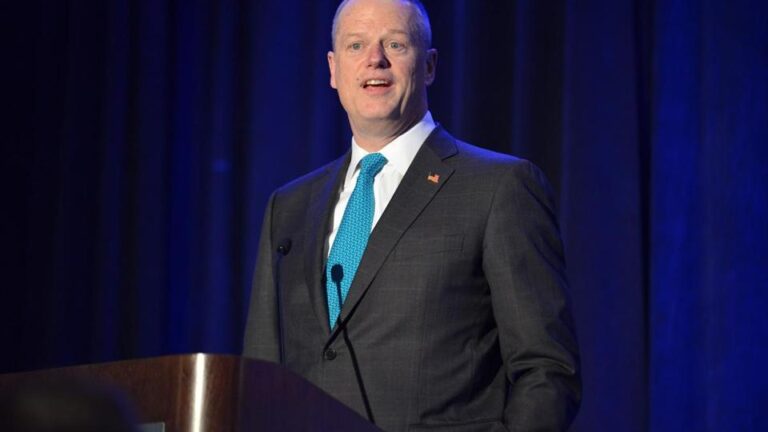
Turnarounds take time, Gov. Charlie Baker said Wednesday while marking the one-year anniversary of new governance at a state agency in the midst of one — the MBTA.
Baker said efforts to reform and modernize the region’s transit system are at the start of stage two of a three-part process. The T has been a major priority of Baker’s administration ever since the record snowfall of 2015 blanketed the agency in crisis weeks after he took office.
“The first step is usually about putting out immediate fires, grabbing low-hanging fruit, and starting the downward slide into the abyss,” Baker said, referencing the last year at the agency, which brought about flurries of negative headlines as its Fiscal and Management Control Board dove into the T’s many issues. “Step two is about bucking the trend, climbing back up the hill and creating positive movement where there is none. And step three is usually where the work of steps one and two starts to create more momentum.”
The Republican governor said that when he took office, the T was in worse shape than Harvard Pilgrim Health Care in the late 1990s, where as CEO he led a turnaround effort earlier in his career. He said the T exhibited “very little 21st-century business process.”
“One very large vendor told [MBTA Chief Administrator and interim General Manager] Brian Shortsleeve that he would be happy to give the T a discount, but only if the T ordered off their website, like every other enterprise customer in North America,” Baker said by way of example.
After public transit puttered to a halt last winter, Baker pushed for the creation of the new control board, and the legislature ultimately provided it. The five-member board met for the first time last July and they’ve gathered nearly weekly since.
In comments to reporters Wednesday, Baker celebrated progress in cutting the agency’s budget shortfall, developing a plan to spend more money on repairs and maintenance, and finding a possible path forward for the long-awaited, long-delayed Green Line extension under the control board’s watch.
He also acknowledged two of the more tumultuous decisions made in the last 12 months: raising systemwide fares by more than 9 percent and ending late-night weekend service, moves that T officials have said will lead to more spending on improving the its ailing infrastructure but that transit advocates called unfair to riders.
But the T still has a long way to go to noticeably improve service for riders, Baker said.
“Obviously, in the end, the proof is in the performance,” he said. “And that’s one of the big challenges I think that all of us believe we need to make progress on this year, which is ensuring that the T delivers what we would refer to as that reliable and dependable service.”
“We’re going to move as quickly as we can to make those investments, because we believe they’re the right investments, and they will also dramatically over time enhance and improve rider experience,” he added. “But it’s going to take a while to lay the kinds of infrastructure down that we need to lay down given how far behind we are at the start of this.”
The next year could also prove contentious, as a developing dispute with MBTA labor figures to further simmer.
Baker said the coming months will see the MBTA focus on continuing to drive down costs, including by privatizing portions of the agency — which became more feasible last year when the legislature agreed to reprieve the T from a law that limits public agencies’ ability to contract out work. Already, the T plans to put contracts to run its cash-counting operation and stockroom out to bid amid union pushback. Baker called on the T to look into other privatization options Wednesday.
“Don’t be afraid to change how services are delivered and vehicles are maintained,” he said. “Actively seek out private partners — even let them make unsolicited proposals — to help the T find new and smarter ways to deliver for its riders and its customers.”
In a statement Wednesday afternoon, Jim O’Brien, the president of the Boston Carmen’s Union, which is the T’s largest labor group, criticized the outsourcing plans.
“Conversations before the [control board] continually focus on finding cost savings for the MBTA, making necessary investments and improvements for the system, and giving riders a better performing public transportation system — but all we hear is how privatization is the only way to do that,” he said. “Privatization is not a magic wand. There is no magic wand to cure the lack of investment of the past 20-plus years. And privatization certainly does not guarantee cost savings or improved service for riders.”
Baker spoke to other possibilities for cost-cutting that would likely rankle labor leaders, saying his administration will file legislation in January in a bid to move workers’ pensions under the state’s retirement program because the state is paying too much money to the privately managed MBTA pension fund. And he took aim at provisions in union contracts that allow workers to be paid for overtime after eight hours per day of work, rather than 40 hours per week.
The Carmen’s Union in June offered to rework its contract to cut new-employee pay if the T promised to limit privatization. Upon receiving the offer, Shortsleeve said it was unlikely the T would resist the opportunity to contract parts of the agency to the private sector, and specifically mentioned overtime structure as a more significant issue that would result in greater savings if changed.
Baker said the T will need to focus in the coming year on building its management ranks, as officials and an outside study have said the agency is too thin at the top. Meanwhile, Baker said positions elsewhere in the organization could be eliminated with “some staffing changes on the way,” though he said other positions could be created.
In June, Shortsleeve said the T may need to lay workers off if too few people in administrative roles took voluntary retirement or buy-out programs. At the time, he said the agency was aiming to get 500 people to leave the organization, and that it would likely replace those departures with about 200 new hires. On Wednesday, Shortsleeve said 260 people took the options, meaning management fell short of that goal.
Baker said any new savings created by the agency in the upcoming year will be redirected toward repair work. Asked whether his administration will ever seek more tax revenue to further fund the system, the governor said not any time soon.
“Let’s focus on the task in front of us, which at this point in time is to get to the point where the T is spending properly and appropriately and effectively and efficiently the available resources it has,” he said.
Joshua Ostroff, interim director of the advocacy group Transportation for Massachusetts, said the control board has put the T in a better position, but disagreed that the system did not need more money.
“Comparing Massachusetts with other states, and the United States with other countries, we need to be investing significant funds in public transit,” he said after Baker’s remarks. “It goes with the public confidence: You can’t have that investment without the confidence of the public and lawmakers that the money is being well-spent. So clearly, the reform [efforts that are] underway are critical, but we need to be thinking ahead, and that’s going to take significantly more revenue than we have today.”
Ostroff said the potential 2018 ballot question that would tax individuals on earnings over $1 million to fund transportation and education could help create that revenue.


To comment, please create a screen name in your profile
To comment, please verify your email address
Conversation
This discussion has ended. Please join elsewhere on Boston.com