
Why the MBTA wants bus passengers to go cash-free
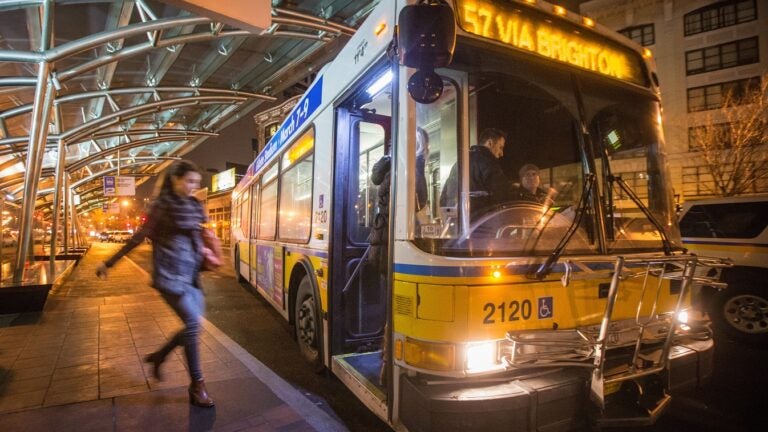
The MBTA thinks it can shave 10 percent off the length of commuters’ bus trips within a couple of years — if passengers no longer pay with cash on board.
The T’s chief technology officer, David Block-Schachter, is scheduled to update the agency’s board on next-generation fare collection technology Monday afternoon. The agency first floated its fare-collection goals, including the idea of going cash-free on buses and the Green Line, in March, with an ambitious timeline of implementing a new fare system within two and a half years.
The proposed new system would allow riders to pay with a T fare card, a smartphone, or a credit card by tapping a fare reader that would be available to passengers at any door on the vehicle.
Block-Schachter’s presentation Monday will detail some of the benefits of ending on-board cash payments for bus riders. They include:
- Boarding times at bus stops would be cut significantly, because all passengers would “tap on” to the vehicle, rather than pay with cash. According to the presentation, riders using cash take between 5 and 20 times longer to board than those who already tap on with a CharlieCard.
- Boarding times would also be cut down because passengers could tap on at both the front and back doors, rather than just the front. (The all-door boarding system would also require new fare-evasion detection and enforcement strategies, according to the presentation.)
- Because bus routes would be completed more quickly with the cut-down on boarding times, the buses could be redeployed on their routes more quickly, meaning shorter waits between buses.
According to the presentation, last year’s free fare day — offered to passengers as an apology for the T’s brutal winter service — showed that per-passenger boarding times on buses were trimmed by about 30 percent. That could be a basis for what a cash-free, tap-on-only boarding system would look like, Block-Schachter said.
However, switching to cash-free boarding would carry challenges for some riders.
Currently, 3.8 percent of rides are paid for with cash on-board, and another 3.3 percent see riders add value to their CharlieCard while on board buses. Both of those options would be eliminated with the new system.
And simply switching to tapping on with a smartphone or credit card would not be easy for every rider, according to Block-Schachter. More than 6.5 percent of Greater Boston residents do not have a bank account. In the United States, about half of those without bank accounts do not have smartphones, he said.
Those riders would need to carry the next version of the plastic CharlieCard, and the T would direct them toward adding value to the card with cash. That can already be done at the T’s fare vending machines, but most bus stops and above-ground Green Line stops where on-board payments are prevalent do not have vending machines.
The T will need to better direct users to fill cards with cash, and further expand the number of places they can do so, according to the presentation. That would require vastly growing the number of retail stores where users could go to add value to their cards, by partnering with companies who place gift cards in convenience stores and other retailers. The T could also add vending machines in certain areas.
One big possible change coming for passengers: The next-generation CharlieCards would no longer be free. Instead, passengers would pay $5 for the physical card, in addition to the money they’d spend adding to it. Block-Schachter said the T would partner with state agencies to get free cards to low-income riders.
The $5-per-card fee would have a cost-savings effect for the T. Since the T began issuing the CharlieCards, it has doled out nearly 18 million of them at a cost of about $12 million, according to the presentation.
Charging for the cards would allow the T to offer a system currently used in London, which has already gone to cash-free boarding. The “one more ride” system allows riders without enough value on their card to tap on and go into debt to the agency. Those passengers need to reload the card to make up the debt, before they can take another ride.
If cards were free, a passenger might have an incentive to take that free ride but then ditch the card and get a new one, never making up the debt. The $5 fee for a new card would make that less appetizing, Block-Schachter said.
Correction: The original version of this story misstated David Block-Schachter’s title. He is chief technology officer for the MBTA.


To comment, please create a screen name in your profile
To comment, please verify your email address
Conversation
This discussion has ended. Please join elsewhere on Boston.com