
In letters, the future Pope John Paul II called Vermont woman ‘a gift from God’
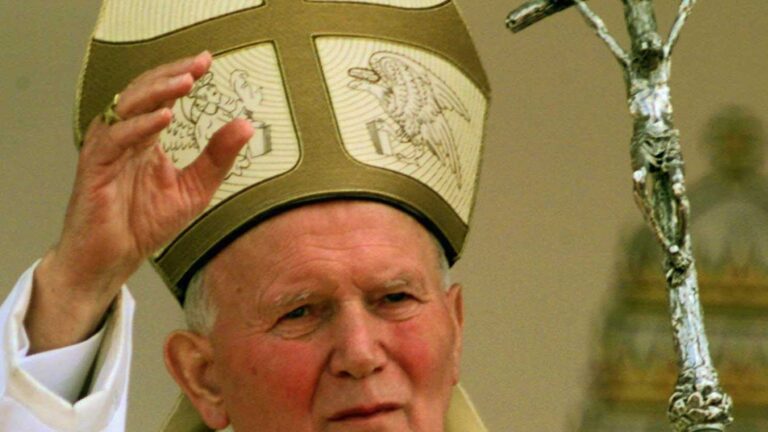
WARSAW, Poland — The future Pope John Paul II, Karol Wojtyla, began a friendship with an American philosopher in 1973 that lasted the rest of his life. She hosted him when he visited New England and translated a book of his, and they stayed in touch, off and on, until his death in 2005.
Now, for the first time, letters that he wrote to the philosopher, Anna-Teresa Tymieniecka, have been made public — and they portray a startling degree of affection.
“God gave you to me and made you my vocation,’’ read a letter dated March 31, 1976, one of several excerpts published Monday by BBC News.
He called her “a gift from God.’’
The letters offer no evidence that the future pope — who was known for his strict adherence to church doctrine on sexuality, marriage and the family, and who was canonized in 2014 — ever had a physical relationship, much less that he violated his vow of celibacy. But they do suggest a tension in the relationship between the married philosopher and the obedient pope.
“You write about being torn apart,’’ he wrote on Sept. 10, 1976. “I could find no answer to these words.’’ He added, “If I didn’t have this conviction, some moral certainty of grace, and of acting in obedience to it, I would not dare act like this.’’
After the BBC released a preview of its report, broadcast Monday night on the BBC News program “Panorama,’’ it drew hasty responses from Roman Catholic officials.
“It comes as no great revelation that Pope John Paul II had deep friendships with a number of people, men and women alike,’’ said Greg Burke, a Vatican spokesman. “No one will be shocked by that.’’
Cardinal Stanislaw Dziwisz, who was John Paul’s personal secretary for nearly 40 years and is now the archbishop of Krakow, Poland, said in a statement: “Those who lived at the side of John Paul II know well that there is no place in his life to search for evil. He was a free and transparent man. He did not have any complexes, because he was pure and respected every man in every possible situation.’’
The excerpts published by the BBC trace the arc of a relationship that stretched over three decades, starting when John Paul was the archbishop of Krakow.
In the earliest letter, dated Nov. 26, 1973, John Paul thanked Tymieniecka for sending him a scholarly article, “Three Dimensions of Phenomenology.’’ He switched to using her given names the next year, in a letter dated Oct. 2, 1974, acknowledging the receipt of four letters from her. “I have kept them and brought them with me to Rome,’’ he wrote. “I am reading them again as they are so meaningful and deeply personal.’’
Edward Stourton, the lead journalist behind the BBC report, reported on Monday, without specifying his source, that Tymieniecka had professed her love in a letter written from a park bench in Krakow in summer 1975.
It is not clear if John Paul responded, but he visited her and her family the next year, during a trip in which he spoke at Harvard. In the letter dated Sept. 10, 1976, he wrote: “Last year I was trying to find an answer to the words, ‘I belong to you.’ Finally, before leaving Poland, I found a way — a scapular.’’
In subsequent letters, he referred repeatedly to the scapular: a devotional garment, comprising two pieces of cloth, that is typically carried as a reminder of piety. It allowed him to “accept and feel you everywhere, in all kinds of situations, whether you are close, or far away,’’ he wrote.
In 1978, a week after he assumed the papacy, John Paul wrote to Tymieniecka, pledging to keep up their correspondence. “I promise I will remember everything at this new stage of my journey,’’ he wrote. Their relationship was strained, however, when Vatican officials objected to the accuracy of Tymieniecka’s translation of the pope’s book “The Acting Person,’’ published in 1979.
According to the BBC, she felt stung that he did not come to her defense. But it was not a lasting estrangement: After an assassination attempt against John Paul in 1981, she wrote in a telegram to his secretary, “I am overwhelmed by sadness and anxiety and want desperately to be close to you,’’ and the BBC reported that she flew to Rome to see him.
Toward the end of his life, John Paul reached out to Tymieniecka, reminiscing about his visit to her home near Pomfret, Vermont. “I am thinking about you and, in my thoughts, I come to Pomfret every day,’’ he wrote on Jan. 26, 2002. “I often wonder what is happening — beyond the ocean — in Pomfret,’’ he wrote on Feb. 19, 2003. The BBC, citing friends of Tymieniecka, said she had been at his bedside on the eve of his death at age 84 on April 2, 2005, an account that could not be independently confirmed.
Tymieniecka died in 2014, at 91; her husband, Hendrik S. Houthakker, a Harvard economist who served in the Nixon administration, died in 2008. A man who answered the phone at their home Monday and identified himself as their son said, “I really don’t know what to say to you,’’ and referred questions to William S. Smith, a friend of Tymieniecka and executor of her papers. Smith did not respond to requests for comment.
The correspondence from the pope to Tymieniecka was part of a trove of documents her estate sold to the National Library of Poland in 2008. The BBC reported that the library had kept the letters out of public view, partly because of John Paul’s path to sainthood, which was fast-tracked by the church. But on Monday, an official at the library, Julia Konopka-Zolnierczuk, said the letters would be made public. “The process of preparing a critical edition of the letters has begun and will take a few years,’’ she said.
In a phone interview, George Weigel, an American Catholic theologian who wrote a two-volume biography of John Paul, said it was “simply silly’’ to view the correspondence as revelatory. “No one who knew this man or studied his life seriously would be surprised by this or have their views changed in the slightest,’’ he said. “Karol Wojtyla had many friendships with women, men, children, clergy, laity, intellectuals, workers — there is no news here.’’
The Rev. Piotr Studnicki, a spokesman for the Krakow archdiocese, suggested that the BBC was sensationalizing innocent letters. “A world in which all male-female relations amount to falling in love would be poor and impossible to live in,’’ he wrote on Twitter.
But the Rev. Adam Boniecki, a Polish priest who knew John Paul, said the relationship was a significant one.
“She was an important intellectual partner with whom he could discuss philosophical issues,’’ he said in a phone interview. He added that “they fought, too,’’ noting the translation controversy.
“She was a very beautiful women, and he was the most powerful man in the Roman Catholic Church,’’ Boniecki added. “Even if there was nothing between them, people would still love to see something there.’’




To comment, please create a screen name in your profile
To comment, please verify your email address
Conversation
This discussion has ended. Please join elsewhere on Boston.com