
Does New Hampshire’s primary discourage homegrown presidential candidates?
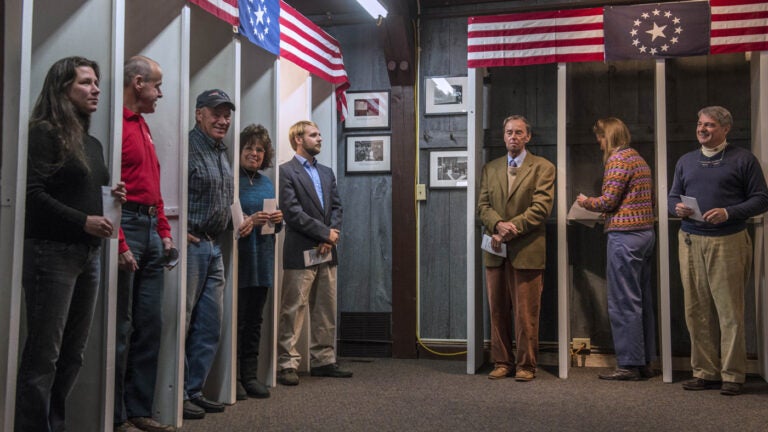
A lot of presidential candidates have visited New Hampshire in the last year, and they all have one thing in common: They’re not from New Hampshire.
If the first-in-the-nation tradition is good for Granite Staters and good for presidential hopefuls, perhaps the one demographic disadvantaged by the process are those at the intersection of the two groups.
Despite New England’s rich history of producing presidential candidates and New Hampshire’s increased rate of political engagement, the state hasn’t produced a major presidential candidate in nearly 100 years.
New Hampshire’s abstinence from generating presidential candidates is not unrelated to the state’s role in selecting them, New Hampshire Secretary of State Bill Gardner told Boston.com.
“There is a feeling among the people of the state that the primary is not about promoting somebody from New Hampshire,’’ he said.
According to an Associated Press analysis, since residents began voting directly for primary candidates in 1952, out of the 300 candidates to appear on the state’s ballot, 19 have been New Hampshire candidates — all of them unsuccessful. And they haven’t exactly been contenders: Those 19 ambitious individuals got a total of about 6,000 votes.
It’s possible Granite Staters are discouraged from running for president because of the potential damage it could do to the state’s first-in-the-nation tradition, according to University of New Hampshire professor Dante Scala.
“If you have a home-state candidate, it does take away from the primary as a whole, if the home-state candidate is a strong one, because then it’s like when Tom Harken ran back in 1992 in Iowa,’’ Scala told Boston.com, referring to the Iowa Democratic senator’s presidential candidacy, which resulted in all other primary candidates virtually ignoring the early caucusing state.
“It gives rivals a perfect excuse to skip the state,’’ he said of a potential New Hampshire candidate.
When New Hampshire Sen. Bob Smith announced he would seek the Republican nomination in 1999, his candidacy “was not widely welcomed by Republican leaders in the state,’’ according to The New York Times.
The Times reported Smith’s fellow Republicans feared “other contenders [would] be inclined to concede him a home-state advantage in the first-in-the-nation primary, do little stumping in New Hampshire and so make the primary all but irrelevant.’’
“I don’t think he his potential candidacy was greeted with a lot of warmth from his fellow New Hampshire politicos,’’ Scala recalled.
Fortunately for those who worried about the state of New Hampshire’s primary tradition, Smith’s campaign never got off the ground. After leaving the Republican Party, attempting to join a third party, and then attempting to run as an independent, Smith dropped out of the race in October 1999, four months before New Hampshirites would vote.

Sen. Bob Smith, R-N.H., withdrew from the 2000 Republican presidential race four months before the New Hampshire primary.
According to Gardner, it’s part of New Hampshire’s political identity to not produce candidates, referring back to 1831 when the delegates from the state initiated a change in the nation’s presidential nominating process from congressional caucuses to a national party convention.
“The object of the representatives of the people of New Hampshire who called this convention was not to impose on the people […] any local favorite; but to concentrate the opinion of all the states,’’ said Frederick A. Sumner, a delegate from New Hampshire, calling the first convention to order in 1832.
“When New Hampshire did that, it was made clear that it was not for any self-aggrandizement,’’ Gardner said.
According to Scala, despite scores of major candidates from New Hampshire’s neighboring states, the state’s lack of candidates could simply be circumstantial. It is, after all, a state of just 1.3 million people (though Vermont’s population is just more than 625,000 and has had two major candidates in the last four presidential cycles, as has Massachusetts).
Though there would surely be local excitement over a homegrown presidential candidates, Scala said party leaders would likely be conflicted.
“It would be seen as a mixed blessing,’’ he said “although the elites from that party would be hesitant to say that.’’

New Hampshire Secretary of State Bill Gardner shows U.S. Republican presidential candidate Jeb Bush photographs of past presidential candidates before Bush filed his candidacy for the state’s primary.



To comment, please create a screen name in your profile
To comment, please verify your email address
Conversation
This discussion has ended. Please join elsewhere on Boston.com