
5 takeaways from Mayor Marty Walsh’s State of the City address
“Protect what we love about our city by, sometimes, embracing change.’’
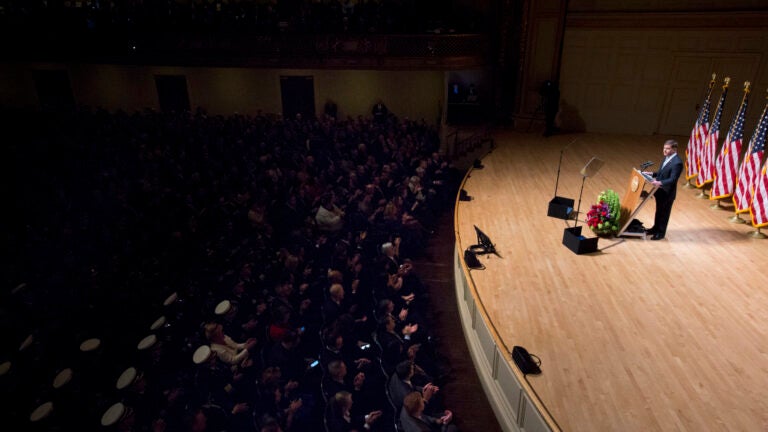
In his second State of the City address Tuesday night, Mayor Marty Walsh said Boston “is as strong as it has ever been’’ and asked residents to come together to move forward on local issues.
“Protect what we love about our city by, sometimes, embracing change,’ he said in front of state and city officials at Symphony Hall.
Here are five major takeaways from Walsh’s speech:
1. A new city office to address rising housing costs
With reports that the middle class could be squeezed out of the Boston area due to rising costs, Walsh announced a new Office of Housing Stability.
“It’s going to develop resources for tenants, incentives for landlords who do the right thing, and partnerships with developers to keep more of our housing stock affordable,’’ he said, noting that people throughout the city are struggling to pay rents or find affordable homes.
According to the city, services of the new office will include quicker case management; trained housing advocates, who will work with local parties to prevent evictions; and staff to help residents find new housing following cases of fire or natural disaster.
The Office of Housing Stability will also draft and recommend new policies to the city.
“People want to live in Boston,’’ Walsh said. “That’s a good thing. But we need to shape growth as a community, not let it shape us.’’
2. A generally electric victory lap
One of the first specific topics Walsh mentioned in his speech: Business giant General Electric’s recently announced move to Boston.
“I look forward to welcoming General Electric to its new global headquarters in Boston,’’ Walsh said, pausing to clap with the Symphony Hall audience, from which a few whoops could be heard.
GE fully will move its headquarters, as well as 800 jobs, from Connecticut to the Seaport during 2018.
“What we offered GE was less an incentive package, than a cultural advantage,’’ Walsh said, pointing to Boston’s reputation for innovation and education.
It is, however, worth noting the incentive package city and state officials offered GE — to the tune of $25 million in property tax relief and up to $120 million in grants and other programs.
3. Studying a $15 minimum wage
Building upon Boston’s business culture of collaboration, Walsh announced the city will “bring workers and employers together in a task force to study a $15-an-hour minimum wage.’’
The announcement comes on the heels of demonstrations at Logan Airport and in Dorchester this week in support of a $15 wage floor. Cities such as Los Angeles and Seattle have already passed measure to raise the minimum wage to $15 per hour.
While some viewed Walsh’s announcement as an endorsement of the $15 minimum wage, others viewed the decision to commission a study on the issue a punt.
Massachusetts’ statewide minimum wage will reach $11 an hour in 2017. Walsh said last year he “was not opposed’’ to a $15-an-hour minimum wage.
4. Defending Boston’s schools — both public and charter
As some parents and students protested outside Symphony Hall, the mayor called for a truce.
“Instead of unity, too often we’ve seen schools pitted against one another, by adults,’’ Walsh said. “Tonight, I’m calling on everyone to come together to back all our children, all our teachers, and all our schools. That means fair and sustainable funding for both district and charter schools.’’
Last year, Walsh called for raising the cap on charter schools, though at a lower rate than what Gov. Charlie Baker wanted.
Walsh trumpeted in his speech the fact he will send a budget to the City Council that increases the $1 billion Boston Public Schools budget by $13.5 million — the third year the mayor has increased school funding.
However, Boston Public Schools Superintendent Tommy Chang estimates the district will face a budget hole of up to $50 million, forcing more than $30 million in cuts. Critics blame Walsh for not advocating strongly against the cuts.
5. Make Boston green again
“Our Parks budget is the biggest in Boston’s history,’’ Walsh said, announcing a plan to convert 6 acres of land in the city into “permanent new parks.’’
After growing up in Boston’s parks and hearing recently from people who lived near a park that they felt was unsafe, Walsh said he was motivated to address the issue.
“We’re going to ensure that America’s first public parks are America’s best, and—inspired by the Martin Richard Playground being built next to the Children’s Museum—America’s most inclusive public parks as well,’’ Walsh said.




To comment, please create a screen name in your profile
To comment, please verify your email address
Conversation
This discussion has ended. Please join elsewhere on Boston.com