
Here’s how the MBTA plans to keep snow off the commuter rail this winter
The MBTA is bringing on nearly 50 pieces of new snow removal equipment to help keep the commuter rail running during the winter, according to officials who unveiled some of the equipment Wednesday.
Many of the heavy duty machines are equipped with plows or snowblowers. A model called a “snow fighter’’ features both.
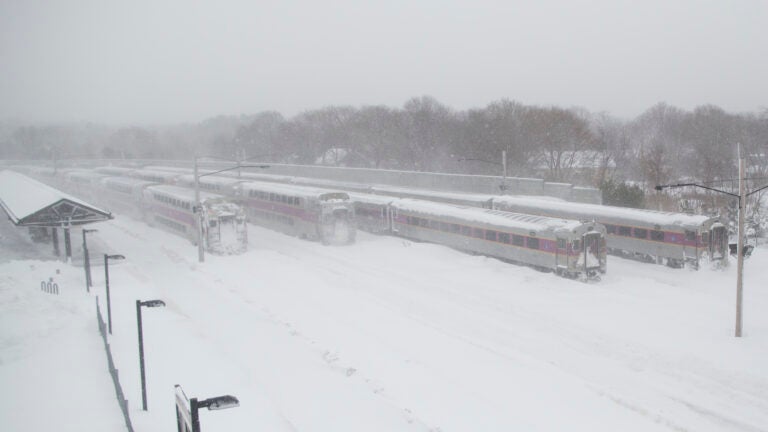
The equipment represents fresh artillery for the commuter rail and its operator, Keolis Commuter Services, whose riders were beset by severe delays and cancellations during last winter’s record-setting snowfall.
In addition to their most obvious function—clearing snow—the machines will also relieve some of the burden on commuter rail passenger vehicles that donned plows last year, often to their detriment, MBTA General Manager Frank DePaola said.
“Last year, the bulk of snow removal … was done by affixing plows to our revenue vehicles,’’ he told reporters at a Cambridge rail yard. “That exposes those vehicles to the stress of snow plowing, and we had a number of locomotives break down. … Using these heavy pieces of equipment to do the bulk of the work will help protect those revenue cars from that stress.’’
Commuter rail trains will still carry plows during service hours this year, but the larger equipment will take care of heavier snow removal duties in off-service and low-service hours, DePaola said.
He said the 10 new snow fighter machines will be the most useful piece of equipment. They are built to remove snow from the tracks and from the area surrounding the tracks.

The T will put 10 snowfighters to work this year on the commuter rail.
The MBTA has also bought 25 snow removal tractors for non-track work; they’ll clear platforms and travel paths for passengers at stations.
DePaola said the new machines would be tracked to make sure they do not fall out of repair, a longtime issue with T equipment.
“These pieces of equipment are not only brought on property, but we track them, we track the maintenance,’’ he said. “So we know if the required maintenance tasks have taken place, and any repairs that are necessary have taken place.’’
Keolis, the company contracted by the MBTA to run the commuter rail, will work to keep the public better informed about how the system is operating in the winter, a weakness last year, according to Keolis General Manager Gerald Francis.
“Our passengers told us: ’You have got to do a better job at keeping us aware of what is going on,’’’ he said.

The T has brought on 25 tractors to remove snow from commuter rail platforms.
Francis said Keolis has added about 30 new employees to its communication team since last winter, who would prioritize more reliably pumping out information at stations and on trains, and through social media, MBTA alert systems, call centers, and the news media.
Keolis is also training more staff to operate snow removal equipment, Francis said.
DePaola said commuter rail riders could still see reduced schedules depending on the severity of the weather this winter, with service potentially running similar to weekend schedules. He said the commuter rail could also be shut down at times during the workday to run the heavy snow removal equipment so that the tracks are clear for the evening commute.
The equipment is expected to be fully on-hand within two months, according to Francis. DePaola said that he is “a little bit’’ worried about storms occurring before then. But he said November and December snowstorms do not present problems as large as those that occur during the sustained cold weather of January and February, and that new equipment will continue to arrive throughout the next two months.
In the aftermath of last winter’s MBTA crisis, Gov. Charlie Baker announced an $83.7 million winter preparation plan to prevent it from happening again. Of that, $22 to $23 million is going toward commuter rail preparation, DePaola said.
The T’s winter plan on the subway includes new third rail on the Red Line, new third rail heating on the Orange Line, the installation of snow plows on Red and Orange Line trains, and fences to prevent snow from piling on the tracks.

Track stabilizers will be equipped with plows to further assist in the winter effort.
Last winter on the MBTA:
[bdc-gallery id=”141492″]



To comment, please create a screen name in your profile
To comment, please verify your email address
Conversation
This discussion has ended. Please join elsewhere on Boston.com