
When Whitey Bulger’s attorney faced off with a 16-year-old girl
The teenage girl who accused a prep school classmate of raping her faced off against a seasoned defense lawyer last week in court. Who won?
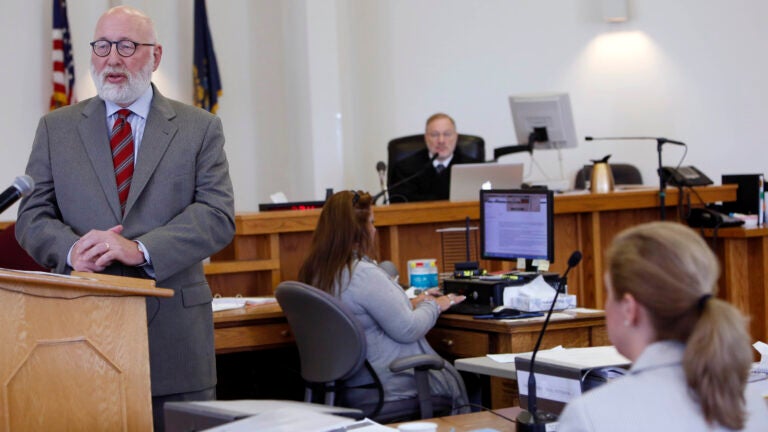
She was not going to take his questions quietly.
The 16-year-old girl was on the witness stand Thursday morning, into her third day of testifying about an encounter last year with an older prep school classmate named Owen Labrie. She says he raped her. He says it was consensual.
Defense attorney J.W. Carney was doing the questioning, holding up a transcript of her interview with Concord, New Hampshire police not long after the incident. He read her sometimes contradictory words back to her, with all the “ums’’ and “likes’’ in there, as she requested.
You missed a word, she told him.
Carney looked down at the page.
“‘Um,’’’ he read. “Does that change the meaning of the sentence?’’
“Yes,’’ she said. “It does.’’
It was a standoff between the defense attorney with nearly 40 years of experience in courtrooms — who’s represented mobsters and murderers, such as James “Whitey’’ Bulger — and a 16-year-old not-yet junior in high school.
In that moment, it appeared, she won.
Cross-examinations are almost always contentious, and it’s a fine line to walk between being too aggressive or too lenient, attorneys say. Outside the courthouse Thursday afternoon, Carney admitted as much.
“You try to be professional, polite, respectful,’’ he said, “And I believe I was all three of those things today.’’
Lawyers need to choose their style, their pitch, their level of intensity, said Boston-based defense attorney and former prosecutor Tom Hoopes, also a fellow of the American College of Trial Lawyers. You have to decide what your beginning, middle, and end will be, all while sparring with an uncooperative partner.
“It’s like a play, a movie. You’re trying to impact and affect the jury, at the same time you’re trying to control the witness,’’ Hoopes said. “It sounds tricky. It is.’’
The key to Carney’s defense seems to be that the girl, who Boston.com is not naming, sent mixed messages to Labrie, now 19. She went willingly with Labrie to a secluded room on the campus of St. Paul’s School in Concord. It was all part of a graduation game called Senior Salute, where upperclassmen tried to hook up with fellow students before leaving the school.
Carney pointed to the comments the girl made to friends about her expectations for the encounter, her “hahahas’’ in friendly chats after the alleged assault, and her laughter during the hookup itself. How was Labrie supposed to know she wasn’t enjoying herself, Carney asked.
For the most part, during the cross-examination, the girl kept her emotions under wraps. Only once did she lash out, when asked by Carney why she said she was cloudy in her recollections of the days before the meetup with Labrie.
“I was raped. I was violated in so many ways,’’ she yelled. “Of course, I was traumatized.’’
Carney offered her a break, but after the prosecutor comforted the girl for a moment, they continued.
At some points, Carney seemed to get frustrated with the girl. In response to his questions, she rambled a bit, explaining her answer. He told her that he’d be asking the questions, and she should respond with a yes or a no. She agreed.
Later, Carney asked the judge to direct her to answer yes or no to his questions. But the judge sided with her. “She is entitled to explain her answer,’’ he said.
After court, Carney was asked about the girl’s pushback, her demanding he read the transcript fully. It seemed to some observers to be a jab at the defense attorney, who earlier in the trial asked for her emails and Facebook messages to be read in full, all the “hahahas’’ included.
“I don’t think I’ve ever experienced that in my entire career,’’ he told reporters. “That a witness would push back about insisting on including an ‘um’ in a statement to make it accurate.’’
He said he may talk about it in his closing argument.
Her aggressiveness could backfire, said Eric Wilson, a New Hampshire criminal defense attorney.
“If the victim is challenging the cross examination … that may send the message to the jury that if she can challenge a seasoned defense lawyer, why couldn’t she challenge the defendant,’’ he said.
Many sexual assault survivor advocates point to the often invasive cross-examination questions as a reason why rape victims don’t report. But defense attorneys have to attack the credibility of the chief witness, no matter what the case, Wilson said. In rape cases, that witness is also usually the victim.
“Whether it’s a murder, a rape, a drug deal, or some other violent felony,’’ he said. “It’s the credibility of the prosecution’s main witness … what the case comes down to.’’
It’s the system lawyers, victims and defendants have to operate in.
“We’ve been doing this since before the Magna Carta,’’ Hoopes said. “It’s been the best engine for the truth and it works. It doesn’t come for free. There’s a price. And unfortunately, sometimes the victims have to pay it.’’
A recent history of New England prep school scandals
[bdc-gallery id=”112781″]





To comment, please create a screen name in your profile
To comment, please verify your email address
Conversation
This discussion has ended. Please join elsewhere on Boston.com