
Do you have to tell a cop you’re using a dash cam?
Medford Police Detective Stephen Lebert was warned he was being filmed, but he didn’t need to be.
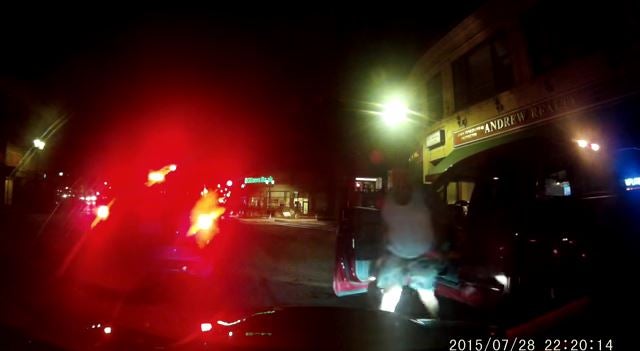
Late Sunday night, Mike, a 25-year-old from Malden, went the wrong way through a rotary and was pulled over by Medford Police Detective Stephen Lebert,who told Mike he was going to “blow a hole through [his] f—ing head.’’
Mike captured the exchange on his dash camera, and told Lebert he was being recorded. Lebert said he would seize the camera for evidence.
But Lebert can’t do that. And Mike didn’t even have to tell him he was filming.
In Massachusetts, it is illegal to secretly record someone without their prior consent, but there is precedent for recording police officers, according to Sarah Wunsch, Deputy Legal Director of the Massachusetts ACLU.
In Glik v. City of Boston, Simon Glik recorded an arrest that he thought used an excessive amount of force in Boston Common. Authorities claimed Glik violated the state’s wiretapping law—the one that prohibits secret audio recordings. But Glik’s recordings weren’t secret: He did not intentionally hide his recording device. The court ruled that there is a First Amendment right to record police carrying out their duties in public.
But what counts as public? Is there a difference between witnessing an interaction with the cops in a public setting like the Boston Common and being pulled over by one police officer?
“When an officer stops a vehicle, he’s carrying out his duties in a public place,’’ Wunsch told Boston.com.
The Medford video made Wunsch think of the 1998 Michael Hyde case, where Hyde was arrested when he started a tape recorder as soon as he was pulled over for car exhaust and an unlit license plate. He didn’t tell the cops he was recording.
This instance was before the Glik case, but is still relevant to understand what is allowed. Though Wunsch still thinks it was wrongly decided, the court upheld Hyde’s conviction because he secretly recorded the officer. A dash cam is not secret, according to Wunsch.
“If the recording device was in plain sight, he would not have been guilty of violating the statute,’’ she said. “A dash cam is obvious enough to the police. It doesn’t matter if the officer doesn’t notice it: It’s in plain sight, it’s not hidden, it’s not secretly recording. The First Amendment protects this activity.’’
Mike told Lebert and the other officers that arrived on scene that he was recording. In the 2012 video of Lebert, he makes a comment that “they just like to record us’’ when a bystander films him.
“Police need to assume anyone nearby may be recording,’’ Wunsch said. “They’re everywhere.’’
But what can be done with those recordings? In the video, Lebert threatens to seize the dash cam, but Wunsch said though he may try, that’s not allowed.
“That would be a violation of the First Amendment—the officer would say ‘I’m going to use it for evidence,’ but really he’d be destroying the evidence,’’ she said. “They’re retaliating against somebody exercising their rights.’’
Wunsch admits that standing up to a police officer is not a pleasant situation to be in, but stresses both sides benefit when police actions are recorded. She also strongly supports body cameras for police. The same assumption would apply that body cameras are obvious enough that it would not be a secret recording of the public, Wunsch said.
But how should you respond to an officer who is trying to force you to stop recording?
“You can say to the officer, ‘I know I have a right to record you carrying out your duties,’’’ Wunsch said. “But when people have been known to insist on their rights, it can also inflame the officer. There’s a phenomenon where sort of disrespecting the police officer can often land you getting arrested for no reason except that you’ve challenged the authority of the police officer. We’re not looking to see people get arrested.’’
When it comes to Lebert, Wunsch understands any apprehension about standing your ground.
“Chief [Leo] Sacco called him a great police officer, and that’s hard to believe,’’ she said. “It looks like he has a pattern of this.’’
Wunsch said there are also apps that allow videos to be streamed online immediately, allowing the footage to be available even if an officer takes the camera. So feel free to record without announcing it—as long as you aren’t intentionally hiding your recording device. There is one thing you aren’t allowed to do though: interfere. Wunsch said that was an important part of Glik—you have a right to record, but you can’t do so in such a way that you’re getting in the way.
“In [the Medford case], this guy was stopped in his own car,’’ said Wunsch. “He was not interfering in anything else.’’



To comment, please create a screen name in your profile
To comment, please verify your email address
Conversation
This discussion has ended. Please join elsewhere on Boston.com