
7 essential reads about the dead Boston Olympic bid
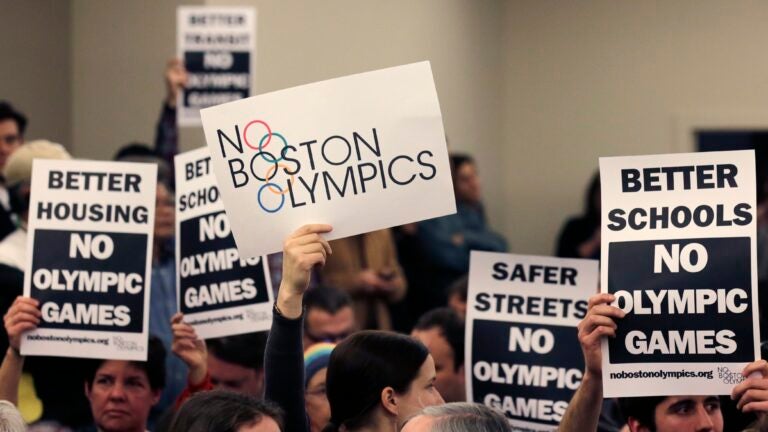
The Boston 2024 Olympic bid died a slow death, but the final blow came from Boston Mayor Marty Walsh on Monday. In an impromptu press conference, Walsh told the public he wouldn’t commit to a contract that would put taxpayers on the hook for Olympic costs. Hours later, the United States Olympic Committee and Boston 2024 announced a compromise wouldn’t be made.
As the brouhaha wanes, brush up on the failed bid’s biggest stories.
“They just don’t want the Olympics’’
Ahead of a recent public meeting about the Boston Olympic bid, Chris Dempsey marched into Burden Hall, a building at Harvard Business School, and found a seat square in the middle of the auditorium. The venue’s name was fitting. As one of the three co-chairs of No Boston Olympics, he has served as a thorn in the side of the city’s bid to host the 2024 Summer Games for more than a year.
Dempsey would be joined after the start of the meeting by co-chair Kelley Gossett. Liam Kerr, the group’s third leader, would catch up on what happened in the early morning while rocking his 6-month-old son back to sleep.
Read the full Boston.com article here.
“Meet the guys who got the Boston 2024 movement started’’
The forces behind Boston’s Olympic bid at this point are a who’s who of power players in the city and the region. Boston 2024’s stakeholders include executives at Suffolk Construction, Hill Holliday, State Street, Mass Mutual, and Bain Capital; it’s brought in the leaders at some of the world’s best known colleges; and it has the support of prominent names in political and legal circles. … The first people to float the 2024 idea in Boston, however, were several rungs lower than any of Boston 2024’s leaders in the city’s power hierarchy.
At the conclusion of the 2012 London Olympics, Corey Dinopoulos, a Dracut native and a Boston resident since college, got the itch.
Read the full Boston.com article here.
“John Fish’s Olympic flameout’’
From his expansive fifth-floor Roxbury office, John Fish looked out at the Boston skyline in the early-morning hours of January 8, 2015—decision day for the U.S. Olympic Committee—and saw a city with his fingerprints all over it. From the 60-story Millennium Tower at Downtown Crossing to the Mandarin Oriental on Boylston Street, where Fish lives in a $7 million, 4,700-square-foot luxury condo, he’d spent his lifetime building much of the city’s past and present. … But those were just things. Fish had always been far more interested in ideas, power, and, more recently, building Boston’s future.
Read the full Boston Magazine story here.
“Steve Pagliuca’s career path is strikingly similar to Mitt Romney’s’’
The similarities between Steve Pagliuca, the new leader of Boston 2024, and his former boss Mitt Romney are starting to get eerie. Both graduated from Harvard Business School and then took their degrees to Bain & Company. Both then moved over to the offshoot investment firm Bain Capital as executives, amassing considerable wealth while doing so. Both unsuccessfully ran for U.S. Senate … And now, with Pagliuca taking over Boston 2024 in an attempt to save the city’s unpopular Olympic bid, he has the chance to add “Olympics turnaround artist’’ to his checklist of Romney-like career moves.
Read the full Boston.com story here.
“Dear USOC: Bostonians love to hate everything’’
Dear United States Olympic Committee:
You may think Bostonians don’t want to host the Olympics, but then you don’t know Boston. … Out where you are in Colorado, everyone is so damn happy. You and your 300 days of sunshine. And now all that legalized marijuana makes everything oh so groovy.
Rocky Mountain High we are not. We get a kick out of knocking people down, putting everyone in their place when they get too big, too successful, too soon. If the Games were ever held here, revenge would be an Olympic sport. At this point, you’re probably saying to yourselves: What on God’s green earth is this place they call Boston? It looks like something out of a gladiator movie. How fast can we move our five-ring circus to LA?
Read the full Boston Globe story here.
“This is what has everybody so worried about the Boston Olympics’’ (and wound up killing it)
The specter of public financing has been the chief concern about Boston’s Olympic bid. Organizing group Boston 2024 has said it will privately pay for venues and Olympic operations, with the state covering some infrastructure costs. It has further said it will heavily insure the games to protect against needing the public’s financial support. Even so, the poll shows doubts organizers can keep the pledge of a privately financed games. That may be because one key element of hosting the Olympics looms over it: the government guarantee to cover any shortfalls in the private budget for the games.
Read the full Boston.com story here.
“Widett Circle businesses still feel shut out of Olympic process’’
Under Boston 2024’s proposal, the 80-acre stadium site is nestled into Widett Circle, stretching north over city- and state-owned parcels currently used as a tow lot, salt lot, and MBTA transfer station. New Boston Food Market, the only facility under a Widett Circle address, occupies 20 acres. Organizers have also re-named the area as “Midtown’’ but repeatedly referred to the stadium being sited at Widett Circle. [Presidents of New Boston Food Market subsidies, Michael Vaughan and Marion Kaiser] added that repeated references to Widett Circle as a “scar’’ were hurtful to the business owners and more than 700 employees where the vast majority of the city’s meats, fish, produce and other food stocks are stored and processed.
Read the full Dorchester Reporter story here.
What Boston might have looked like if it hosted the Olympics:
[bdc-gallery id=”115186″]




To comment, please create a screen name in your profile
To comment, please verify your email address
Conversation
This discussion has ended. Please join elsewhere on Boston.com