
Someone sees a dorsal fin. Does that mean lifeguards will close the beach?
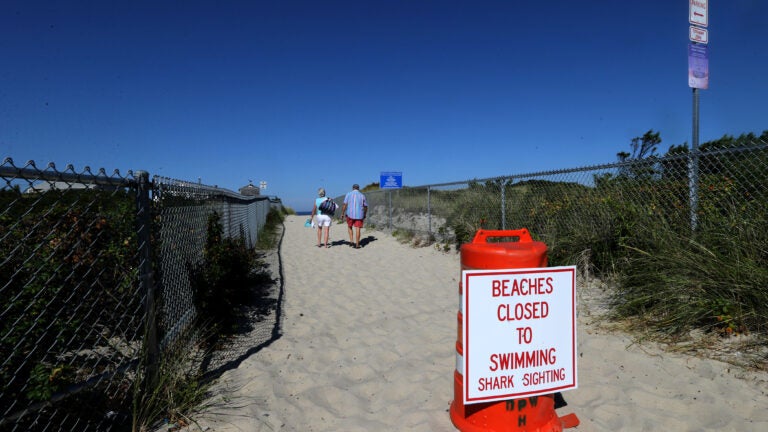
“Freckles’’ was out for a swim off the coast of the Cape when shark researchers spotted her Monday. The 15-foot female is the first great white researchers identified in Massachusetts this year, but, as the weather warms up, they predict we’ll start to see more of her friends.
But, what’s playtime for sharks can mean an end to water activities for the Cape’s beachgoers.
Leslie Reynolds, chief ranger of the Cape Cod National Seashore, said closing the beach for a shark sighting is rare, but it does happen to protect beachgoers’ safety. The National Seashore has been home to an increasing number of gray seals in the past few decades, which draws more great whites who prey on them.
Reynolds said in 2014, there were 19 reported shark sightings on the National Seashore, but only two confirmed sightings resulting in beach closures. In 2013, there were 10 reported shark sightings, only three of which were confirmed and resulted in beach closures.
She said the National Park Service has a beach-closing procedure that applies to the six National Seashore beaches that are manned by lifeguards. It doesn’t, however, apply to all beaches on the Cape, as some towns choose to follow their own procedures.
Here’s what happens when lifeguards consider closing a beach:
1. Make sure there’s actually a shark.
Not a bird or a seal or a floating piece of garbage. The National Seashore classifies shark sightings in two ways: unconfirmed and confirmed. An unconfirmed sighting is when someone who doesn’t have marine life identification training says they saw a fin.
A confirmed sighting occurs when a lifeguard or law enforcement ranger spots a fin in the water. If an untrained person has a picture or video of a fin and shows it to someone with marine identification training, then the sighting will also be considered confirmed. (You know, pics or it didn’t happen.)
2. Get people out of the water.
Once the fin is determined to be a shark, playtime in the water is fin-ished. The shrill sound of lifeguard whistles fills the air as lifeguards warn people to get out of the water. Because their chairs are spaced far apart and the yells of lifeguards might not travel down the length of the beach, guards will use hand signals to get one another’s attention, Reynolds said.
3. Alert the other beaches.
Once everyone is out of the water, and, in case the whistles and yells aren’t clear enough, lifeguards will patrol the beach to let people know there was a sighting. On the Seashore, beaches within one mile will also receive a warning and their status will be changed to “wading only,’’ meaning people can’t travel far out into the water.
4. Wait.
For at least an hour. But, if a lifeguard feels that the shark was hanging around the area for an extended period of time, Reynolds said the lifeguard might decide to close the beach for a longer period of time.
5. Get back at it.
Once it’s seemed “safe,’’ beachgoers can resume all water activities again.
6. But stay alert.
Reynolds said most of the shark sightings are basking sharks or sunfish, because great whites are stealth, and often travel unseen.
The National Park Service released a list of tips for beachgoers, which include only swimming in areas where your feet can touch, to swim in groups, and to avoid seals, which are a favorite prey of great whites.
Of course, “Freckles’’ and other great whites aren’t the only sharks found in New England. Check out these other common breeds:
Sharks you might see in New England
[bdc-gallery id=”111399″]



To comment, please create a screen name in your profile
To comment, please verify your email address
Conversation
This discussion has ended. Please join elsewhere on Boston.com