
Tsarnaev: ‘I’m sorry for the lives that I have taken’
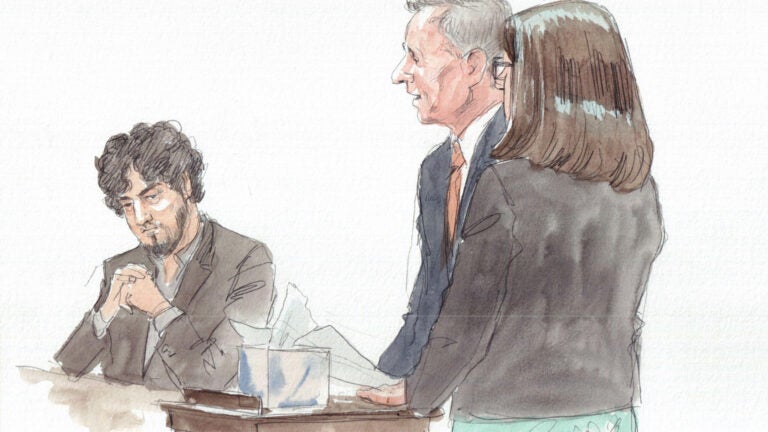
After two years of silence, Boston — and the world — got to hear from Dzhokhar Tsarnaev.
There were no cameras in the courtroom to capture Tsarnaev’s words, so those outside the Moakley Courthouse had to rely on a transcript or reporters’ accounts. He invoked the name of God multiple times as he apologized for the death and mayhem he caused at the 2013 Boston Marathon bombing.
“The Prophet Muhammad, peace and blessings be upon him, said that if you do not — if you are not merciful to Allah’s creation, Allah will not be merciful to you,’’ he said. “So I’d like to now apologize to the victims, to the survivors.’’
Read Dzhokhar Tsarnaev’s full statement here.
Tsarnaev, who in May was convicted on multiple charges related to the bombing, described learning about his victims after he placed the bombs on Boylston Street.
“Immediately after the bombing, which I am guilty of — if there’s any lingering doubt about that, let there be no more,’’ he said. “I did do it along with my brother — I learned of some of the victims. I learned their names, their faces, their age. And throughout this trial more of those victims were given names, more of those victims had faces , and they had burdened souls.’’
For the first time, survivors heard Tsarnaev’s voice.
“Nobody realized we didn’t know what it sounded like after two years,’’ said survivor Lynn Julian. “After we heard it, we wish we hadn’t.’’
Julian said what Tsarnaev had to say was “shocking.’’ She was upset at his declaration of thanks for his legal team for making his life “easy’’ the past two years, “while our lives have been anything but easy.’’
What she wanted was a simple, believable apology.
“There was nothing simple about what he said and there was nothing sincere,’’ Julian said.
But Henry Borgard, a fellow survivor, said he was glad to hear what Tsarnaev had to say.
“For me to hear him say he is sorry, that is enough for me,’’ he said. “And I hope because I still do have faith in humanity, including in him, I hope that his words were genuine. I hope they were heartfelt. I hope they were as honest as the statements you heard today in court from the survivors.’’
It took courage to make a statement as a survivor, Borgard said. It took courage for Tsarnaev to speak, too.
“The fact that he made a statement, which he didn’t have to do, gives him a little bit of credit in my book,’’ he said.
Borgard, 23, who spoke in court of having to drop out of Suffolk University because of the bombing’s mental and physical affects, said he looked up at one point during his statement and locked eyes with Tsarnaev.
It wasn’t like looking at the face of a criminal. It was the face of a boy.
“He’s a human being,’’ he said. “I believe in second chances.’’
U.S. Attorney Carmen Ortiz said she was struck not by what Tsarnaev said in his religiously-focused statement, but on what he didn’t say.
“He didn’t renounce terrorism,’’ she said. “He didn’t renounce violent extremism. And he couched his comments in line with Allah and Allah’s views.’’
After Tsarnaev finished speaking, Judge George O’Toole formally sentenced him to death.
“No one will remember that your teachers were fond of you … That you were funny, a good athlete,’’ O’Toole said. “What will be remembered is that you murdered and maimed.’’
Read Judge O’Toole’s full statement here.
Tsarnaev stood as his death sentence was announced. O’Toole ordered he be executed at a federal facility in Indiana.
“I sentence you to death by execution,’’ O’Toole said before Tsarnaev was led out of the courtroom.
Read updates from the Moakley Federal Courthouse below.
[fragment number=0]
The Dzhokhar Tsarnaev trial in courtroom sketches
[bdc-gallery id=”147383″]



To comment, please create a screen name in your profile
To comment, please verify your email address
Conversation
This discussion has ended. Please join elsewhere on Boston.com