
Marathon bombing survivor: ‘He chose hate … We choose love’
Survivors tell of their new lives after April 15, 2013.
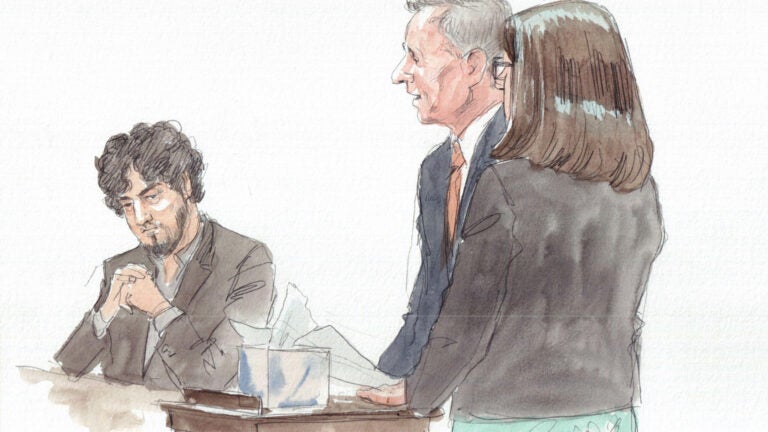
For three hours, he listened to stories of injuries suffered, careers derailed, marriages strained, and lives lost.
Twenty four people stood Wednesday in Courtroom 9 of the U.S. District Court in Boston before the cause of all their pain, Dzhokhar Tsarnaev.
They already knew the Boston Marathon bomber’s fate: death, as decided by a jury on May 16, for murdering Krystle Campbell, Lingzi Lu, Martin Richard, and Sean Collier.
There were the physical injuries—shrapnel removed, limbs severed, hearing damaged, brains concussed. The emotional wounds—the mourning of the lives they once had, the fear of crowds, the inability to ever feel safe.
Then, there was the guilt of placing friends and family in harms way, of surviving.
But there was also hope. And resilience. And triumph.
Bill and Denise Richard, now a family of four instead of five, spoke of Tsarnaev’s decisions in the past, and their family’s decisions in the future, without 8-year-old Martin.
“He chose hate. He chose destruction. He chose death,’’ Bill Richard said, his wife by his side. “This is all on him. We choose love. We choose kindness. We choose peace.’’
Meghan Zipin told Judge George O’Toole that he had given her and her fellow survivors a difficult task of describing the impact of their suffering. The best way to think of it, she said, was to imagine a ripe dandelion, fuzzy seeds forming a perfect sphere.
Then blow it away.
“You’ll never be able to put it back together,’’ she said. “With this question you’ve asked me to find these pieces and make it a sphere. You’ve asked 260 survivors to find the pieces and make their sphere.’’
But though Zipin’s not fully back together, she does have lots that Tsarnaev never will have. She’ll go sleep in her comfy bed, eat pizza, go to yoga. He’ll go back to a cell.
“I’m the one who’s alive,’’ she said. “And the defendant, he’s already dead.’’
For those who survived, they are living different lives than they had before April 15, 2013. Jobs were abandoned. Marriages ended. Bank accounts were drained.
Even tiny moments are different now. Michael Chase, who ran from his wife to help little Jane Richard on Boylston Street, spoke of the first time he carried his 4-year-old daughter from their car to the house. He had to put her down and began crying, shaking.
“It was the first time I picked up a young girl since that moment,’’ he said.
Henry Borgard, a college student walking home from work when he got caught in the bombings, can’t go to his hometown Fourth of July parade anymore. Richard Donohue can’t take care of his 2-year-old son without his wife’s help. Scott Weisberg can’t use a stethoscope to listen to his patients’ heartbeats.
“Now in my journey to reclaim my life I realize I am starting over,’’ said Jennifer Rogers, Sean Collier’s sister. “I’ll never have a complete and happy family again.’’
They pitied Tsarnaev for what he wasted.
Patricia Campbell, mother of Krystle Campbell, said Tsarnaev was brought here for a better life by his parents and squandered it.
“I know life is hard, but the choices that you made are despicable and what you did to my daughter is disgusting,’’ she said. “I really wish you had gotten help for your brother.’’
“He is a leech,’’ Collier’s sister, Rogers, said. “Abusing the privileges of American freedom and he spit on the face of the American dream.’’
U.S. Attorney Carmen Ortiz said today wasn’t just the conclusion of one part of the trial, but a time for the victims to have a voice.
“Today was an incredibly powerful day,’’ she said after the hearing.
“I have been so touched and so moved and inspired by their strength, their courage and their resiliency,’’ she said. “And also voices of hope.’’
JP Craven, another survivor, saw hope in Tsarnaev.
“As ironic as it now seems, Dzhokhar now possesses the ability to be a force for change (to those) many of us wouldn’t have the ability to reach,’’ he said.
The survivors thanked the jury. They thanked the prosecutors. They thanked the investigators who spent days on Boylston Street and weeks talking to witnesses.
Rebekah Gregory, in a bright blue dress and yellow necklace, refused to call what she was saying a “victim’’ impact statement. For that, she said, she’d have to be someone’s victim.
“That’s why it’s so funny to me that you smirk and flip off the camera,’’ she told him. “Because that’s what we’re doing to you every day we continue to succeed, fake limbs or not.’’
Then she gave him a promise: to keep changing the world in a way that he never will.




To comment, please create a screen name in your profile
To comment, please verify your email address
Conversation
This discussion has ended. Please join elsewhere on Boston.com