
This Massachusetts woman could become the face of the $10 bill.
Meet Frances Perkins
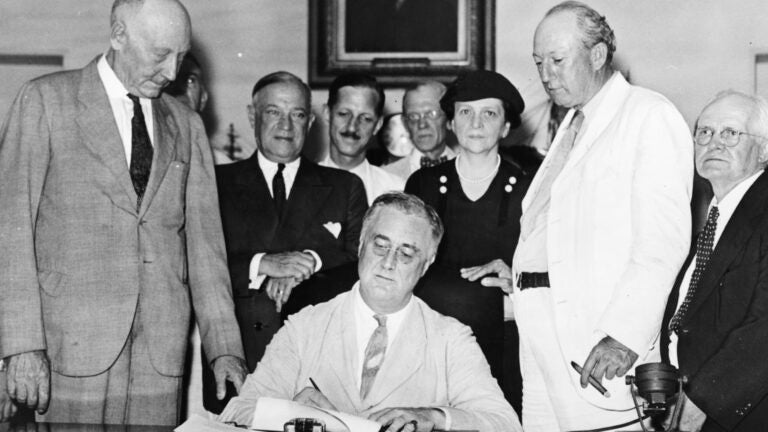
After news broke last week that the U.S. Treasury plans on putting a woman on the $10 bill, the next question was which famous American heroine it would be.
Debate ensued. Harriet Tubman may have had the momentum after winning an online vote in an earlier campaign to replace Andrew Jackson on the $20. Eleanor Roosevelt, Rosa Parks, and former Cherokee Nation chief Wilma Mankiller were also finalists in the Women on 20s poll.
However, a Boston woman has recently picked up a small surge of high-profile endorsements to join Alexander Hamilton on the $10. Her name is Frances Perkins.
While she may not be as well known today as the aforementioned American women, Perkins, labor secretary for President Franklin Delano Roosevelt, was arugably just as accomplished, forging the foundation of our social safety net, including Social Security and the minimum wage.

Frances Perkins
Perkins was born in Boston in 1880 and went to high school in Worcester. In 1902, she graduated from Mount Holyoke College, president of her class, with majors in both chemistry and physics, according to the college’s website. While in college, she was required for a class to visit and interview local factory workers in Holyoke about their working conditions.
After three decades campaigning for women’s suffrage and worker’s rights, she became the first woman cabinet member in U.S. history as Roosevelt’s labor secretary. And she was one of only two cabinet members to serve for the entirety of Roosevelt’s presidency from 1933 to 1945.
Under Roosevelt, she was a “major advocate for unemployment insurance and Social Security,’’ wrote Occidental College professor Peter Dreier. In the midst of the Depression, she seized the opportunity and pushed for a landslide of legislation.
While Perkins was the head of the Labor Department, the government established a minimum wage, the 40-hour work week, paid overtime, workers’ rights to unionize, unemployment insurance, and — last but not least — Social Security, for which she was particularly passionate.
From Dreier’s Huffington Post article:
“In a meeting with Roosevelt present, she went around the table and extracted from each of the major members of her committee a pledge to support the program being prepared by the committee. Publicly obligated, they could not back down later.’’
Frances later called committee leaders to her home, “led them into the dining room, placed a large bottle of Scotch on the table, and told them no one would leave until the work was done,’’ according to Downey.
With Perkins at the helm, they crafted a bill. She smartly tied together several key ideas. Unemployment insurance would tide over the jobless workers who were the primary source of support to children. Social Security would provide old people with pensions so they could retire without falling into desperate poverty.
…
But then the president got cold feet, pressured by conservatives within his Cabinet and Congress, and decided it would have to wait. As Downey explained:
“Perkins hit the roof. ‘That man, that man!’ she muttered. She ripped over to the White House. The next day, FDR told the press conference that he was ‘tremendously’ for the bill.’’
Now Perkins would be on the $10 bill when it’s refurbished in 2020, if it were up to a few powerful female politicians.
“I would add Frances Perkins, who is the first woman Cabinet officer and the author of Social Security,’’ said Nancy Pelosi last week. “She certainly has affected many lives.’’
Joining the House minority leader was New Hampshire Sen. Jeanne Shaheen, who led the charge to put a woman on the $20.
“I like Frances Perkins,’’ Shaheen told NHPR. “She’s from New England. She was the first woman cabinet member, the longest-serving Secretary of Labor in history.’’
Perkins died in 1965, and the Department of Labor building in Washington, D.C., was named in her honor in 1980.
Even if Perkins isn’t picked for the $10, there’s noreason Andrew Jackson can’t bereplaced on the $20 sometime soon.
2016 presidential candidates
[bdc-gallery id=”140212″]








To comment, please create a screen name in your profile
To comment, please verify your email address
Conversation
This discussion has ended. Please join elsewhere on Boston.com