
How Tsarnaev was sentenced to death
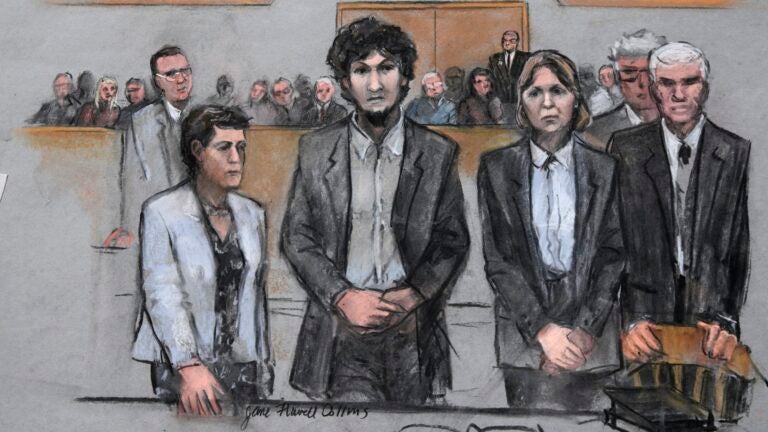
Below are the jury’s findings in sentencing Dzhokhar Tsarnaev to death for bombing the 2013 Boston Marathon.
Tsarnaev was eligible for the death penalty on 17 charges, which he had already been found guilty of during the prior phase of his trial.
Jurors were first asked if they agreed that Tsarnaev was at least 18 years of age at the time of his crime.
Yes.
Jurors were asked to consider “gateway factors,’’ which if found to be true, would allow for the death penalty to be considered.
1. Tsarnaev intentionally killed his victims: Yes, on some applicable counts.
2. Tsarnaev intentionally inflicted serious bodily injury: Yes, on some applicable counts.
3. Tsarnaev intentionally participated in an act, contemplating that it would take a life: Yes, on all applicable counts.
4. Tsarnaev intentionally engaged in an act of violence knowing it created grave risk of death, such that participation constituted a reckless disregard for human life: Yes, on all applicable counts.
Jurors were asked to consider “statutory aggravating factors,’’ which defined elements of the trial that could lead to the death penalty.
1. Death occurred with the use of a weapon of mass destruction and/or the destruction of property affecting interstate commerce by explosives: Yes, on all applicable counts.
2. Tsarnaev created a grave risk of death with the offense: Yes, on some applicable counts.
3. Tsarnaev committed the offense in an especially heinous, cruel, or depraved manner: Yes, on some applicable counts.
4. Tsarnaev committed the offense after substantial planning and premeditation: Yes, on all applicable counts.
5. Tsarnaev intentionally killed and attempted to kill more than one person: Yes, on all applicable counts.
6. Tsarnaev is responsible for the death of a victim, Martin Richard, who was particularly young and vulnerable: Yes, on all applicable counts.
Jurors were asked to consider “non-statutory aggravating factors,’’ that if found to be true would make the death penalty more likely.
1. Tsarnaev made statements suggesting that others would be justified in committing additional acts of violence and terrorism: No, not unanimously proven.
2. Tsarnaev caused injury, harm and loss to Krystle Campbell, Martin Richard, Lingzi Lu, Sean Collier, and their friends and families: Yes, on all applicable counts.
3. Tsarnaev targeted the Boston Marathon, which draws large crowds: Yes, on all applicable counts.
4. Tsarnaev demonstrated a lack of remorse: Yes, on all applicable counts.
5. Tsarnaev murdered a law enforcement officer, Sean Collier, while the officer was engaged in police activity: Yes, on all applicable counts.
6. Tsarnaev participated in other uncharged crimes on April 15, 2013 in Boston and April 19, 2013 in Watertown: Yes, on all applicable counts.
Jurors were asked to consider mitigating factors, which the defense intended to offset the aggravating factors and which were presented during the sentencing phase of the trial.
1. Tsarnaev was 19 years old at the time of the offenses: 12 jurors agreed.
2. Tsarnaev had no prior history of violent behavior: 11 jurors agreed.
3. Tsarnaev acted under the influence of his older brother, Tamerlan: 3 jurors agreed.
4. Tsarnaev was susceptible to his older brother’s influence: 3 jurors agreed.
5. Tamerlan planned, led, and directed the bombing: 3 jurors agreed.
6. Tamerlan shot and killed Sean Collier: 2 jurors agreed.
7. Tsarnaev would not have committed the crimes if not for his brother: 3 jurors agreed.
8. Tsarnaev’s teachers knew him to be hardworking, respectful, kind, and considerate: 12 jurors agreed.
9. Tsarnaev’s friends knew him to be thoughtful, caring, and respectful: 11 jurors agreed.
10. Tsarnaev’s teachers and friends still care for him: 3 jurors agreed.
11. Tsarnaev’s aunts and cousins still care for him: 12 jurors agreed.
12. Mental illness and brain damage disabled Tsarnaev’s father: 12 jurors agreed.
13. Tsarnaev was deprived of needed stability due to his father’s mental illness: 2 jurors agreed.
14. Because of his father’s mental illness, Tamerlan was the dominant male in Tsarnaev’s life: 2 jurors agreed.
15. Tsarnaev was deprived of the stability and guidance he needed due to his mother’s emotional volatility and religious extremism: 1 juror agreed.
16. Tsarnaev’s mother facilitated Tamerlan’s radicalization: 10 jurors agreed.
17. Tamerlan became radicalized first, and then encouraged his brother to follow: 5 jurors agreed.
18. Tsarnaev’s parents’ return to Russia in 2012 made Tamerlan the dominant adult in his life: 2 jurors agreed.
19. Tsarnaev is highly unlikely to commit acts of violence in the future while serving a life sentence in federal prison: 1 juror agreed.
20. The government has the power to restrict Tsarnaev’s communcation with the outside world while in custody: 2 jurors agreed.
21. Tsarnaev has expressed sorrow and remorse for the suffering he caused: 2 jurors agreed.
The jurors found that Tsarnaev should be sentenced to death on six counts.
Count 4: Use of a weapon of mass destruction (Pressure Cooker Bomb #2) on or about April 15, 2013, in the vicinity of 755 Boylston Street in Boston, Massachusetts, and aiding and abetting, resulting in deaths of Lingzi Lu and Martin Richard.
Count 5: Possession or use of a firearm (Pressure Cooker Bomb #2) during and in relation to a crime of violence, namely, use of a weapon of mass destruction as in Count Four of this section, and aiding and abetting, resulting in deaths of Lingzi Lu and Martin Richard.
Count 9: Bombing of a place of public use (Pressure Cooker Bomb #2) on or about April 15, 2013, in the vicinity of 755 Boylston Street, Boston, Massachusetts, and aiding and abetting, resulting in deaths of Lingzi Lu and Martin Richard.
Count 10: Possession or use of a firearm (Pressure Cooker Bomb #2) during and in relation to a crime of violence, namely, the bombing of a place of public use as in Count Nine of this section, and aiding and abetting, resulting in deaths of Lingzi Lu and Martin Richard.
Count 14: Malicious destruction of property by means of an explosive (Pressure Cooker Bomb #2) on or about April 15, 2013, in the vicinity of 755 Boylston Street in Boston, Massachusetts, and aiding and abetting, resulting in deaths of Lingzi Lu and Martin Richard.
Count 15: Possession or use of a firearm (Pressure Cooker Bomb #2) during and in relation to a crime of violence, namely, malicious destruction of property as in Count Fourteen of this section, and aiding and abetting, resulting in deaths of Lingzi Lu and Martin Richard.
[fragment number=0]




To comment, please create a screen name in your profile
To comment, please verify your email address
Conversation
This discussion has ended. Please join elsewhere on Boston.com