
What it’s like to get hit by a car on your bike
COMMENTARY
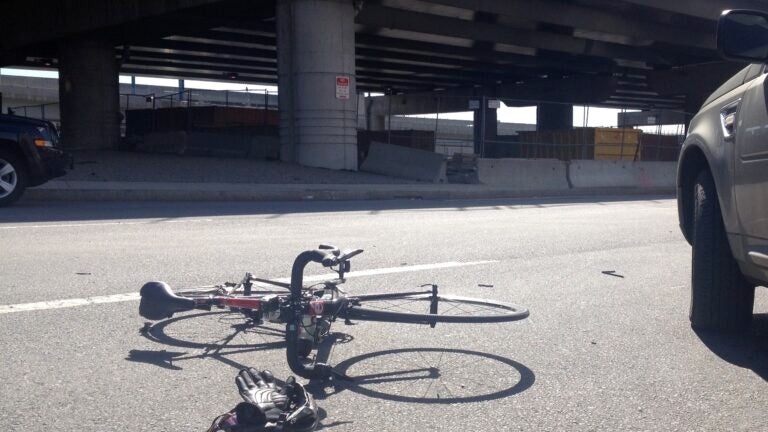
As I sat alone in the middle of a busy Boston road, I ruefully looked at my beautiful black racing bicycle lying nearby, reflecting the sun and the big silver SUV that hit me.
The bike looked naked and small next to the truck, and I felt that way too, as the wail of police sirens grew louder.
Only moments before, my bike and I were gliding north on the sidewalk along Albany Street and approaching the rear of the Pine Street Inn homeless shelter on a sunny spring morning. The long-awaited warmth seduced me into riding my nice road bike to my job at The Boston Globe that day.
I had no business riding any kind of bike on that sidewalk, though. While it is not illegal to bicycle on sidewalks in Massachusetts, it is banned in business districts — which include almost all of Boston.
Anyway: Cars don’t expect cyclists to be on sidewalks, and it’s unsafe for unsuspecting pedestrians, even on that often abandoned underbelly of I-93.
Yet there I was, pedaling along at 12 mph, the J&T Mobil parking lot coming into view and the carefree “wheeee’’ sound of my rear hub spinning freely.
Then, from the alley behind the corner of the building, the nose of a big silver shape appeared, a big truck pulling out into the road on Albany Street.
Time slowed down.
Reflexively, I swerved away from the truck and into the road and oncoming traffic. And then I realized for a terrible moment that the type of nightmarish story I heard told by too many cycling friends was happening to me.
I actually had the time in that frozen second to think to myself: “So this is what it’s like to get hit by a car.’’
And then … “Crrrunch.’’ I heard the sound of metal meeting carbon fiber, like the sick sound a plastic toy makes when accidentally run over in a driveway.
The truck connected with the left rear of my bicycle, flipping me off the bike, into the air and onto the truck. I saw a violent blur of darkness and silver as I rolled over the hood and onto the street, where I landed hard on my shoulder.
In a rush of adrenaline I jumped to my feet, as if to prove to myself I was OK. I felt dizzy, so I decided to sit down, on Albany Street.
“Where’s my helmet?’’ I wondered. I was afraid to look at my bike, but I did anyway.
A nice lady approached and helped me back to the sidewalk, and soon a police officer appeared. “Are you hurt,’’ she asked.
I inspected my body for answers.
“I think I’m OK.’’
Luckily, I wasn’t seriously hurt that day, besides some soreness, scratches, and bruises.
But really, I wasn’t alright. I felt vulnerable and exposed on the road. Blind corners gave me flashbacks. (They still do, sometimes.) For the first time, I wondered whether riding a bicycle to work was really worth the risk.
I started to feel safe a month later, when I joined the Ride on Washington, a charity ride organized by professional cyclo-cross champion Tim Johnson of Topsfield. I didn’t just feel safe because we obeyed traffic rules, respected motorists, and helped one another through difficult sections of road.
I appreciated that the ride was raising money for People for Bikes to improve road conditions for bicyclists. For example, it awarded a $10,000 grant to help a group working to extend the Somerville Community Path to Boston.
I thought that maybe, through participating in this ride, I might prevent other accidents.
So Friday, on National Bike to Work Day, I invite you to ride with us. This year, we ride on Chicago.
I speak to you on this subject not as a journalist, but as a cyclist whose objective thoughts about riding a bicycle around this city were lost on that spring day beneath the highway. I harbor hope that Boston can become an even better place to ride a bike in the future.



To comment, please create a screen name in your profile
To comment, please verify your email address
Conversation
This discussion has ended. Please join elsewhere on Boston.com