
The Long, Sprawling Legal Road Still Ahead for Aaron Hernandez
Even after his life sentencing, former New England Patriot Aaron Hernandez has not seen his last day in court. Not by a long shot.
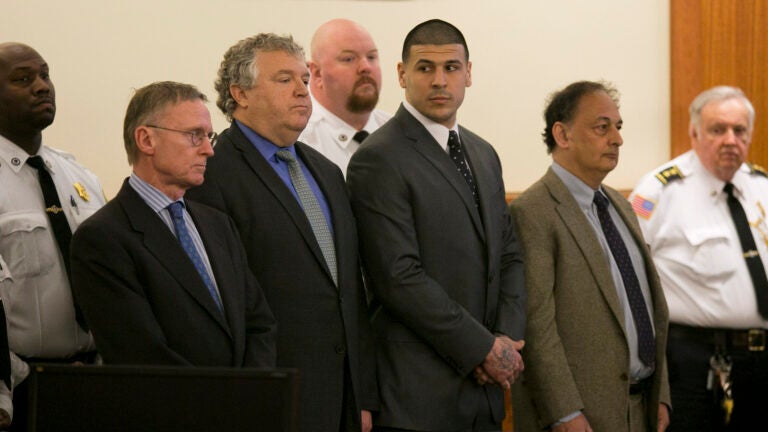
Aaron Hernandez was convicted of first-degree murder and sentenced to life in prison on April 15, but that does not mark his last day in court. The defense will automatically appeal the conviction, in which jurors found Hernandez guilty of murdering Odin Lloyd in 2013. But there’s also another upcoming murder trial and multiple shooting-related civil cases against the former New England Patriot.
Let’s take a walk down the Hernandez legal road that lies ahead. First, the appeal:
How does the appeal work?
Under Massachusetts state law, the defense is entitled to appeal a first-degree murder conviction. The same defense team that represented Hernandez during the trial — Charles Rankin, James Sultan, and Michael Fee — will file the appeal with the Massachusetts Supreme Judicial Court (SJC).
According to Suffolk Law School professor Chris Dearborn, the process will take at least a year. The trial took ten weeks, more than 130 witnesses, and thousands of pages of testimony transcript, which the defense will comb through looking for appealable material.
Will it work?
By all accounts, the chances are slim, according to Dearborn.
Despite the defense’s record of success in overturning convictions, Judge E. Susan Garsh’s conservative rulings — while at times visibly frustrating the prosecution — now make the conviction much harder for the defense to appeal. Despite asking Garsh to recuse herself before the trial, the prosecution may have Garsh to thank for a solid verdict.

Garsh’s principled decisions before and during the case may be barriers to the defense’s appeal
“She excluded a lot of evidence and information that, had she not excluded, would have been the best appellate opportunity,’’ Dearborn told Boston.com.
Among the evidence Garsh barred from the trial was the content of text messages Lloyd sent to his sister minutes before his death, a photo Hernandez took of himself holding what looks like a .45-caliber Glock, 45-caliber ammunition seized by police, and any mention of the 2012 double murder charges that Hernandez faces.
Garsh also limited what a couple ofthe prosecution’s witnesses could testify about. She even sternly instructed Lloyd’s mother not to cry during her testimony.
Former judge Tom Merrigan told the Boston Herald those decisions made the verdict “bulletproof.’’ Prosecutors appealed her rulings during the trial multiple times. Each time the SJC upheld her decisions.
What then, if any, are the opportunities for appeal?
There are at least two potential areas for the defense to target, according to Dearborn.
The first is the defense’s request to move the location of the trial due to the media coverage. Before the trial, Hernandez’s lawyers had hired a polling company, which found approximately two-out-of-three respondents in Bristol County believed Hernandez was guilty.
The defense argued that this showed the jury pool was “tainted,’’ but Garsh said more than a half-million person county was large enough to find an impartial jury, and denied the move.
Garsh repeatedly reminded jurors during the trial to avoid any news coverage or discussion of the case.
Another point of appeal is the testimony of former friend Alexander Bradley. Though earlier in the trial, Garsh did not let another acquaintance testify about Hernandez possessing guns, she did allow Bradley to testify about seeing Hernandez with what “appeared to be a Glock.’’
Allowing that particular circumstantial evidence, according to Dearborn, was slightly inconsistent with her other rulings and could be targeted by the defense.
What if the appeal is successful?
If Hernandez wins his appeal, he could request a retrial.
And, if not?
The defense could appeal to the federal court. But for a murder conviction, according to Dearborn, this occurrence is unlikely, and if successful would be ’’extraordinarily rare.’’
What about Hernandez’s co-defendants, Carlos Ortiz and Ernest Wallace?
Ortiz and Wallace, who were with Hernandez the night of the Lloyd’s death, are also charged with murder. Massachusetts’ joint venture laws means that multiple individuals can be charged (and convicted) with the same crime.
In this case, if prosecutors can prove that Ortiz and/or Wallace both knowingly participated in the murder and “did so with the intent required’’ to commit the crime, Hernandez very well may not be the only one convicted for Lloyd’s killing.
They will each get separate, independent trials, and both have pretrial status hearings scheduled. Ortiz will appear in court on June 12, and Wallace will appear on June 26, according to the Bristol County Superior Court clerk’s office.
They both have pleaded not guilty.
Ortiz’s lawyer was often present during the Hernandez trial and had requested to look at the surveillance footage used as evidence in the case.

Carlos Ortiz during a hearing at Briston Superior Court in January of 2014.
Do they stand a chance, now that Hernandez was convicted?
The circumstantial nature of Hernandez’s conviction might actually give Ortiz and Wallace a better defense, along with the benefit of hindsight.
“They’re going to have the benefit of picking apart the (Hernandez trial) transcript and maybe find some holes,’’ said Dearborn, noting juror statements that they were “shocked’’ by the defense’s admission that Hernandez was present for the killing. If anything, their lawyers can learn from the perceived mistakes of Hernandez’s lawyers.
Similar to the Hernandez case, the prosecution against Ortiz and Wallace also does not have a confession of guilt, a murder weapon, an eyewitness, and any clear motive. Those four problems, plus no current evidence that they had access to guns, as did Hernandez, could make things tough for prosecutors.
“But it’s still difficult to say without knowing the full evidence,’’ adds Dearborn.
Is there anything else relating to the Lloyd murder?
On April 22, the Lloyd family announced they were filing a wrongful death lawsuit against Hernandez, seeking unspecified compensatory damages. Additionally, aside from the impact on the former Patriot’s bank account — if there is anything left — Hernandez may be forced to take the stand in the civil suit. Unlike criminal court, Hernandez does not have the protection to plead his Fifth Amendment rights, and lawyers for Lloyd’s family said they expect to call the former NFL star to testify.
According to the family’s lawyers, they expect to have something in court “within the next few weeks.’’
And what about the other murder trial?
Hernandez is also facing double-murder charges for a 2012 drive-by shooting of two Cape Verdean immigrants — Daniel Abreu and Safiro Furtado — in Boston’s South End. Hernandez was charged with the two murders on May 15, 2014, as well as three counts of armed assault with intent to murder, one count of assault and battery with a dangerous weapon, and unlawful possession of a firearm.
What are the chances Hernandez is convicted for these murders?
Compared to the Lloyd case in which most of the evidence was circumstantial — no murder weapon, no eyewitnesses — the evidence against Hernandez for Abreu and Furtado’s murders is much stronger.
Police say Hernandez and Bradley were at Cure nightclub when Abreu accidentally bumped Hernandez and spilled his drink. This allegedly enraged Hernandez. Security footage shows Hernandez and Bradley leaving the club, before getting into a Toyota 4Runner and allegedly trailing the victims as they later walked to their car.
According to Suffolk County prosecutor Patrick Haggan, Hernandez pulled up next to the victims’ car and fired at least five shots from the driver’s side, killing Abreu and Furtado and injuring another person in the back seat. Bystanders at the scene corroborated seeing Hernandez and Bradley to police.

Salvadore Furtado pictured with a photo of his son, Safiro Furtado.
In 2014, police seized a gun linked to Hernandez that upon ballistic testing was positively matched to bullets found at the crime scene. Additionally, Bradley — who was in the car with Hernandez during the alleged shooting and since testified against Hernandez in the first murder — has been mentioned by prosecutors as a witness in this case.
Why is the 2012 double murder being tried after the 2013 murder?
Simply, police charged Hernandez with the murder of Lloyd first, despite the fact it occurred after the 2012 killings. Though police had known that Hernandez was present at the same club as the victims the night of the murder (Hernandez had left an hour before the murder), it wasn’t until they were tipped off by a witness during their investigation into Lloyd’s murder.
The witness, who worked at Rumor nightclub — where Lloyd and Hernandez partied two nights before Lloyd’s murder — said someone at the bar “accidentally spilled the beans in front of me.’’ It was then that police went back and took a closer look at the 2012 security footage.
During the past trial, prosecutors hinted that this might have provided a motive for Hernandez to kill Lloyd.
When does that trial begin?
Though it was originally slated to begin in May of 2015, the start was delayed by the Lloyd trial. According to the clerk’s office at Suffolk County Superior Court, there is no set timetable yet.
Isn’t there another alleged shooting too?
There’s a reason Bradley has turned against Hernandez. Once a good friend and godfather to Hernandez’s daughter, Bradley is suing Hernandez for an alleged shooting February 13, 2013. In the suit, Bradley says Hernandez shot him in the face and left him for dead after the two got into an argument outside a Miami strip club.

Bradley also testified for the prosecution in the Lloyd murder trial.
However, when Bradley was found by police, he refused to cooperate or to name the shooter, so the criminal investigation was closed. Bradley had to undergo multiple surgeries and lost his right eye in the incident.
Hernandez asserted his Fifth Amendment rights in response to the suit, which was filed in June of 2013, just days before Lloyd’s murder.
An official at the district court chamber where the suit was filed told Boston.com the case was on the docket, but could not issue a specific date when the suit would be heard. Bradley’s lawyer told Sporting News “the other side is not anxious to go to trial.’’ Bradley is seeking $100,000 in damages.
Is there anything else?
Yup. Like the Lloyd family, the families of Abreu and Furtado both filed wrongful death civil suits (even before criminal charges were filed, citing strong evidence) against Hernandez, each seeking $6 million.
How much money does Hernandez actually have?
As early as May 2014, Hernandez was reportedly struggling to pay his legal bills and lawyers for Lloyd’s family have expressed doubts about what assets are left.
A restraining order was placed on his $1.3 million North Attleboro house, and the Patriots have refused to pay supposed guaranteed salary and bonuses. The NFL Players Association has filed grievances against the team. Lawyers for the families of Lloyd, and the 2012 victims, will seek whatever money is paid out by the Patriots.
If Hernandez is unable to pay his expensive defense team to continue to represent him, that long legal road ahead might become a very short losing battle.
The Aaron Hernandez Murder Case in Pictures
[bdc-gallery id=”316750″]



To comment, please create a screen name in your profile
To comment, please verify your email address
Conversation
This discussion has ended. Please join elsewhere on Boston.com