
Displacement, Diversity Focus of Latest Boston Olympics Meeting
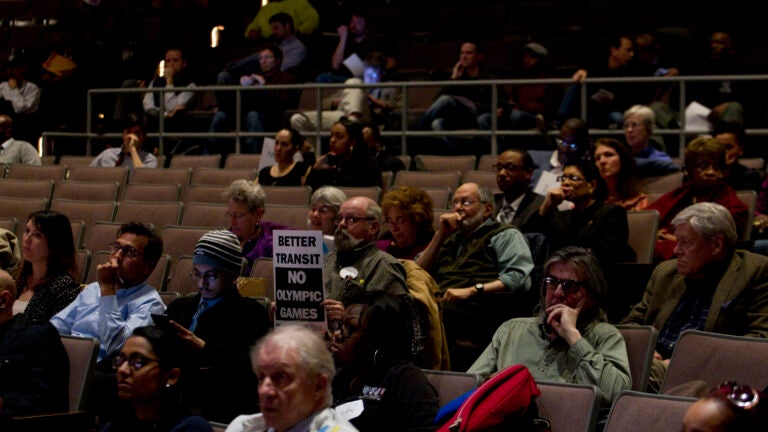
Roxbury residents voiced concerns about displacement and gentrification, a disgraced former elected official criticized a planned Olympics-related workforce development plan, and an angry man walked on stage in an attempt to join a panel of Boston 2024 officials.
It was that kind of a night for the Boston Olympics bidding committee.
At the city’s fourth monthly meeting about the bid, which was held at Roxbury Community College on Tuesday night, Boston 2024 changed up some of its tactics in pitching its plans. It kicked things off by having a Fidelity designer named Corey Dinopoulos—who helped get the Olympic bidding process started in late 2012—explain how the idea came to fruition. Dinopoulos had not spoken at previous meetings.
And the group’s general counsel, Paige Scott Reed, unveiled a proposed “localization strategy,’’ to be led by a new Boston 2024 subcommittee. It would work to ensure the involvement of women- and minority-owned businesses in hosting the games, as well as to connect Boston residents from communities of color with Olympics-related jobs. It would also seek to address issues like affordable housing—and would study past Olympic bids to see where they went wrong on that front.
But audience members seemed skeptical of the bid. During a long Q&A session, many worried that the development associated with the Olympics would accelerate gentrification in Roxbury and other neighborhoods.
“People, read between the lines,’’ activist Joao DePina said to applause from a crowd of about 300. “What is happening is gentrification, and 2024 is just another way to finish it off.’’
John FitzGerald, the city’s liaison on the bid, referred to the city’s plans to add more than 50,000 new housing units by 2030 as a way to mitigate these concerns.
But Dianne Wilkerson—the former state senator from Roxbury who served 2.5 years in prison after pleading guilty to bribery charges—argued that if past Olympics are any example, residential displacement in minority communities is “the only transformative thing’’ the Olympics would bring. She cited housing issues from the 1996 Atlanta Olympics and reported mass displacement ahead of the upcoming 2016 Summer Games in Rio de Janeiro. “Housing rights have to be central to what you do,’’ Wilkerson said. “If you don’t get this right, we will be displaced.’’
Wilkerson, who has maintained some clout since her release from prison, also said she is skeptical that Boston 2024 is capable of establishing a workforce development plan that incorporates residents from communities of color. “Somebody has to be hired who…knows what they’re doing, how to do it,’’ she said. Wilkerson added that any workforce diversity plan should include work other than construction, and should focus on working with minority-owned businesses that she said are more likely to hire minority workers in the first place.
Another man—Chris Hoeh, of Jamaica Plain, who identified himself as a director for Jamaica Plain Youth Soccer—berated Boston 2024’s plans for Franklin Park (which is the proposed site of equestrian events and more), and then asked what he would have to do to get a seat on the panel.
Boston 2024 CEO Rich Davey responded, “It takes an open mind, sir.’’ Hoeh, in response, walked on stage in an attempt to join the panel.
[fragment number=0]
Hoeh walked off the stage after FitzGerald suggested he would call security. Davey apologized for his “open mind’’ comment.
Others took more measured tones. One audience member suggested the bid committee incorporate Roxbury Community College and the Reggie Lewis Center into its plans, and another asked how the local arts community would be involved.
Still others echoed questions from previous meetings, asking when Boston 2024 will be able to present a more concrete plan and give more definitive answers.
To that end, the group provided a small update on its process, by saying it will unveil a first attempt of new plans at some point this summer, based on the feedback that has been received at public meetings to that point. On another process note, Davey said it would be more than a year before Boston 2024 will have details about a proposed insurance policy meant to safeguard the city from putting public money toward the games.
The meeting was the first held by the city in Roxbury about the Olympic bid, but it was not Boston 2024’s first. The committee had previously held its own meeting in the neighborhood in February, in which residents urged Boston 2024 to better involve Roxbury in its plans.
Past Olympics meeting coverage:
2/24: Condon School (South Boston)




To comment, please create a screen name in your profile
To comment, please verify your email address
Conversation
This discussion has ended. Please join elsewhere on Boston.com